
When I was at school here in Lincoln,
my well-meaning parents would give me money
so I could buy a healthy lunch.
(Laughter)
But I would walk past the fruit,
the healthy salads and the healthy sandwiches,
and I would go across the road to the local garage,
where I would spend at least ten minutes
looking at the tasty treats just in front of me in the sweet aisle.
After much consideration,
I’d then leave the shop with pockets full of chocolatey goodness
and a big smile on my face.
Now, I am afraid to say
that this addiction has not left me, as an adult,
but as a chef, I’m pleased to say
that I have now learnt that the true beauty in chocolate
comes not from the additive-stuffed, mass-produced chocolates
that you can buy in your local garage,
but more in their handcrafted, high-quality,
yes, more expensive
chocolates that you can buy from specialist retailers.
Ladies and gentlemen, it is this chocolate that I believe can change the world.
So, before I get into the world-changing properties of chocolate,
I want to tell you a little bit more about where it’s all from.
So, cacao, the plant which chocolate is derived from,
is grown all over the Equator,
and they’re just like wines
with their different regions having different flavors:
Cacao grown in Indonesia
will taste different from cacao grown in Central America.
Now, it comes in three main families:
There’s the Criollo, there’s the Forastero, and there’s Trinitario.
The Criollo family taking up about 2-3% of the world’s cocoa market,
the Trinitario taking up about 12-13%,
and the winner being Forastero, with about 85% of the cocoa market.
So, who was the first to introduce us to this wonderful product?
Well, before this gentleman,
it was actually the Olmec civilization, who used their chocolate as a drink,
and they found it so valuable that they used it as currency.
So, it was this gentleman who brought it over to this side of the pond first,
in the 1500s,
but it wasn’t until the 1540s
[that] this gentleman, Hernand Cortes, brought it over in a larger scale.
Now, he thought so much of this drink that the Olmecs made
that he believed that just one cup of this precious drink
can permit a man to walk for a whole day without food.
Now, this isn’t something I wanted to try myself,
but apparently, he believed it.
So, then we have the bean-to-the-bar process,
which is how the actual chocolate that we buy in the shops is actually made.
The way to do it – very basic forms –
when the pod is ready, when it’s ripe,
it is then hacked down with a machete
and then opened up, and it looks just like this here.
The seeds are then removed and dry roasted,
and just like coffee,
the longer it’s dry roasted, the more intense and deeper the flavor.
So once they’re dry roasted,
they are then packed up and shipped off to the factories all around the world,
where they’re blasted with heat.
And what happens then is they get broken up into the cacao nibs.
Once they’re still hot, the cacao nibs are then pressed,
and that releases the cocoa butter,
and then what is remaining
is then ground into what everybody knows as cocoa powder.
So, these are then mixed together
with different milk powders and some other exciting things,
and that’s how we make chocolate that we know in the shops.
Now, you’ve all heard in the news, over the recent years,
how good, actually, raw cacao is for you.
Now, I just wanted to dig in just a little bit further into this
because it’s something that I believe is very relevant in today’s world.
So, cacao itself is full of antioxidants;
it’s actually the highest level in any foods.
And there’s vitamin C –
cacao has more vitamin C in it than most berries.
So, it strengthens neurotransmitters; chocolate makes you smarter.
(Laughter)
Then there’s this serotonin, which is the feel-good hormone.
There’s tryptophan; there’s anandamide.
Ananda means bliss.
And for all the couples out there,
there’s the phenethylamine, which is an aphrodisiac,
and the only other food with phenethylamine in it is blue-green algae,
and it’s a lot easier to get people to eat chocolate than blue-green algae.
(Laughter)
For me, I love chocolate for many, many reasons,
and so not only in the way it makes you feel better,
but also the stuff that you can do with it.
So here we’ve got a selection of things people are doing nowadays with chocolate:
So, we are 3D printing it, which is incredible.
Then we’re making models of it.
Look at the detail in that.
Then we’re making jewelry from it.
Mine is actually not chocolate, at this time;
I ate my chocolate one, earlier.
(Laughter)
We’re actually making full sets of clothing with it,
and there are companies making the world’s smallest chocolate bars,
and then there’s people making the world’s largest Easter eggs.
Now, ladies and gentlemen,
this product is so amazing, we’re even making beauty products from it.
(Laughter)
As a chocolatier myself,
what I do is buy it in bar form,
and what I do is temper the chocolate,
which is a process where you melt the chocolate to 45 degrees,
then cool it to 25,
then you warm it up to 31 degrees,
and what that does:
it aligns the crystals within the different parts of the chocolate,
which, when set, gives the chocolate a nice shine and a beautiful snap
when you bite into it.
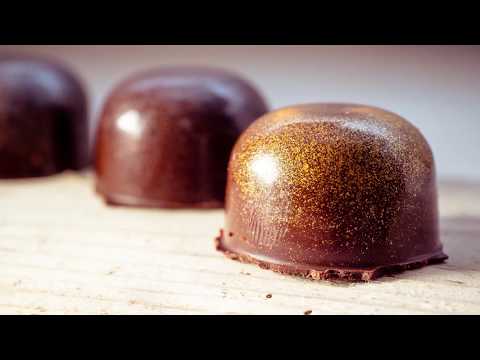
I then fill the molds with that,
and then I tip it out to get the shell,
then fill the shell with different caramels,
jellies, ganaches, all sorts of different things,
fill it up with more tempered chocolate,
take it out, and then it’s ready to be sold –
such as this.
The chocolate confectionery market
is currently worth an astounding 102.3 billion U.S. dollars.
So it is quite a business to be in, I have to say.
But, ladies and gentlemen, what about the future of chocolate?
So, I’ve got some bad news: it’s running out.
(Audience) Oh no!
What I mean by that is that we’re –
(Laughter)
So then, what I mean by that
is that we are actually eating it faster than we can produce it.
(Audience comments)
So, yes, quite right.
So, a recent study showed
that the average Westerner eats about 286 bars of chocolate a year,
and to make that much chocolate,
we need pods from about ten cacao trees.
Now, I can see the looks on your faces that that’s not really that much,
which is a fair point,
but you multiply that up with the number of people in the Western world,
and it all of a sudden becomes a lot of chocolate.
So, ladies and gentlemen, do not panic!
(Laughter)
It’s all under control.
We’ve got companies all over the world
that are working on creating a stronger, more disease-resistant cacao plant
to aid in the world’s need of chocolate.
So, ladies and gentlemen, just wanted to point out as well,
on top of all of the things that I’ve mentioned so far in my talk,
that chocolate also doesn’t follow any specific religion;
it doesn’t set any rules we must follow;
and even though you can buy it as dark, white or milk,
chocolate is not racist.
(Laughter)
And, ladies and gentlemen, with all its health benefits,
chocolate brings people together and it makes people happier.
So how much of a better place would the world be
with healthier, happier people?
I wanted to leave today with just one thought,
and please, if you only take one thing from my talk,
please let it be this:
[Chocolate comes from cocoa, which is a tree
That makes it a plant. Chocolate is salad.]
(Cheering)
Thank you very much.
Thank you.
(Applause)
”
Be First to Comment