
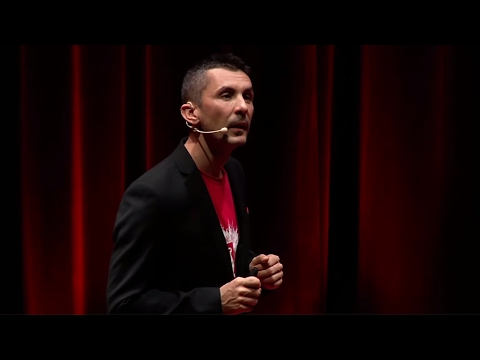
Good evening everyone.
I am going to tell you my story.
I am 17 years old and just obtain my baccalaureate.
My father only dreams of one thing:
that I prepare for the entrance exams to the “grandes écoles.”
He himself teaches at the ESCP computer science and marketing.
So he tells me,
“Go for it my son, hang in there!
Surpass yourself!”
Me, personally, I only think of one thing actually:
mainly, going beyond the confines of my neighborhood.
I can only think of one thing: to leave and travel far
in France but also elsewhere.
So, I modestly enrolled at Nanterre University
in ethnology and then in ethno-musicology.
Ah! Here is a good opportunity to travel.
I work on my thesis about the music of Benin,
of North Benin, a population called the Nyende …
Two months travelling, four months travelling.
But alas, I find it difficult to finish university.
I only think of one thing
and it is playing music.
I am a drummer, a percussionist.
I work with different world music ensembles.
I love all types of music: biguine, jazz, African music,
Balkan music, Raï, and so on.
In 2004, I founded
my own band called Haïdouti Orkestar.
What is Haïdouti Orkestar?
It’s a combination of Balkan, Oriental and Turkish music.
Quite a variety!
Does this ring any bells? Does this speak to you?
Not really.
This group consists of musicians from very, very different backgrounds.
As Georges Moustaki would say, a true bunch of wops.
We have a Greek from Rue de la Roquette
who can hardly string together three words of Greek;
a genuine gypsy from Serbia;
a Bulgarian;
some French people – yes, French people like me,
but upon scratching the surface, not really truly French –
a Spanish woman who claims she is Catalan, if you please, from Barcelona.
Do you know this group Haïdouti Orkestar?
No.
Yes, I heard a yes. There’s one person. So much the better, here’s a clip.
(Video) (Song: “Ya Ayn Moulayiitain”)
(Sylvain on stage) This song is a tribute to Syria,
to the Arab Spring,
at a time in which there still remains a bit of hope.
Usually in concerts, the audience gets up and starts to dance.
You can …
It feels good too!
(Rhythmic claps)
(End of video)
(Applause)
Thank you.
I discovered this music at the end of the 1980’s –
it’s getting a bit old –
especially through Emir Kusturica’s films “le Temps des gitans,” “Underground.”
I’m sure everyone know those films.
Yes, of course.
For me, it was love at first sight, an amazing realization.
I developed a passion for these musics.
I literally fell in love with them, and I delved deeper.
It was the start of a long immersion into these cultures.
On this journey, I was to meet people, musicians,
because for me, it was about immersing myself in the world of Balkan music,
the Gypsy music, I didn’t know anybody,
and about encountering Turkish music, all that stuff.
And that’s just what I did.
I am going to dwell for a moment on three people very important to me.
Firstly,
Jasko Ramic.
Behind him is a woman playing the tuba.
She is the only woman in the band.
I think a lot about her, her name is Charlotte.
Back to Mr Jasko Ramic.
He is a gypsy from Serbia.
He is a true accordion virtuoso,
a real “big shot” as we say.
He has an empirical and theoretical knowledge of all these musics.
I meet him in a basement bar in Paris.
A Bulgarian musician friend introduces him to me.
In addition, he is a polyglot.
He speaks Russian.
He speaks the Romany and Serbo-Croatian languages.
But as for me, I come and I speak French,
and I can’t communicate with him.
Big problem. How can we break this barrier?
In the end, we don’t talk, we play.
Since then, we’ve been working together for more than 10 years.
He helps me to discover this culture, this music,
its energy, its nostalgia.
And personally,
I see that what I learn contrasts greatly with what I hear in the media.
What do I hear of the Roma people in the media?
I hear things that are not very nice.
They speak of shanty towns, of child abduction.
But I experience something completely different.
I travel in Bulgaria, in Macedonia. in Greece.
I feel safe there.
I meet with generous people who have literally given me their music.
There you have it.
I advise you to check out the work of “La Voix des Rroms,”
an association that deals with the Romany community’s issues
and aims to promote a more positive image.
The second person who has been very important to me is a trumpeter.
He is Lebanese but above all French
since he grew up a few kilometres from here
in the south of the region.
This guy has an incredible energy.
I met him when he was 25, it’s now a good 10 years.
He is Lebanese, and his parents fled Lebanon.
That’s important.
Today, this guy is well known.
His name is Mr Ibrahim Maalouf.
I’m sure you’ve heard of him.
This guy brings us to the Olympia.
Recently, we wrote the music for Mohamed Hamidi’s film “La Vache,”
starring Djamel Wilson … Djamel Debbouze, Lambert Wilson!
(Laughter)
(Video: Music “Le grand voyage”)
That’s the meeting of cultures!
Here’s a clip.
(Sylvain on stage) That’s the instrument I play, among others.
I play the drums.
(Video: Ibrahim Maalouf and Haïdouti Orkestar – “Le grand voyage”)
(End of video)
(Applause)
The third person who has been very important to me
in my career, on my journey, is Mr Zéki Çölaş.
This man hails all the way from Antioch in Turkey,
at 80 km from Syria.
He fled Turkey at the age of 30 for political reasons,
a saz under his arm.
He traveled through Syria. spent some time in Germany,
and ended up in France, in Bobigny.
So I meet this gentleman in a restaurant in Paris,
a good fifteen years ago.
I can’t remember if it was a Kurdish or Turkish restaurant.
For me, back then, they were kind of the same thing.
But in reality, they are very different.
I end up taking a walk with this man.
He shows me Little Istanbul.
Do you know Little Istanbul?
Little Istanbul is the Turkish quarter in Paris
between Château d’Eau and Strasbourg Saint-Denis.
It’s here that this culture, this community comes together.
So we walk through the streets.
We meet his friends from the Özgül book store.
We go to listen to the latest arrivals at Tuana Music,
the only Turkish music shop in Paris.
All the novelties, records, musical instruments and so on,
everything related to Turkey is found there.
Very quickly, we grow a desire to share things,
to familiarize ourselves with this Turkish music
which we don’t know and which is largely unknown in France.
We also decide to go further
and open ourselves up to other cultures.
Here we are, I had another map earlier. This is not the same one.
Anyway, we are also interested in Armenia and Azerbaijan.
We try to go beyond our limits, to cross the borders.
You’ll notice that this whole region is today a real powder keg,
between the migrant problem, the Kurdish issue,
and Erdogan who has now become a true dictator –
we can say this plainly.
So, it’s at this point
that certain associations made contact with us,
associations that have values somehow similar to ours,
that are in favor of sharing.
I am thinking about La Cimade, Valeur ajoutée.
I met La Cimade in Massy, not too far from here.
Each year, they throw a party,
where there is a lot to eat, different dishes from all countries.
That was another moment of sharing.
I am also thinking about BAAM, the Migrant Reception and Support Office.
Last September, we held a concert.
This was equally a huge moment of emotion and sharing.
Somalian, Erythrean, Turkish, French people,
everyone gathered to unite through our music.
It was a tremendous moment.
More recently,
I also wanted to go beyond genres,
so I set out to find the jazz music.
(Video: Haïdouti Orkestar and Bojan Z- Tchagri)
(Sylvain on stage) Here is a Bosnian pianist.
With this presentation, I wanted to show you
how much music and my encounters
and that cross-breeding is a means to open us up to the world.
There you have it.
Thank you.
(Applause)
”
Be First to Comment