
Is it worth photographing without seeing the result?
My answer is, “Yes, by all means!”
It’s worth it because I want it, because I can
and because I can connect to other people.
I didn’t know that until becoming visually impaired at 28 years of age,
in 2004,
when I started to view my world differently.
My visual impairment was due to bilateral uveitis,
a high-grade inflammation that destroys the whole eye.
I had a retinal detachment
in the right eye, causing total sight loss,
and I had an optical lesion in my left eye,
causing reduced vision.
I can see only a color ratio and many shapes.
Being visually impaired brings sadness, depression.
In order to move forward,
I tried to take several courses for visually impaired people.
That’s how, in 2007, I started to do sports.
I did swimming, street running and athletics.
Sport opened several doors to me.
Through sport, I managed to get a scholarship
and was able to get a degree in History.
I was a high-performance athlete,
and competed as such in championships,
regional championships,
and even in the national athletes league.
During game breaks I’d photograph the other athletes.
In 2008, I started a course,
“Visual Literacy,”
which is a course that has its own methodology
of teaching photography to visually impaired people.
This is a free project course,
part of the graduation syllabus of a university in São Paulo.
In other words, I started to have contact
with sophisticated technology to help me in my condition.
In 2010,
I had the chance
to exhibit,
to participate in an exhibition
with one of the greatest blind photographers in the world,
Evgen Bavcar.
It was a great exhibition,
and it was a moment to learn, to exchange,
and to share blind photography.
Then I started thinking
about becoming a professional photographer.
But my story only starts to be told to the world
in 2016.
I was the first and the only visually impaired photographer
to cover the Rio Paralympic Games in 2016.
Before I became visually impaired,
I had already photographed as an amateur, as a hobby,
but my dream was to become a great professional.
Now, folks, think about it:
when I arrived at the Paralympic Games,
I thought I’d be invisible.
But, on the second day,
thanks to the referral of a photography colleague –
a great news photographer
in one of the biggest communication companies,
the AFP, Agence France-Presse –
the reporter wanted to meet me, and wanted to follow my work close up,
to know how I was going to shoot those photos.
And by the end of the day the photography director bought my images
and sold the article in four languages:
French, English, Spanish, and Portuguese.
So, think about it.
A confusion began because I wasn’t able to work.
Several communication channels wanted to interview me
to know who this visually impaired photographer is
who photographs with such sensibility.
As a visually impaired photographer,
I use my senses to photograph.
And what would they be?
Tact, smell, and hearing.
As I’ve said previously, I’m not totally impaired.
In my left eye, I can perceive shapes and colors.
Through these shapes and my hearing, I manage to photograph.
I know I’ve made many friendships during the Paralympic Games.
I got to know people.
Certainly, the stories, the learning
were a great school to me.
It transformed my life, and I believe my presence
also transformed those press professionals
in the Rio 2016 Paralympic Games.
I think you’d like to know how I shoot my photos.
I think everybody is curious about it.
Well, I’ll tell you.
I know that…
you see…
I had to go through a hard process.
To be present here today on this stage, it hasn’t been easy.
I’ll give an example.
In the Paralympic Games, I used a cell phone and a professional camera.
Sometimes I used one, sometimes the other.
The cell phone has screen reading technology,
which helps me, through facial detection,
to shoot a photo.
But I used the professional camera much more
because I used my senses,
tact, smell,
to capture these images.
I’ll give you an example: 5-a-side football
which is a sport adapted for people with visual impairment.
The ball has a bell inside it
and the players are guided by its sound.
The supporters can’t make any sound,
they can only cheer after a goal has been scored.
So I felt in my comfort zone being able to photograph those athletes.
Likewise, in goalball, another sport created for blind people,
I also shot the images,
and it was incredible, extraordinary.
So…
there’s this technology,
that I hope very soon,
that this artificial way of reading images
can be used in professional cameras,
because it means I’ll have more autonomy.
And not just for me, but for anyone with visual impairment,
to be able to handle a professional camera
with total autonomy, and use it in the manual mode,
and be able to configure it, to make it ready to shoot the images.
It’s very important to tell you
that behind my work
there’s a being, a human being.
And the partnerships I make help me a great deal.
It’s thanks to these partnerships that I’m successful today.
Let me give you some backstage examples.
The first time I ever wore a photographer’s vest
and went shooting for an official competition,
I was full of joy, I was anxious, moved.
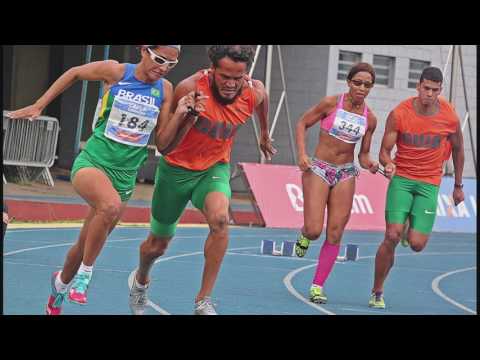
I was shooting a speed race,
and there was a visually impaired athlete
and her guide.
I asked my colleague next to me, “Which lane are they in?”
He said, “Five and six, João. Get ready.”
I positioned my camera right away.
Suddenly, when they were about to reach the finish line, he said,
“João, it’s lanes seven and eight!”
Conclusion: I thought I was the only blind person at that moment.
(Laughter)
There are some other stories.
In the beginning, I had to use the resources that I had at that time.
And I thought, “I’ll change my strategy.”
I invited technical aides, technicians,
so they could help me inside the tracks,
to shoot those athletes with greater confidence
and know who I was photographing.
So that was one of the strategies.
But I remember one event
in the Paralympic Games.
I was on the beach to shoot the triathlon.
I arrived early, positioned myself inside the photographers’ area,
closed my cane.
Then in the heat of the race
when the athletes were about to reach the sand,
I got pushed aside, and…
Too bad, I missed the shot.
True, not everybody in this world shows sensibility.
I think it’s important that we understand
that visually impaired people
need to have this opportunity.
And opportunities are created through showing sensibility.
And I can’t forget to mention another example to you,
about when I was at home after the Paralympic Games.
I got a call from a person
from the interior of the northeast, in the state of Alagoas,
a visually impaired person, who asked me the following:
“João, I’m very happy to hear about your story.
I thought visually impaired people couldn’t photograph.
But seeing your story,
I’d like to ask if you could teach me something about photography.”
Of course, this moment made me very happy,
and I shared the little I knew about photography.
A few days later, she calls me,
“João, I’m managing to photograph.”
To me this is incredible
because I’m somehow helping people to grow,
to become empowered and to have greater self-esteem.
Just a few days ago, I went on my first international trip.
I traveled alone, you see?
I went to Santiago, in Chile,
for my first conference and photography workshop.
I had a chance to meet people, get to know places, a culture,
and I did all this thanks to blind photography.
I was out photographing places I passed by;
feeling the smell of those places.
I had the chance to photograph those street artists who perform.
I had a chance to get to know the scenic viewpoints,
to smell the regional food,
the aroma of wine.
I had a chance to visit the coast,
to feel the breeze and the smell of the sea.
We can and should come out of our obscurity
and search for the light of knowledge.
A few days ago, I started a partnership
with a colleague who is a journalist
and works with biographies.
Through this story of mine we want to set up a project
so the story can be told
as the first visually impaired person
to cover the Paralympic Games,
in a book totally accessible
with what?
With braille, enlarged letters for low visual impairment, and audio.
Let’s see.
I have the responsibility of spreading this knowledge,
through my talks and workshops,
to any place in Brazil,
or the world.
Here in Brazil I know that the farther we are from more developed areas,
the farther we are from these places,
the greater the lack of art that enables handicapped people to develop
and to have an idea of what blind photography is.
Besides, I believe that photography
is the same for everyone.
Because when we photograph,
we want people to give us feedback saying,
“Gee, João, this shot is excellent!”
“Wow, what an image!”
While I have the chance to photograph,
I’m keeping in my memory a part of that moment.
And when I develop that image on photographic paper
and ask someone else to describe the image,
I’m retrieving that memory.
So I think that either consciously or unconsciously,
you have already done that.
That’s why photography is the same thing for me as it is to you,
even for me with my visual impairment,
because we all like photographs.
I’ll finish by saying
that since 2004 I’ve been working
so that my work
can have a greater dimension,
and can impact everyone,
with or without handicaps.
Because I’ve learned that, even without the normal ability to see –
and I know that we need the ability to see,
that we need this normal way of seeing –
I’ve learned to live without it.
What’s my way of seeing?
My way of seeing is with the heart.
And yours?
Thank you.
(Applause)
”
Be First to Comment