
Under my presidency, unemployment will go away.
Under my presidency, there will be 10% growth per year.
Under my presidency, France will lead the world’s economy again.
That’s the kind of promises
made by all those men and women
who run for presidency.
President!
That’s the dream job
for all politicians, both men and women,
in our country.
But did they just look at the first word?
When you look closely,
the full title is “President of the Republic”.
People typically focus on “President” and neglect the “Republic” side.
So what is a republic?
A republic is a flag, and a national anthem,
but rest assured,
we’re not here today to learn “La Marseillaise”.
What I’d like to talk about today
is the republican motto: Freedom, equality, brotherhood.
It’s a fascinating motto that comes to us from the Enlightenment.
and today we’ll try to assess how well we implement it
after 200 years.
Brotherhood, equality, freedom.
Let’s start with brotherhood.
What brotherhood are we talking about,
when in our country
more than nine million people live under the poverty line,
in a country like ours, which is the world’s fifth economy?
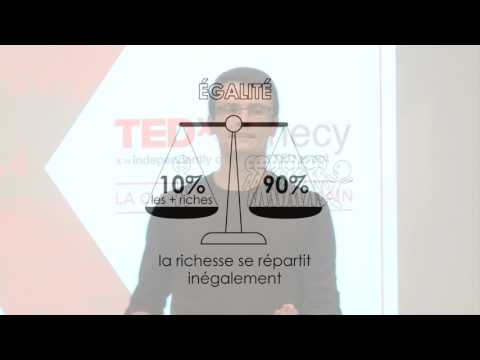
Equality, then.
Where is the equality,
when the richest 10% makes just as much as the remaining 90%?
Compared to this room,
and assuming there is more or less 100 people,
and the only asset in the room is the chairs?
It’s like I said to the 10 people in the first row:
“You are entitled to own 50 chairs”,
and to the other 90,
“Get by with the remaining ones”
Nonsense.
Freedom, then.
What freedom is that,
when addressing our fundamental needs
takes forcing someone into find a job
in a market with more than 9% of unemployment?
Brotherhood, equality, freedom.
You can sense the health status of the republican motto
with a number: nine.
Nine like nine million people under the poverty line.
Nine like the nine tenths of people
making as much as the richest tenth.
And nine, like 9% of unemployment in our country.
The purpose of my talk, anyway, is not putting you down.
Somehow, we will have to try and find a solution.
What I’d like to talk to you about today is the universal income.
So what is universal income?
Just to start, is a definition with three criteria to match
so it can be properly defined: “universal income”.
A universal income is a sum of money
that’s granted to everyone on a monthly basis,
with no strings attached, to each individual.
If this sum of money is only granted to young people
or only to those who make less than 2,000 euro per month,
that’s not a universal income.
If we talk about a sum of money
that comes with the condition
of finding some kind of job,
that’s not a universal income.
If that sum of money
is only granted to a household, or a couple,
that’s not a universal income.
These are the three needed criteria
in order to properly talk about universal income.
With this definition in mind, many questions may arise.
First question: why?
Why in the world one might want to implement a universal income?
Essentially for two reasons.
One more “historical”, the other more contemporary.
The historical reason is,
because, truth be told, even if current debates
present universal income as a new idea,
it’s actually been discussed for many centuries now.
In history,
one of the first thinkers to propose universal income
was Thomas Paine, in 18th century.
The idea was to fight poverty
and redistribute wealth with a very simple idea:
the property of land, that we all share,
and belongs to everyone,
has been collected by the few.
Therefore, not everyone has a piece of land
to address their basic needs.
Therefore, as a compensation,
he longed for the implementation of a universal grant.
The most contemporary reason,
which is why the debate is having a comeback now,
is that the universal income
could be a viable answer to an ever changing job market.
We must be aware that with automation and digitalization
a lot of jobs will disappear,
and others will be created to replace them.
What no one is sure about today is,
will new jobs
outgrow the destroyed ones?
I’ll go straight to the answer:
we do not know.
The only thing we know
is that today’s new jobs
will be much less stable than yesterday’s ones.
In the past, an employee could remain 40 years in the same company;
today, not only you won’t stay in the same company for 40 years,
but over a single workday several activities could be done.
Therefore, a universal income would in a sense act
like a safety line
for a less linear job market.
First question: why?
And the second is: how much?
How high should this universal income be?
A lot of propositions have been formulated.
But generally speaking,
the range goes from RSA, a little more than 500 euro per month,
to SMIC, a little less than 1,200 euro per month,
with the poverty line in-between.
The poverty line, in France,
it’s 1,000 euro per month, for a single person.
How do you measure that?
It’s an international definition.
It’s 60% of median income.
So what’s the median income?
It’s the income level that splits people in two:
50% of people make more than that, 50% less.
In France, median income is 1,666 euro.
And 60% of 1,666 euro, it’s 1,000 euro.
Why is poverty calculated that way?
Because one is always poor compared to where she lives.
It’s easy to get that 1,000 euros in France.
It can help you get by, but its hardly a liveable income;
In a developing country, they’d make a much bigger positive difference.
You could even be labeled as rich.
Why, then, and how much.
The third question you might ask is: how?
How to implement it? How to finance it?
There are three great funding families.
The first is self funding.
The idea is:
with a universal income at the level of poverty line,
RSA has no reason to be.
So the amount currently allocated to RSA
could be diverted to universal income.
The second funding family of universal income are taxes.
And taxes are often related
to the philosophical reason
why someone should implement universal income.
If the policy goals
are fighting against povery and sharing wealth,
we’d rather tax incomes or assets.
If instead the real goal
is coping with the shifts in the labor market,
we’ll probably end up taxing
companies and robots.
And the last source of funding of universal income,
an almost neglected ones, in public debates,
is monetary creation.
You must know that currently, to boost the economy,
central banks create money out of thin air
and inject it into the system.
And we might well ask ourselves,
why give this money to private banks
instead of giving it directly to citizens?
The bottom line, with universal income,
is that’s a broad concept with different implementations.
My closest connections call me “Mr Universal Income”
but actually, I don’t appreciate every possible flavour of it.
Universal income is a concept I understand.
I agree with some of its implementations
and disagree with some other ones.
So we have a failing republican motto
and a broad, multifaceted concept.
What if we combined the two?
That would give us a R.E.V.E. (dream), our dream.
A dream we made with Romain,
with whom I founded the Ecolo-Humanists.
R.E.V.E [Dream]
stands for Emancipatory Income to Express Ourselves in Life.
Let’s reconsider the Republican Motto
so we can better defines
what our universal income would ideally look like.
Brotherhood.
For us, an ideal universal income
would be set at the level of the poverty line.
That would allow us, by the way, to respect Article 25
of the Universal Declaration of the Human Right.
This Article 25
of the Universal Declaration of the Human Right
mandates that everyone has a right to a standard of living
high enough to address our fundamental needs:
food, shelter, and a roof over our head.
Universal Declaration of Human Rights, Article 25.
We signed it long ago, but we still fail to respect it
Equality.
For us, universal income should be a redistribution tool
tied to a progressive taxation
in order to finance it.
We didn’t say there will be no simplification.
Some aids will forcibly disappear.
But often, in today’s conversation,
universal income is only seen as a simplification tool.
For us, it should also be a redistribution tool.
And finally, freedom.
What freedom would give this freedom, this universal income?
It would allow us to say no.
The ability to say no.
Which is fundamental, in order to be masters of our own life.
Saying no could allow employees to negotiate better working conditions,
and thus work better.
Likewise,
some may choose to work less
in moments of life when they’d rather
raise a baby, start a company.
Working less? Working better?
We could even start asking ourselves, what can be called work?
That’s why we’ve chosen to illustrate freedom with bees.
Currently, if you consider a bee’s worth,
and GDP as our single indicator to meter the economy,
GDP gives bees no value
but the honey they make and we sell.
Whereas the true added value of bees
is their pollination,
that allows fruits and flowers to develop.
Likewise, speaking of human beings,
we could ask ourselves:
are we worthless
except for the monetary value we create in a company?
Or perhaps, the added value that’s created
isn’t, just like for pollination,
all those social relationships of ours
that allow us to realise our potential, and knit the fabric of society?
Our R.E.V.E. [dream], Emancipatory Income to Express Ourselves in Life.
If there’s a word to remember, in this definition,
is the emancipatory side.
For us, the implementation of this ideal universal income
would be a true paradigm shift.
We live in a society today where we “make ends meet”
and those who are left behind are helped,
despite the a cost for them of social stigma,
treated as they might be like aided people.
With the introduction of a universal income,
the game changes completely.
We could finally trust anyone,
and those who are better off
will fund their universal income, or other peoples’/
You’ve got it now;
our dream, and hopefully someday your dream also,
is give some reality to the republican motto.
Freedom, equality, brotherhood.
And in that moment, only in that moment,
we can wrap up the speech by saying:
Long live the Republic, and long live France!
(Applause)
”
Be First to Comment