
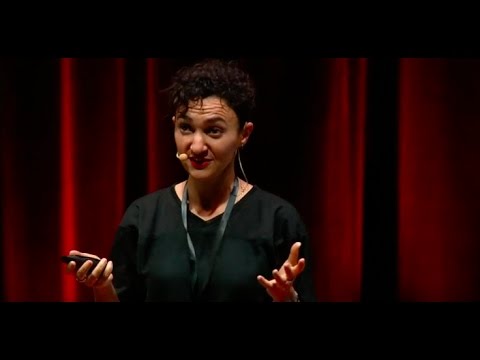
You might all wonder why human beings have been dancing
for over 30,000 years.
Why has dance been present in our life, in our societies,
in all cultures,
no matter the age, the culture, the background,
where we come from, or what we do?
Well, because dance is one of the most fundamental ways
by which we express,
we belong, we communicate, we bond, we are.
Dance is fundamental, in our lives, in what we do,
in how we exist in the world.
You might still be wondering at this point of the video,
why is a scientist, or an academic interested in dance?
Well, first because I grew up as a dancer, from a very young age.
So dance has shaped my life since 25 years, or over 25 years.
And as I started my academic career, I wanted to cope with something
that was close to my heart, in which the questions
was personal and interesting for me, as a person, as Sarah.
So I started to work on dance, as a computer scientist.
And as I started to realize that dance has actually asked many questions
to academics and beholds many challenges, even for a computer scientist.
So, let’s start from the beginning, where I come from, ballet.
Ballet is a form that has existed for a long time,
and culminated during the reign of Louis XIV, in France.
It is relying on a set of precise steps,
that has not changed much since that time.
It is quite determined.
And because I like to challenge myself a little more,
I decided not to work with ballet, but go with contemporary dance.
Because no matter how contemporary dance is related historically,
or have a lineage with ballet, it still pushes the limits
of what this vocabulary is about,
and is always asking itself: where do I come from,
what are my methods?
Contemporary dance searches for a new aesthetics,
new ways of making dance, new freedom, and new vocabularies all the time.
So it is quite challenging to work with.
At this point you might still ask yourself, why dance,
and how is it different from other arts?
Dance, unlike music, doesn’t rely on a score.
So, for example, you may or may not have seen
a score like that, called Labanotation.
This is actually a dance sequence.
But as you can see, it is quite complex,
and very few dancers in the world know how to read, or write,
or perform a score like that.
Labanotation is thought of in very few programs, around the world,
so it not quite used.
Dance, in reality, stays stored in dancers’ memories.
And dance is varied from one choreographer to another.
So these are the challenges that I am facing all the time.
For example here are pictures of the dance making,
of various choreographers that we’ve interviewed.
It shows you the variety, and the heterogeneity of that field.
They all manipulate different objects.
They all manipulate them with their own methods,
their own operations, and reinvent their vocabulary
and ways of working.
For example, Anne Theresa de Keersmaerker, here,
is interested in the general space.
She comes up with algorithms, mathematical algorithms,
that allow placement of dancers, in relationship with each other in space.
So she makes pieces with circles, pieces with Fibonacci series,
pieces with different kinds of relationships,
functional relationships.
Another example is William Forsythe,
here in improvisation technologies.
William Forsythe is obsessed with geometry.
He works on creating geometry with his body,
and manipulating these geometries.
And as he is manipulating them, he is creating the movement in space,
and the vocabulary in his dance pieces.
Another piece by William Forsythe, who’s always renewing himself,
is “One Flat Thing Reproduced.”
In this piece, he’s focusing on the cues
that dancers are sending to each other in time,
and the various time frames, that happened between the dancers.
This is a visualization by Synchronous Objects Project,
who shows you the little communication between the dancers.
So, as you see, it is very varied.
And as it is very varied, it starts to be really hard
to make sense of the recipe behind the choreographic making.
It starts to be really hard to archive a dance work;
it starts to be really hard to transmit the dance work
outside of oral transmission.
So these are the challenges that we are dealing with.
And in my work, I propose a technology,
as a good opportunity to make a dance piece archivable,
to transmit it through new ways,
new interactive systems, and to create new bodies,
and new opportunities on stage.
So the question is: what knowledge can we extract from dance,
and how can we use that knowledge in interactive systems
for creation, for archive, for transmission, or for the stage?
I will attempt to illustrate a little bit of this question,
and how I address this question in my work,
through three main projects that I am going to talk about.
First, ‘Double Skin/Double Mind,’ which is an installation
where I worked with the dance company Emio Greco PC,
where we have designed
an interactive installation for pedagogical purposes,
that relies on four main components of the company.
The company has defined that qualities of movement,
called breathing, jumping, expanding, and reducing.
These qualities don’t rely on a specific form or steps
that one might do,
but on the quality by which the movement is performed.
So, we designed an installation where we had cameras,
that would capture the dancer’s movement in real time.
And we trained the machine learning algorithm
to recognize those components in the dancer’s movement.
And according to what the system would see,
we would give feedback, sonic or visual feedback to the dancers,
in order for them to incorporate the vocabulary,
and use it creatively.
So, we had the opportunity to tour with this installation,
and to have a lot of different users, a lot of different dancers try it out.
And what we could see with our experiments is that,
a feedback that allows the dancer to have a knowledge of what’s he doing,
in relationship with these avatars,
and all of these sonic and visual information;
encourage their exploration,
encourage them to incorporate that vocabulary to make it theirs.
Lately, I have also started to look at the Laban movement analysis framework,
I got a certification in that framework.
So, what is Laban movement analysis?
It’s a bit more general.
It looks at the body in ways
in which we can observe, perform, describe it with four main categories.
The first category is “body,” which is: what is moving the hand, the torso,
and the knee, etc.
“Effort” is how is the movement performed,
so again, this idea of qualities of movement.
So, in “effort,” we’re looking at movement
in terms of weight between light and strong;
in terms of space between direct and indirect attention to space;
in terms of time: a sudden movement or sustained movement;
in terms of flow, a free movement or a bound movement in space.
Laban also described movement in terms of space,
which is the kinesphere on the reaching capacities of our limbs;
and in terms of shape, which is the dynamical shapes of the body.
So as you see, it’s a categorical framework,
that allows us to describe and observe movement,
but it’s very useful when we’re dealing with the machine,
that has to kind of analyze things in a categorical way as well.
So what I’ve been working on is mainly the movement quality aspect,
because it holds the aspect of affect expression
that I am interested in in dance.
So I built this system that relies again on heavy algorithms,
to recognize movement qualities,
and here is an experiment
where we’re recording a mostly capture session
with the dancer, who is going to perform eight different combinations
of these movement qualities of weight, time, and space.
Enjoy!
(Video) Narrator: Action
[Measuring dance movement qualities]
Dancer: (Vocal effects)
So as you can see, it’s a very nuanced, but you can all observe
all of these qualities and distinguish them.
For a machine, it’s a harder question.
But we did it and we had an algorithm that works,
and that is available and that we’re using in pedagogy,
we’re using to build interactive installation,
or to have performances on stage.
And finally, the third project
I want to talk about is these little Scrabble tiles that I built,
where I’m putting some Labanotation on the top of them,
that would represent different movement patterns.
And these, I give them to children, to dance students, to performers,
and they play games with them.
They challenge each other,
one would move, the other one would observe
and notate with the Scrabble;
or one would pick a sequence
and challenge their friend to perform it, etc.
My aim through this, is first to make people move,
but then to bring that notation knowledge a little closer to people, to dancers,
and to make it fun and engaging for them.
Finally, I would like to leave you
with an excerpt of a dance piece that I’ve been making over the summer,
that’s called “Skin.”
Because I’d like to give you little hints
of the works I’m choreographing myself.
And I’d like to conclude my talk about what I’ve been talking about,
which is that movement is complex, and dance making is also complex,
and varied, and challenging somehow.
But before I leave, I’d like to give you a message,
mostly about how movement is important in our life,
and how moving is about engaging with each other,
and how dance is about joy, peacemaking, and happiness,
and that moving is, and I hope will remain an essential part of our lives.
Thank you very much.
(Applause)
”
Be First to Comment