
Today, I want to talk about clothing and altered states of consciousness.
Basically, I want to explain to you
why I’m going to spend the next 18 minutes picturing all of you in your underpants.
Terence McKenna said that the body is the nexus of the mystery of life.
It’s the lens
through which all of our outward experiences pass through us,
and become feelings and emotions and logic.
It’s also through which those inner feelings
become outward expressions.
At the apex of this lens is the practice of body adornment.
The term “participation mystique”
denotes a psychological connection with objects.
It denotes a lack of distinction between the object and the body.
We spend our lives locked in an intimate embrace with clothing.
They’re very powerful objects.
When I was a little girl, my mom decided one Halloween
that she’s going to make my costume a clown costume
rather than buying a ready-made.
My mom wasn’t a really big seamstress,
she maybe did some hemming and mending,
but it wasn’t really something she’d ever done before,
to make something from scratch.
So, I watched her really suffer through this process,
there is like blood and sweat and tears.
But she made it, she did it, it came out, and I wore it.
And I wore it again, and I wore again.
And then my mom wore it, and then my grandma wore it,
and my mom still wears it and sends me pictures every Halloween.
So this object has become sort of this trickster archetype
that shows up every Halloween
like a family member home for the holidays.
As young children,
we interact with clothing as a way to access our imagination
and become these creatures from other times and places.
We traverse time and space through clothing.
That’s me as a triceratops
with my brother and sister helping me out at the back end.
And on your right
are three costumes that I’ve made in my current work,
where I’m exploring different parts of the psyche.
These three costumes represent the ego, the super-ego, and the id.
I’ve also been utilizing this practice to process different traumas in my life.
I had some deaths in my family last year,
and so I built myself a skeleton costume,
took it to Death Valley National Park,
and I walked across the salt flats.
It’s a very effective way to process grief.
Before I get into the more ephemeral purposes of clothing
that I’m really interested in talking about,
a break down of the functions of clothing,
and why we actually dress ourselves.
Luckily, Dr Miles already kind of broke this down for you.
This is an image of Maslow’s hierarchy of needs
which she was talking about before.
At the bottom of the pyramid is the physiological needs,
things like warmth, and protection from the environment.
Garments can allow us to exist
in environments we’re unable to exist in without their help.
It also gives us a sense of security, of order,
as we confront one another,
both on the literal battlefield and on the metaphorical battlefield.
It can also give us a sense of safety in terms of superstition,
like the lucky socks help us to win the game;
gives us a sense of belongingness,
helps us to identify like-minded individuals,
and individuals who share our same tastes.
It identifies cultural standards of beauty which differ so vastly,
it helps us to identify our individuality as well,
helps to set us apart from the crowd.
It helps us to identify our esteem needs,
it expresses a sense of accomplishment,
it shows what we hope and dream for ourselves,
helps us to embody our successes.
And at the tippy top of the triangle, where we are today, apparently,
and my favorite part of the triangle,
is the self-actualization part.
This is where we have peak creative experience,
manifestation of the human spirit, and communion with the divine.
And so I want to break down this part of the pyramid a little bit further,
and so I’ve categorized a few different aspects of this.
We can utilize clothing as spiritual machines
to access the supernatural.
They can be time machines
to bring us into a past that we’ve never been able to experience,
or far into the future which we might never see.
They can be spaceships for transcendence.
This is the whirling dervish costume from Turkey,
used in the Sama ceremony.
And these dancers spin with these wide skirts,
and their hems never touch one another.
This requires a huge amount of concentration and focus
that lends itself to meditational state.
As a side note,
the Egyptian tanoura dance is an offshoot from the the Sama ceremony,
that’s become sort of a form of entertainment.
The fabric of these skirts are embedded with LED lights,
and, as the performers spin, they look like UFOs.
We also can embody the gods that we worship.
This is a member of the Matsés tribe from the Amazonian rainforests in Peru.
These people make themselves in the likeness of large cats
because they worship them.
This way they can embody their power and also learn secrets from the jungle.
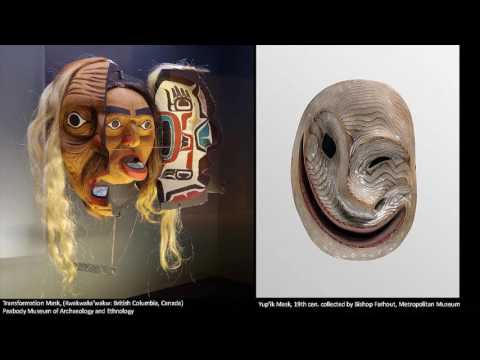
Shamanic practices have a long history of utilizing costume
as portals to the multi-dimensional realm.
Again, shamans will enter into a costume that represents nature’s spirits.
This helps them to become one with nature,
and again gives them access to some of the secrets
for healing and transformation.
These costumes oftentimes embody representations of spirits
that the shamans encounter on their journeys:
sometimes to ward off harmful spirits, sometimes to attract helpful ones.
Shamanic practices oftentimes include a form of transformation.
A lot of times, these costumes will physically represent
that outward transformation
to sort of be a representation of the inner transformation as well.
In death, we also decorate our bodies.
We fill tombs with the wealth and value of our current lives
in hopes that the gods will be grateful to us
and send us on to an afterlife with similar value and wealth.
And we know that oftentimes these figures don’t get to keep their wealth,
and we usually loot it.
But their legacy lives on,
their legacy of value ends up in our pop culture.
The practice of Carnivale or festival
is a time and space set aside for us to express our inner beast.
It’s cross-cultural.
This happens across all times and all across all different cultures.
The costume allows us to purge ourselves of the weird and the wild and the bizarre.
It’s a catharsis that allows us to understand that inner beast
and become one with it, to become whole.
Psychomagic is a term coined by the great man, Alejandro Jodorowsky,
a filmmaker and great thinker.
This term denotes a practice of using symbolic action
for growth, transformation, and healing.
We utilize psychomagic throughout our entire lives.
We use them in rites of passage.
This is the quinceañera dress which dates back to Aztec traditions,
and the Apache sunrise ceremony,
a four-day ceremony,
symbolizing the transformation of a girl into a woman.
Matrimonial dress is super-important to us.
We need a vehicle, a ship, to help us join in union with another individual
to commemorate that experience.
Mourning dress is also a vessel
in which we need to communicate
our sadness and our grief to our community,
so that they can give us space and compassion during this time.
But it’s also like shedding a skin from a snake.
After you grieve, you’re able to leave behind that shell
and not carry that sadness with you.
As I mentioned before,
clothing can give us protection in the elements.
So much so, that we can explore the far reaches of outer space
as well as the boiling core of the Earth,
with just a small layer of fabric in between us.
In addition to this, we seek symbolic protection within our garments.
It gives us bravery and courage,
and allows us to become superhuman.
I like to think about garments as prosthetics,
extensions of the body that can alter our experience of the physical world,
but also extensions of the mind and soul.
This is Emilio Pucci from the mid-1960s, during the psychedelic revolution,
when people were having extreme inner experiences,
and needed to exercise it and let it out into the world,
and let other people know what was happening inside of them.
This was no new phenomenon however.
The Shipibo embroidery you see there,
which is from another tribe from the rainforests in Peru,
utilizes these tapestries
to express a multi-sensory, vibrational experience
of a oneness with the universe
through ceremony and plant medicines.
The Huichol beadwork from Mexico
similarly utilizes images of the peyote cactus and animal gods –
as I was mentioning before –
to communicate and give homage to these figures.
I was fortunate enough, a few years ago,
to travel to the Andean mountains in Peru with some of my students.
We visited a town right outside of Ollantaytambo,
and the women in this town taught us how to spin fibers from raw wool,
dye those fibers with plants and minerals from the surrounding mountains,
and then weave them into a small piece of cloth.
We took this stuff from nothing
and created something complicated and beautiful and useful.
We used only things from nature.
It was quite profound to feel that connected to the Earth again.
In visiting these women,
I looked at their tapestries,
which were much more advanced than the ones we were making,
and through this,
they were utilizing a mystical language full of symbols
that connected them to nature and to their belief systems.
So, what does this mean for us now,
and what does it mean for our modern relationship with clothing?
The fashion industry has a long history of neglect for the environment.
It’s the second most polluting industry after the oil industry.
It’s neglected human lives, caused pain and suffering,
and has created a huge surplus of materials
that’s negatively affecting communities.
It’s not all bad,
there’s a lot of really awesome stuff going on
I’m going to tell you about.
Many designers are looking to innovation
to create the fashion industry for the future
as an agent of change.
Many designers are repurposing some of that surplus material
to create new and interesting designs.
Many designers are utilizing alternative resources.
This is the ocean plastic shoe by Adidas
that recently came out.
And this is pineapple leather –
I think this is Camper using the pineapple leather.
Engineers are working to create patterns
that create no surplus, no scraps, no waste products.
Similarly, advances in digital printing are alleviating the burden
of making, again, no waste products, and potentially no distribution.
As we extend ourselves further away from this mothership Earth,
we also need to think about
what our garments are going to look like in the future.
Perhaps there will be no garment in the future.
Perhaps it will all be virtual, I don’t really know.
And the unknown is amazing, the unknown is exciting.
I have hope.
I hope that the students that I teach
become designers that want to make the world a better place,
and I hope that you all can become consumers
that are also responsible and want to make the world a better place.
I hope that we can view fashion,
not as a drug to feed our hungry egos,
but as a medicine and a sacrament.
I hope that we can change our relationship with clothing,
and make it more meaningful.
Eckhart Tolle said
that attention is primordial intelligence, consciousness itself.
That’s all it takes.
Thank you.
(Applause)
”
Be First to Comment