
Hi.
First of all, I would like to know
which of you are related to the world of agriculture.
Please, raise your hand.
Nothing happens.
What if I ask you which of you have had a cup of coffee?
Where does the coffee come from?
Of the field.
Of agriculture.
From the rural world.
Now, again I pose,
Who of you are related to the world of agriculture?
That is the bridge, the “bridging”,
with which I want to start sharing my experience,
to share this opportunity to tell you
how that bridge of union between us, as consumers,
leads directly to improve and alleviate living conditions
of rural areas or the most disadvantaged areas.
In the world we live in today, we have changed a lot.
Now we receive a greater amount of money for our work in general,
speaking worldwide.
We are more people in the world.
And, in addition, we have some challenges and social challenges a little greater.
Just consider the following:
between the years 2006 and 2050,
the United Nations Food and Agriculture Organization, FAO,
estimates that we will need 60% more agrifood products.
Do you consider that we can be co-responsible and have some relationship
between that challenge – that challenge of being able to produce 60% more food –
and that we can produce them in a sustainable way,
in a profitable way at an economic, social and environmental level?
This is where science and technological development
they can allow us to get there and tackle that kind of challenge
with a social conscience.
That’s where I want to invite you with this talk.
This photograph is of the Amazon.
My work in rural development and agriculture
It allowed me to know the challenges faced by rural populations,
the most disadvantaged populations.
Nothing else we have now climate change.
We have more rain.
We have more droughts too.
We need to change our consumption models
so that the productive models can be improved and changed.
What are the answers to these challenges?
This is where I repeat again
that science can give us those solutions and those answers.
For example, creating seeds and plants that are more resistant to drought,
or versions of plants more resistant to insects, to different pests,
or even make certain products to achieve zero waste,
or that avoid soil erosion and desertification.
But, let’s see the curious thing.
75% of the population facing a situation of poverty
it depends on natural resources and agriculture.
And this population is in developing countries.
But what do you tell me about science and technological development?
Where are they?
They are found in the richest and most powerful countries.
These are the ones with the greatest access to technology and scientific development.
We want to make a call
so that science and research allow us to develop and address
these social challenges globally.
And it is true that it is being done, not only from science and research,
but also from companies and corporations.
What do we have today?
Corporate social responsibility,
thanks to which we are more sustainable and respectful.
Companies want to be more responsible.
But of course, not all corporate social responsibility
has an interest – let’s call it “real” –
in getting to alleviate the needs or social problems.
Many times, these corporate responsibility plans
are more related to a consumer trend,
in which consumers, we, are more aware.
Then, companies – large, medium, small –
they ride in that new wave and start promoting these programs
of social responsibility in which they see that they share part of the benefit
of your economic activity to alleviate
a social need in a certain field.
It is no less true that corporate social responsibility is changing.
The paradigm is changing.
We are changing the model as consumers.
From the moment we are most sensitized
and we demand that the supply chain of our food products
be obtained in a more respectful manner and allow sustainability models
it has been achieved that these models of corporate social responsibility
become much bigger and more ambitious models,
and allow true sustainable development,
and that they no longer just share
part of the profit generated within the economic activity,
but allow us to establish supply policies,
production and distribution policies,
really sustainable consumption and marketing programs.
I want to comment on one of the experiences
I have lived in the high Andean area of Peru.
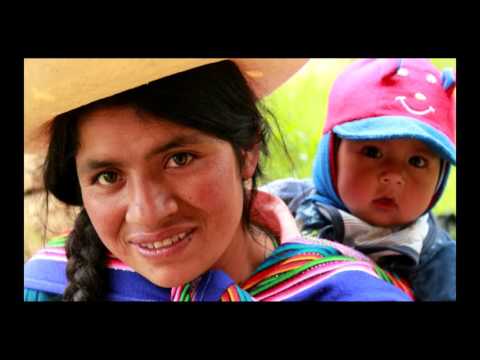
That picture you see is of a mother with her child.
There we had the opportunity to know a very nice experience
to alleviate the incidence of anemia,
of the lack of iron in the high Andean population in the Peruvian country.
There we had the opportunity to meet a super interesting project,
in which, through biotechnology
and of the vegetable selection of different varieties of potato,
it was possible to reach a potato that contained 50 times more iron
regarding its usual content.
And how did they get to that development?
Not only because of the biotechnological development that this crossing allowed us
– that vegetable selection of potatoes with the highest iron content –
but also through an anthropological scientific process,
in which it was concluded that they could not be introduced
different or new foods in the diet of the people of those populations.
You had to respect ancestral knowledge.
You had to respect the knowledge of the ways of doing,
of the ways of eating, of the ways of preparing their Andean dishes.
And here we see children eating their usual dishes with one difference:
that many of the ingredients and products they used
They were already a source rich in iron.
This is how the NGO Action Against Hunger
contributes in an unmatched way to reduce iron deficiency
in the high Andean areas of Peru.
But we do not stay there.
I also want to share an experience from the field of entrepreneurship.
Not only large companies build models
of corporate social responsibility
and they are now generating a transfer to more powerful sustainability models.
There are also social entrepreneurs,
who, in one way or another, know the native populations.
They have a relationship with them and want to work directly
with disadvantaged, rural populations,
with populations that live directly in the countryside,
valuing the ancestral knowledge of these populations.
Nothing more a data:
of all the arboreal species of the Amazon
only less than 1% of the trees in this jungle area have been studied.
So, science has a lot to do.
It has enormous potential to be able to develop many answers
for the needs of the community and the population in general.
This is where those ventures
they start working with biotechnology and with scientific development,
developing research that allows us to identify
compounds and properties that this type of products confers,
like purple corn.
Compounds that are related are identified
with a positive and healthy activity in the body,
How can antioxidants be?
How does it benefit us?
The consumption of products rich in antioxidants
It has a positive impact on our cardiovascular health.
In the same way, we can identify anti-inflammatory compounds,
energizing, invigorating compounds
compounds that help cognitive development,
which contribute to the development of the exoskeletal system, etc.
This is where science, through direct work with these populations,
can give answers identifying new uses for this type of products.
And it’s not just a matter of buying a raw material.
But it is a matter of studying a raw material
– a bark, a root, an Andean cereal –
and be able to transform it in a sustainable way and respectful of the environment,
that allows us to have ingredients and natural products
that can be brought into international trade,
respecting standards and sustainability.
There are supremely interesting ingredients and compounds in these areas.
We must preserve them.
We must allow its sustainability.
That the products we work with today,
we can work them tomorrow,
and that the children of our children can enjoy them in the next generations.
And here comes the “binding”, the union:
the linear, the shelf, the supermarket, the neighborhood store.
It is here where all and all, where each one of us,
he has the possibility and the power to decide who he consumes,
why it consumes you,
what kind of agriculture or food or consumer products
we want in our life.
This is where our paper is,
where we have that ability to tell the industry, the productive sector,
where we want our products to be served,
that the products we need are served.
For what?
So that people, families and communities like this one
also have access to sustainable development
and a quality of life like the one we all want.
So, I invite you, from the commitment and joining bridges,
We can be able to give our support and collaborate
to achieve a better and more sustainable world.
The moment is now.
Thank you very much.
(Applause)
”
Be First to Comment