
(Imitation of siren sound)
(Live)
(Applause)
Calling attention is easy, right?
Difficult is to be understood.
I’m a professional explainer
and I love matrimandir.
Raise your hand here who knows what matrimandir is.
Some people here.
Some there. A few people, right?
Most do not.
You who did not raise your hand,
you are at the zero degree of the scale of understanding of that subject.
Matrimandir is a temple of meditation
in the center of the city of Auroville in South India.
Okay, just to know this, you guys who did not raise their hands
already jumped to the first degree of this scale.
You now know what it is, you already know that it exists.
If someone speaks that name later for you,
It is up to you to connect with our conversation here.
Two years ago,
I also jumped from zero to one.
(Sound imitation)
[0 – unknown]
[1 – attentive]
And then I wanted to know more.
I was enchanted by the gardens, by the architecture.
I was enchanted by the history of matrimandir.
I was really interested.
(Sound imitation)
[2 – interested]
From there, when you get interested,
the desire you have is to want to go there, to know, to experience that.
In January of that year, I had the opportunity.
I was there, with my dear wife Mari del Mar, who is here.
And it’s incredible!
The excitement begins already in the garden.
You get there, and a huge, incredible garden, that golden ball,
This is all gold.
Then you enter the temple underneath.
When you arrive, it’s huge inside.
Then you go up a ramp.
It seems like you’re going to heaven.
Until you get in a little door,
which has a meditation chamber
and, within that chamber, has one of the most incredible things on this planet:
the silence.
I who am to make sounds, I love silence.
And then you get there and meditate.
And when that happened to me, I was really delighted.
(Sound imitation)
I was converted to this subject.
I tried it and enjoyed it.
Then I went crazy: every morning, I took my little one,
(Laughs)
left Auroville in the morning and went to the matrimandir to meditate.
And that was incredible.
I really wanted to know more,
that will to learn and to want to know more
about matrimandir, the stories,
want to know about the architecture,
how it was built, the people who built it.
I became an apprentice from that.
(Sound imitation)
[4 – apprentice]
The people we meet there,
People are amazing.
Aria Mane, for example, is a Brazilian who has lived in Auroville for more than 40 years.
She is a real expert on matrimandir.
(Whistle)
And besides knowing too much, knowing a lot about that subject,
one of her jobs is to lead people through history
and for the first experience in that place, in those gardens, in that temple.
(Whistle)
She was my mentor.
Who inspired all this?
A Frenchwoman named Mira Alfassa, in the late 1960s.
(Whistle)
[7 – teacher]
She had a dream of building an international city,
where a modern society, a different society …
But that’s another story.
This scale here I created
exactly to help people explain better and to be understood
because after all being understood is a human need.
We have to be understood all the time.
We are surrounded by other people.
We have to be understood.
And have a news:
we are all explainers,
since we were born.
The cry of the birth
was his first explanation out of his mother’s belly.
We cry to say it’s cold, it’s weird, it hurts.
Also – have you stopped to think? – we were there in the womb,
warm, tight, dark, silence.
Here comes a call.
(Imitation of phone ringing)
(Imitation of phone ringing)
Baby: Hmm?
Voice: You’re going to have to be born now.
Baby: Um, um, um?
Voice: Now!
Baby: Um, um, um, um …
Rodrigo Geribello: Girou, entered the channel, and went.
He was born, he cried, he explained.
From there, you were already an explainer,
or an explainer, right?
Explaining is easy.
Explaining everyone explains.
It really is difficult to be understood.
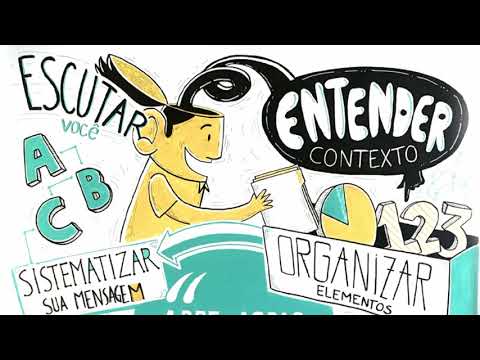
To be understood you need to listen,
think of the other.
To be understood you have to make choices.
What will you choose from your subject?
so that the other is interested and wants more?
This is the explainer’s question.
At age seven, I chose to play the piano.
Then, at 17, I was already the highest in the class.
Then I had to explain to people
that I did not play basketball because I played the piano.
With 17, you have to choose what to do for the rest of your life.
Difficult this. My father had been an engineer, an administrator.
My brother had been an engineer, an administrator.
Then I thought: I’m going to skip engineering, right, do administration soon.
I entered a good college,
and I kept playing the piano and making noise.
(Imitation spray)
Well, from there, double life:
on the one hand, the business world,
entrepreneurship;
on the other side, art, music, theater.
And then I learned to reconcile the two:
look at my purpose and make choices by thinking about it.
Today
re-presents a show, which is already a success, shot Brazil,
and I do the music and the sound design.
(Imitation of dog)
(Siren Imitation)
And I chose to be here.
Choosing is one of the skills of being understood.
To explain is to make choices.
I even started to choose the subjects that I wanted to explain:
subjects that I like,
matters that interest a lot of people
and matters that need to be understood.
Do you know those who, if people understand better, the world will be better?
You have now learned a little more about matrimandir.
Raise your hand here who knows what matrimandir is now.
Now everyone.
Look, this scale is exactly for that.
It suits any subject.
Today I chose matrimandir, but it could have been the dolphin-rotator.
(Imitation of dolphin)
Drills with impact.
(Imitation of drill sound)
It could have been…
beach sherbetters.
(Imitation of horn of the ice cream maker)
(Laughs)
I simply chose a subject. It suits any subject.
In your next explanation, take this scale.
She’s available.
Identify your subject and answer:
what is the distance from your understanding to the understanding of the other?
Your answer can help you choose language, format,
and even depth of your message.
And if you were interested in what I said here,
welcome and welcome
at level two of the understanding scale of being understood.
Thank you very much.
(Applause)
”
Be First to Comment