
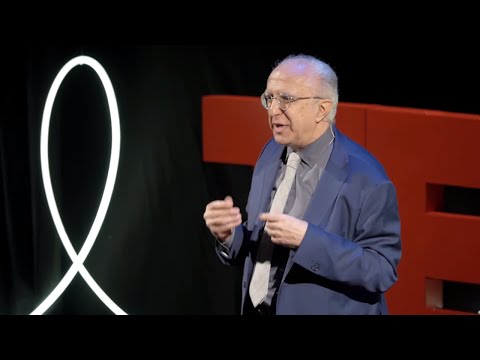
A very common question I used to hear is “What’s your job?”
And I say, “I play the piano.”
“Oh really? You play the piano, wow.
It’s very funny. But your job, what’s your job?”
(Laughter)
It’s frustrating
to explain that even playing the piano should be a job.
But it’s natural because if I ask, “What is music for?”
What is music for?
Music is for fun, entertainment, amusement, relaxing …
Of course!
But it seems that music enters our life
when the real life stops, when it’s finished.
So, from a certain perspective, music is good for nothing,
really, effective.
So it’s natural, “Oh, you play the piano. But what’s your job?”
But here I would like to share with you a different perspective:
going beyond music to find something to enjoy a harmonious life.
Because mankind has the great gift of music
not for unproductive amusement,
music can disclose in itself a secret power beyond the sound
where happiness is living.
The most ancient civilization knew it very well.
For example, Pythagoras, 2,000 years ago and more, said,
“Music is not for entertainment
but to connect one’s soul to their divine nature.”
Wow, music like a bridge to connect my soul
to my own inner higher nature.
And the philosopher Plato said,
“Music is not to aim to the fun but to build harmonious personalities.”
And in the Middle Ages, as you can see in this slide,
the main road to gain freedom for mankind
were considered the liberal arts containing the trivium and quadrivium.
In the trivium, you had to master logic, grammar, and rhetoric,
and in the higher part,
you had to master arithmetic, geometry, astronomy …
… and music.
And I think music was at the top
because music contains all the other ones.
For example, the tonal system is like the solar system.
A symphony has a perfect geometry.
The rhythm is based on numbers: 1,2, 3, 4, 5 … No?
And music is a language, so has its own grammar, its rhetoric.
Everything is logical in music.
So what have we lost about music?
But the good news is, nowadays, we can regain this secret
because science is revealing that to us.
For example,
the scientist Vittorio Gallese,
from the staff of the discoverers of mirror-neurons, said,
“From a certain point of view,
art is higher than science.”
Because the artistic intuition allows us
to understand mankind’s nature more quickly and more deeply
than the scientific approach.
Daniel Levitin and more neuroscientists from BRAMS Institute of Montreal,
using neuroimaging diagnosis techniques,
demonstrated that when we listen to music,
or we play or we sing,
almost the full brain is activated at the same time,
harmoniously and simultaneously.
I would like to invite you to sing with me
a very famous anthem of your beautiful country.
A traditional anthem.
(Sings) ♪ La la la … ♪
Please, sing with me.
(Audience joins) ♪ La la la… ♪
(Audience clapping hands)
(Singing and clapping ends)
Oh, beautiful. Beautiful sound.
So now, if we should take a picture of our brain,
like in the slide number two,
you can see the full brain is activated.
The sensory cortex, the auditory – of course, but not only –
the hippocampus,
the memory – the first time we listened to this beautiful music –
the visual – an image connected with this music –
the cerebellum –
with the sense of movement: ♪ Ta la ta ta … ♪ –
and the prefrontal – we are counting –
and the emotional part – the amygdala and nucleus accumbens –
the limbic system – the sense of belonging,
to be part of the same country, the same group –
and so on and so on.
The full brain is activated simultaneously.
So this fact demonstrated that music has a secret power
to create a harmony between the mental, the emotional and the cellular system.
And when they are aligned, we are perfectly performing our cells.
But what is the hidden secret,
lost in time, to reach this inner harmony?
Music is a fractal.
In a fractal, all the parts reproduce the whole
because they contain it.
So knowing the part, you can know the whole.
So music is a product of a human experience it contains.
So knowing the music, we can know the whole human experience.
Everything you need,
everything we need to express our excellence,
to manifest our higher selves.
But how can we find out?
This is a secret power within music fractality.
I will introduce you four great models showing us how to do.
Four great musical geniuses
providing us the instruction to go towards a harmonious life.
The first one is Johann Sebastian Bach.
Please, can we listen to music number one?
It is composed by Johann Sebastian Bach and is a very special music.
(Music starts)
If you listen, there is something that is repeated some times.
Some times, for example
when the first part finishes, what you can hear is this:
(Sings) ♪ ta ta ta, ta ta ta, ta ta ta, ta ta ta ♪
This rhythm.
♪ ta ta ta, ta ta ta, ta ta ta, ta ta ta ♪
♪ ta ta ta, ta ta ta, ta ta ta, … ♪
♪ … ta ta ta, ta ta ta ♪
(Music ends)
It’s fantastic. This music lasts seven minutes.
And in the seven minutes, you will find only “ta ta ta.”
(Laughter)
Nothing else. It’s perfect, ha-ha!
(Applause)
So, 400 bars
and in each bar you will find exactly repeated “ta ta ta,”
but there is not a bar equal to another one, it’s genius,
because Bach had this ability to go from one idea to infinite solutions,
to infinite possibilities.
So, Bach’s music is the expression of unity’s fractal:
everything is repeating, everything is one.
The sun comes back everyday;
our breath is repeating; our heartbeat is repeating.
So, if we don’t repeat, we die. So to stay alive, we have to repeat.
It’s interesting, and Bach said,
“To express your excellence,
find your identity, discover who you really are.”
Find out your “ta ta ta,”
and be consistent with it, repeatedly, everyday in your life,
going from your one to your infinite.
So repetition is the first law beyond music.
So to be happy, find out your “ta ta ta” and enjoy to repeat it.
(Laughter)
Simple.
But the second musician is Wolfgang Amadeus Mozart.
Now it’s the time of Mozart.
If we listen to this music – please, you can go –
this is the first time: motif one.
(Music starts)
It’s famous. But now it changes.
Two. It’s different; not the same.
Two, okay …
Three is different. How does he dare?
Four: ♪ La la la, la la la ♪
It’s different.
This is little repeated, but hmm …
And changed. Five: ♪ ta ra ra ta ta ♪
Six: ♪ ta ra ra ra ♪
Seven: ♪ ta tim ta tim ta da ♪
Eight: ♪ ta dam ta tam ta dam ♪
Nine.
Ten: ♪ pam pam pam pam ♪
Ten. Repeated a little, but changed.
Now: 11.
12.
12.
13 – please, please continue.
13.
And now, 11, 12, and 13 for one time are repeated.
11 to 13.
And now: 14.
15 …
(Laughter)
Thank you.
15 different ideas in one minute.
So Bach: seven minutes, only “ta ta ta.”
(Laughter)
And Mozart: one minute, 15 different ideas.
And the expertise of Mozart is to create harmony.
So it seems perfect, it seems fantastic,
something that is the full perfection.
And Mozart’s music is the expression of variety’s fractal;
everything is changing, everything is different.
After the sun, the moon, after the day, the night,
and beside the man, the woman.
Our experience is to stay in the middle of this difference, of this duality,
and to try to harmonize it.
So Mozart says, “To express your excellence,
be open to change, be available to explore the new,
try to practice a new solution every day, don’t stop to search.”
So exploration is the second law beyond music.
So to be happy, enjoy to explore the new.
But there is the third musican, Johannes Brahms.
Johannes Brahms composes his music, using only one main idea, like Bach,
but transforming it ever and ever and ever
in a lot of different new ideas, like Mozart.
So in his music, we can find both Bach and Mozart together.
Brahms’s music is the expression of similarity’s fractal:
everything is transforming.
Do you remember “panta rhei”?
Everything is similar.
7 billions of people on the planet and nobody is the same,
yet everybody is similar.
Our body is transforming itself day by day.
So Brahms said, “To express your excellence,
keep continuing to transform yourself, keep continuing to evolve,
moving towards your higher dimension,
going beyond,
and don’t stop to layer.”
So exploration was the second,
and the third law is transformation, evolution.
So to be happy, enjoy to transform yourself.
The fourth, the last composer, is Charlie Parker
and Jazz musicians in general.
The music of Charlie Parker is not composed; it’s fully improvised.
Right now and right here, create every moment in a different way.
He said, “I like unexpected ideas that arrive without a plan.”
Jazz musicians go on stage without knowing what they will play.
And they like it. They like incertitude.
They are known to have a fantastic mindset.
So Charlie Parker is the expression of time-space fractal.
Everything is only right now and right here,
so everything is perfect as it is.
So Charlie Parker says,
“To express your excellence, be grateful for this moment.”
Because it’s the only possibility we have;
yesterday is gone, tomorrow we don’t know.
We have only this present, so it’s a gift – you remember.
So, gratitude is the fourth law beyond music.
So to be happy, be grateful for this present moment.
So at the end, the four fractals –
unity, variety, similarity, and time-space –
and their laws –
repetition, exploration, evolution, and gratitude –
draw down the main road to go towards a harmonious life.
And at the end, joining the four fractals,
we can awake our genius, the genius of music.
The sound genius, we should say, in ancient cultures,
the genius was a good spirit.
A guardian angel generated genius,
generated with us to drive our action, to protect our well-being.
And music is a guardian angel to push us to go beyond,
because the sound genius fractal contains the whole,
the whole attitude and behavior, so we need to express our excellence.
So, resuming: What is the hidden secret in the music fractality?
One more time, it’s science saying us: Albert Einstein says,
“God created the harmony of the world, and Mozart put it in music.”
Wow, so going beyond the music of Mozart,
we will find the harmony of the world.
My harmony too, your harmony too.
And going into music on deeper levels,
going beyond the sensory appearance of its beautiful sounds,
we can find the main road to go towards a harmonious life.
First, find out your “ta ta ta,” your identity,
and repeat it, be consistent with it,
repeating in your life – Bach.
Second, be open to explore the new – like Mozart.
Third, continue to evolve yourself and to transform – Brahms.
And be grateful for this moment – like Charlie Parker.
So, at the end, what is my job?
It’s to play the piano, of course,
and I play the organ, I compose music, I conduct orchestras,
of course, it’s my job to create fun for you,
but as a musician, I also feel the responsibility
to share with people the possibility to go beyond,
to express their excellence in every field,
personal and professional,
with the help of art and music.
Remembering always, as said Fyodor Dostoyevsky,
“The beauty will save the world,
the beauty will save us – nothing else.”
So, make sure to look for the beauty in your life.
And you will find, beyond beauty, beyond music,
you will find your inner harmony;
right now and right here, waiting for you!
Thank you for your attention.
(Applause)
”
Be First to Comment