
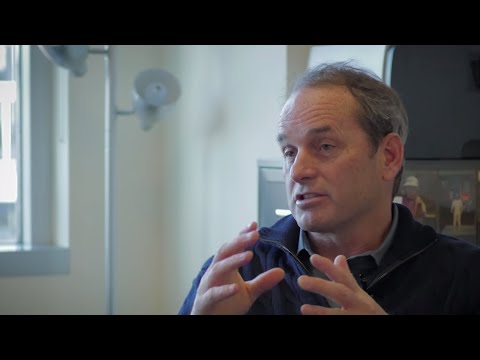
Today in biology, I think we’re undergoing
some sort of Renaissance.
It is going to change the way we do biology,
change the way we do medicine,
change the way we think about biological complexity,
and permeate, I think, everything we do.
[The power of collaborative, interdisciplinary research]
[Dr. John Aitchison — Professor, Institute for Systems Biology]
About 15 years ago now,
scientists in general, the group of us,
finished the human genome.
So we’ve managed to sequence the human genome,
and this was a paradigm shift
that gave us the blueprint for who we are.
What was missing, or still is missing to a large extent,
is how each of these proteins work by themselves and then together,
and how they create this emergent property that is life.
What systems biology tries to do
is to, rather than focus on the individual parts of a cell,
the protein,
we try to put it all together
and try to interrogate the entire system as a whole,
break it down,
and then rebuild it
and try to understand how these components work together
to give us this complexity.
If you think about that,
you think about how complicated that is,
how much information might exist in a single cell?
We need to start incorporating challenges of computation.
We need computer scientists, we need mathematicians,
we need physicists.
We need to all work together to try and understand this complexity.
And so, in about 2000,
Leroy Hood, Ruedi Aebersold, and Alan Aderem
started the Institute for Systems Biology.
It’s a huge challenge to begin to break down
these traditional silos of an academic organization,
where a physicist would be in a physics department,
and a chemist would be in a chemistry department,
and they wouldn’t speak to one another or to the biologist.
But now we’re all under one roof.
One of the things we started was what we called the Discussion Group.
And the Discussion Group was a time
where many people from the Institute got together
and began talking about subjects
most of us really weren’t experts in.
And so what that did was, it really broke down our egos.
We began to talk about things that we had learned from each other,
but understood that each of us was somewhat vulnerable
in each of our disciplines and in each of the things that we knew.
Typically in academia, one does not want to be vulnerable.
And so I think what that did is, that built an incredible trust
among all of us.
And that allowed us to begin to explore
in a very safe environment
and learn from one another.
In some of the early work,
a computational biologist that I worked with,
a guy named Ilya Shmulevich,
he began to teach me about electrical engineering concepts.
And I told him what I was doing in gene regulatory networks,
how gene regulatory networks actually work in my mind;
that is, how genes are turned on and turned off,
and there’s a coordinate dance of all the proteins
that make genes go on and off.
And it struck him
that maybe there were some electrical engineering concepts
that could be related.
So he taught me about them, and I taught him about transcription,
and we continued digging deeper and deeper.
And I never would have been able to begin to address them
if we hadn’t had that level of trust,
that willingness to say,
“You know, I don’t know what you’re talking about.
I need you to speak in more layman’s terms,
and I need you to get this down to my level,”
But at the same time,
I was getting the cell biology concepts down to his level.
And so there was a recognition that we all have
these levels of expertise in particular areas,
but in order to communicate, you’ve got to come down and then back up.
There’s a project at ISB
which is focused on following individuals,
about 100,000 individuals, over time,
and measuring their blood and a number of other clinical markers,
and identifying those indicators of a shift from well to unwell.
And that shift from well to unwell can happen
long before traditional clinical signs occur.
And so, if we can do that, that changes the game completely.
All of the sudden, we can make predictions
about someone’s future health or lack thereof,
and we can change the trajectory of someone
from unwell, or their trajectory towards disease,
to wellness.
So if you think about something
as simple as antibiotic resistance in bacteria —
I mean, this is becoming a huge problem.
We have drugs that will generally kill a bacterium
because the bacterium will not be able to replicate.
But then, over time, the bacterium will adjust its lifestyle,
change its gene expression patterns and respond to the drug,
or mutate away from susceptibility
to that drug.
And then we need to think about, well, how would we intervene
with another drug
to be able to prevent that resistance from occurring?
And so, if you think about biology
as a network of molecules that are interacting,
you can think of it —
let me use the example of a scaffold.
So, a scaffold is built by multiple redundant bars or poles.
And I can pull out most any one of those poles
without any catastrophic consequence to the scaffold.
But if I pull out the right one,
the scaffold will collapse.
And so if we think about
systems biology interrogation of that bacterium,
what we’re trying to do is identify that second pole.
One of the analogies that people use is that old joke where —
and I think it contrasts what is traditional reductionist biology
to systems biology —
is the example of a man looking under the streetlight for his keys.
And the cop comes up to him and asks him why he’s looking here,
and he says,”Because this is where the light is.”
But systems biology illuminates everything.
So, no longer do we have to look under the streetlight for our keys,
but we can look at the entire street.
I think that is what we’re trying to do.
And if we can do it in the context of the lab,
we can certainly do it in agriculture,
we can certainly do it in environmental engineering
or environmental studies,
we can certainly do it in food sciences —
anything where we need to interrogate
the biological system in its entirety
and make predictions about new behaviors and new outcomes.
And I think that’s the real power of collaborative research
and interdisciplinary research.
”
Be First to Comment