
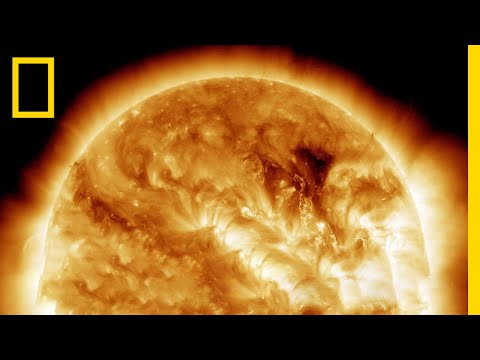
Plays a special role for us here on earth our
Sun formed about 4.5 billion years ago in the Milky Way galaxy’s Orion’s fur
It was born when a cloud of dust and gas known as a solar nebula
Collapsed and in the middle of this formation matter condensed into a burning ball of gas that became our Sun
The sun’s fiery nature along with a tremendous gravitational pull and an extensive magnetic field
Helped it to become the heart of our solar system
The Sun can be divided into six layers or regions the corona the
chromosphere
the photosphere
the convective and radiative zones and the core in terms of atom count the Sun is about
91% hydrogen the sun’s fuel eight point nine percent helium and
point one percent heavier elements such as carbon and nitrogen
Due to the sun’s extreme temperatures these elements stay in a gas like phase called plasma
In the core
temperatures reaching at least 27 million degrees Fahrenheit
Combined with the sun’s powerful gravity fused together hydrogen molecules to create helium
Called thermonuclear fusion this releases an enormous amount of energy in the form of radiation
Electricity solar wind and as we experience on earth
Life-giving heat and light
Such volatility is contained. Thanks to the sun’s tremendous gravity
It’s strong enough to hold the solar system intact and is primarily due to the sun’s size and mass
Our Sun is the largest and most massive object in the solar system
it’s more than 100 earths wide and
Could theoretically fit all eight planets inside
nearly
600 times
It also contains approximately ninety-nine point eight percent of all the mass in the solar system
Because of this mass the Sun has a great pull on the fabric of space
Creating a gravitational force that causes nearby planetary bodies to be drawn toward it
This gravitational pull allows the Sun to hold together a system of eight planets
potentially dozens of dwarf planets at least
170 moons and countless comets and asteroids
Without the sun’s gravity these celestial bodies would drift off into deep space
Another critical property of the Sun is its magnetic field which encapsulates the entire solar system
Called the heliosphere this force field protects the planets from harmful cosmic radiation
It’s caused by the sun’s plasma pushing electrically charged particles toward the Stars poles
This process turns the Sun into a giant magnet
Although the sun’s magnetic field is invisible to the naked eye
Its effects are noticeable
On the sun’s surface are dark areas called sunspots, which marked strong pockets of magnetism
on
Earth and on some of the other planets the sun’s magnetic field interacts with their atmospheres
resulting in beautiful Aurora’s
Despite its size and strength the Sun will not last forever
in about
6.5 billion years it will run out of its hydrogen fuel
Expand to envelop Mercury Venus and even earth and then collapse into a small star known as a white dwarf
in
The meantime the Sun will continue to play a critical role in the system that bears its name
the Suns protected magnetic field
Tremendous gravitational pull and ability to create vast amounts of energy will protect
Contain and give life to our solar system
”
Be First to Comment