
something on the spur of the moment.
And if you say no, me me me, I I I, nobody likes you.
Anybody that tries to centralize everything
through themselves or through their staff
really is making a terrible mistake
You can’t control how lucky you are, although
the more you work the luckier you get
You can’t just say something and believe it
You have to be able to show people that you’re right
The most important asset you have are the people
that leave at night and come in in the morning
I just don’t have anything in common with people
that sit there and say “Oh my God, it was terrible.”
You’re going to spend your entire life doing
something different than what you think.
Should’ve, would’ve and could’ve is not a particularly
useful thing to spend your time doing.
This is a world, and I think it’s good,
where you don’t do anything by yourself.
– He’s an American business magnate, politician
and philanthropist.
He served as the 108th mayor of New York City serving
for three consecutive terms with a net worth
of $41 billion, he’s the seventh richest person
in the United States.
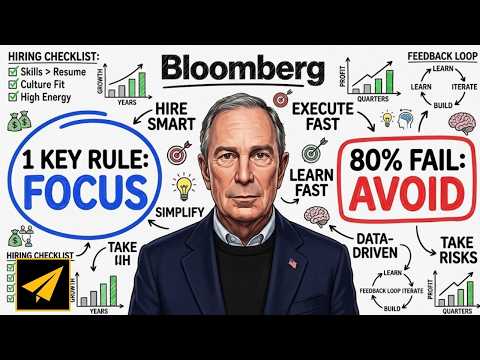
He’s Michael Bloomberg, and here are
his top ten rules of success.
– You know, I think it’s very, my advice to young people
is you never want to do something on the spur of the moment
you don’t want to jump too quickly, that doesn’t mean
you should sit around and waste your whole life
and never realize when something’s not going to happen
or when the opportunity’s not going to be presented
but every time I thought about leaving Solomon I stopped
and said you know I’m learning a lot, and even though
I might have been able to make more money elsewhere
it was a great firm.
They were scrupulously honest, phenomenally competent,
worked very hard, very nice to me, erm, and, er,
I always decided to stay.
I don’t think I ever seriously, other than maybe a little
Walter Mitty dream now and then, I don’t think I ever
seriously ever thought of leaving and it turned out to be
great, I’d say nothing but good things about them,
even when them firing me was the right thing.
– You never wanted to beat your competition?
– No, I wanted to be successful
– You said teammates versus competition
– But I mean, at Solomon Brothers all those times,
you work with other people, one of the ways incidentally,
Stephanie, to really get ahead, is to give credit
to somebody else.
When I say oh, I didn’t do it,
Lloyd did that and he involved me, let me tell you,
I’m telling everybody it’s me as well, but I’ve now
made a friend, and you respect me because I’ve shared
the credit, and if you say, no, me me me, I I I,
nobody likes you and nobody respects you and they think
you’re exaggerating everything, but to the extent
you’ve credited someone else with the thought
of, are they exaggerating?
It doesn’t even come up.
And I’m a big delegator in terms of management style
If you’re going to run a 24/7 organization
you have to do that.
Anybody that tries to centralize everything
through themselves or through their staff
really is making a terrible mistake.
But that’s why lots of businesses don’t work
And that’s why lots of governments don’t work
Because they do exactly that.
The only thing that you can control
that influences success in life
is how hard you work, how honest you are, and
how well you deal with others.
You can control those variables.
You can’t control how lucky you are
although the more you work the luckier you get.
You have no influence on the intellectual capabilities
that God did or did not give you, but you can
work as hard as possible, you can be scrupulously honest
so that people respect you, and you can get along
with others, cos nobody does anything by themselves.
– Did you have to pay a price though, you personally?
– Well I think that everything is an either-or.
There’s a price in everything.
You can study or you can go out and play.
You can defer to others or you can try to hog the credit.
You can be honest and suffer the consequences,
or you can lie, cheat and steal, and short-term,
maybe even advance.
But long term, you are better off if you work harder.
You are better off if you’re honest,
and you are better off if you give others credit
and get them to help you by helping them.
– What do you tell others who try to strike that balance?
Between family and work and volunteer efforts
and anything else?
– Well the answer to either/or is invariably yes,
you can’t go all in one direction.
You cannot walk away from your family for your career.
On the other hand if you walk away from your career
for your family, you’re not going to have the money to
support the family, and parents all the time are making
those kinds of choices between career and family.
They do some of both and you try to blend the two,
and that may not be the perfect answer but that’s a
practical answer, that I’ve always told young people
when they go off to college, you have to study and
you have to get good grades, but you certainly
should have a good time as well because that’s part
of your growing-up experience and there’s no point
in leading life to suffer all the time,
you want to enjoy life as well as the next person,
so some balance, some blend between the two.
I went to Hopkins to study physics and it turned
out there was a German requirement so after 30 days
I became an engineer where there was no language
requirement.
And I think looking back, an engineering background
was perhaps the transformative thing in my life.
Because in science, and it would have worked if I had
stayed as a physicist too, I suppose, in science,
you have to be able to look in the mirror and
answer the question, you can’t just say something
and believe it, you have to be able to show people
that you’re right.
The essence of science is that somebody else,
independently, can verify
what you claim you saw.
And that discipline of not just taking
people’s word for it, or not just automatically falling in
to what’s generally accepted, has forced me to step back
and say why?
And to question.
And if you question why we’re doing things,
I think you’ll find yourself targeting your energies
much more efficiently, appropriately, and in a much
more satisfying way.
So somebody says well this works,
well that may be, but you know, stop and think,
does it make any common sense?
Listen to what people are telling you to do.
Think about what they say in the newspaper,
does it make any sense?
Do you want to be part of it?
Could you do it better?
It’s that mental discipline of questioning,
which I guess is the scientific method.
– What do you think has mattered about the culture
of Bloomberg?
And what lessons do you think a company like this
should learn?
– I think it’s not just for companies
I think it’s for governments and everybody else.
People want recognition and respect.
And whether you do it by giving them free food
and nice offices, whether you do it by always
giving them the credit when somebody says why
does it go along?
I always make a point when I walk into a building
I shake the hands of the security people at the door.
If it wasn’t for them, the rest of us wouldn’t be able
to go in and conduct our business.
They’re just as important as the head of the company.
I think we have too many distinctions between
people and the egalitarian concept that America
was built around, I think, really works.
And at Bloomberg I abolished all titles
there’s no titles in the company.
On my card, it never said anything,
it just said Michael Bloomberg, and address,
and phone number.
In those days you didn’t even have email addresses,
today they continue with that process.
Everybody knows who they work for,
there is a hierarchy, you have to have a hierarchy,
you have to have structure, but that doesn’t mean
that we should have, every time we introduce somebody,
something that distinguishes and says that one person
is more important than the other.
In city government you can’t quite do that
because they’re built into the structure is
different, and the requirements they use titles
is different, but in the private sector to the extent
that you can include everybody in this room and
around the world that works for Google, I would argue,
do it, that’s what we do at Bloomberg.
To the extent that you can make people be happy
to come to work and want to be there,
in the end luck plays a very important part
in how successful you are, but the harder you work,
and the longer you work, the luckier you’re going to be.
So you want people to want to come in early in the morning
and want to stay late.
You want people that, if they want to take some time off
for family obligations that’s fine,
but you want them to want to come back,
and I think if you take a look,
you’re never going to please everybody.
Bloomberg has about 9,500 employees,
maybe 120 offices around the world,
and there’ll always be somebody that isn’t happy.
But fundamentally we have a very low turnover rate,
and I think whenever you have intellectual content
as the basis of your business, and certainly Google does,
and certainly Bloomberg does, the most important asset
you have are the people that leave at night and come in
in the morning.
And so that’s where your focus should be.
– And what’s your advice to these small
business founders today?
– Work hard, you’re going to need some luck,
but the harder you work, the luckier you get.
And if it doesn’t work out, it’s not the end of the world.
I just don’t have anything in common with people
that sit there and say “Oh my God, it was terrible.”
It’s water over the dam, under the bridge, get on with it
and start another business the next day,
or another career, and be honest, look in the mirror,
and say why didn’t it work out?
Well it wasn’t the skillset, or it wasn’t I didn’t have
the temperament for it, or I was in the wrong place,
wrong time, maybe I can afford to do it again,
maybe I can’t, but people aren’t honest with themselves.
What I’ve always done is I’ve taken a yellow pad,
I’ve drawn a line down the middle,
write out the pros on one side, the cons on another,
in the sense that if I let you see it, you wouldn’t
laugh at me.
And then when I get done, I just rip it up and throw it
away because I’ve worked out in my mind,
What is real, and what isn’t and what I can
present to people and what I can’t.
And this goes back to my boy scout days, is be prepared.
I know what you’re thinking, you’re
already prepared, you’ve mapped out the rest of your life,
the rest of your education, postgraduate work,
residencies, fellowships, clerk ships, and you’re
going to have a long, meaningful career.
You have all of your plans already laid down.
That’s not the preparation I’m talking about,
because let me tell you the likelihood of you
winding up 10 years from now doing what you think
you’re going to be doing ten years from now
is probably less than one in ten.
The truth of the matter is, you don’t know
what opportunities are going to be presented
to you, you don’t know where you’re going to succeed
and where you’re going to fail, the careers that
you wind up in are invariably going to be very different
so what I would do is I would focus on how I interact
with people, how I approach problems, I would get involved
in government, if you want to go into public service,
I would recommend you first become a billionaire but
that’s another issue.
You’re going to spend your entire life doing something
different than what you think, and the good news is
that Dartmouth is preparing you for that, because
while you think there are individual subjects, what
they’re really teaching you to do is to think and to
reason and to build relationships, and that’s what’s going
to carry you.
– Well from the book, after you were fired or let go
from Solomon, “I didn’t sit around wondering what was
“happening at the old firm, I didn’t go back and visit,
“I never look over my shoulder, once finished, gone,
“life continues.”
Yes, you can’t sit there, and should’ve, would’ve
and could’ve is not a particularly useful thing
to spend your time doing.
It will just leave you
heartsick, or it’ll leave you living a past life
and not looking towards what could be great tomorrow.
– How important is it to have salesmanship,
you could have the best idea in the world?
– I don’t know any business where sales isn’t a big
part of it, or cooperation and collaboration isn’t
a big part of it, I suppose if you’re a monk and have
a vow of silence, maybe, but an author, for example,
you’ve got to work with an editor, you’ve got to talk
to a publisher, and you have to deal with your family.
And it’s, they’re all, this is a world, and I think
it’s good, where you don’t do anything by yourself.
Nobody just works for one person or just works for
themselves, nobody does anything independently,
we deal, and whether it’s your family, your outside
life, your business life, or whatever
– Thank you guys so much for watching, I made
this video because Will C asked me to, so if there’s
a famous entrepreneur that you want me to profile next,
leave it in the comments below, I’ll see what I can do.
I also love to know which of Michael Bloomberg’s
top ten rules meant the most to you, what’s going to
have the biggest impact on your life, on your business,
leave it in the comments during the discussion.
Thank you guys so much for watching, continue
to believe, and I’ll see you soon.
– What would you like to see as your legacy?
– What would you like to say that you achieved with
your life?
– Well I think I’d want my kids to look back and say
he was a great mayor, and honest, and made a big
difference in the city, but I think the things
that will last are things like the life expectancy
numbers or the economic development of New York City
compared to other cities, or reforming education,
which is always a two-step forward, one-step back thing,
but if we can be an impetus to Rahm Emanuel, for example,
to stand up and fight for the control of the school
system in Chicago, or elsewhere around the country,
I think those would be good legacies.
If we could figure out a way to stop this carnage
from illegal guns, that would be another thing,
but if you go back, go down the road and look back,
those are the kinds of things, investment in educational
institutions, my alma mater, Johns Hopkins, that you’re
on the board of, or Harvard, where one of my daughters
went to graduate school, and I did, or Princeton,
and NYU, those universities will, I hope,
make a difference in the world and I’ll be a little
part of it.
At Hopkins we have a malaria project, for example,
trying to build a better mosquito.
And the reason, you want a mosquito that’s tougher
than the others that doesn’t carry the malaria
parasite, and then it would drive out the others.
It’s really probably the only ways to stop malaria
which kills a couple of million people every year.
When our Nobel Prize winner who runs the project
wins his second Nobel Prize, and I’ve challenged him
to do so, I’ll have a little bit of that prize,
’cause I helped fund it, and so will the clinicians,
and other scientists that work with him,
and so will patients that work with him.
We don’t do anything on our own, and everybody
collaborates and gets something from somebody else.
And I also hope that I’ll set a standard and that
whoever comes after me will be a better mayor than I am.
I’m going to live in New York City and I’ve always, in my life
tried to hire people smarter than me.
I’ve certainly done that with my deputy mayors in the city,
I’ve certainly done that with the people that are running
Bloomberg, and hopefully the public will pick a successor
that will turn out to be, nobody’ll ever think anybody is
at the beginning, but will turn out to be a better mayor
and will take it forward.
And I hope that Washington gets its act together
and starts understanding, we are in trouble
in this country.
Niall Ferguson wrote a great story about the end
of civilizations and how quickly things can collapse.
Rome in a couple of decades, the USSR in a couple of years.
I mean that was the second biggest power in the world
and two years, it’s gone.
We really are on a cliff, and it’s not just the fiscal cliff
we’re already over the fiscal cliff, the question is,
are we going to pull a rip cord or just keep falling?
But we’re on a cliff socially, as well.
And the world is not necessarily on our side.
– Did you ever think your company wasn’t going to make it,
in the early years?
Were you nervous it wasn’t going to make it?
– Sure.
For the first year, it’s always an exciting
thing, every two weeks I wrote another check
to the company from my personal bank account,
to put money in to pay the help.
And the last year of the three that it took me
to get customers, you could see that that light
at the end of the tunnel wasn’t a train
coming towards you, it really was that you were
going to get out of this and it was going to work.
The middle year, what you find is that your family
and your friends say, you know, I know you know
what you’re doing and I have all that confidence in ya,
but you know just in case, because we were competing
against big companies, and every article in the paper
said this was foolish, you can’t win against big companies,
I’ve always thought that competing against big companies
for a small company is not only exciting, it is, it has
enormous potential, because big companies never believe
the little company is going to challenge them until
it’s too late, and big companies have such an infrastructure
and investment, and product and people and brands, and
that sort of thing, that they can’t change, and you know,
Clay Christensen’s Disruptive Technologies, if you need
more examples of that taking place just pick up the paper.
Every day there’s another industry going out of business.
The other day we gave awards to ten different
small startup companies.
Our economic development corporation did.
In the fashion industry.
And I’m talking to this guy, what did he get an award from?
He has a computer program, you just stand in front
of his camera, turn around once, and then he has your
body measurements for every single square inch of you
down to a science.
That goes straight to the loom,
and the next set of jeans that comes off is built
perfectly for your body.
Think about how many people in the process
that’s going to take out.
That’s one of the great challenges for creating new jobs
that that kind of technology takes away a lot of the
kinds of things.
But there is still the demand for people creating that
kind of program, there’s still demand for the designer
who comes up with what’s fashionable or not.
So there is potential, but it requires investment in
infrastructure and it requires better education
than we are providing our kids today with.
And it requires people from around the world wanting to
come here, rather than sending these industries overseas.
”
Be First to Comment