
what it is after this.
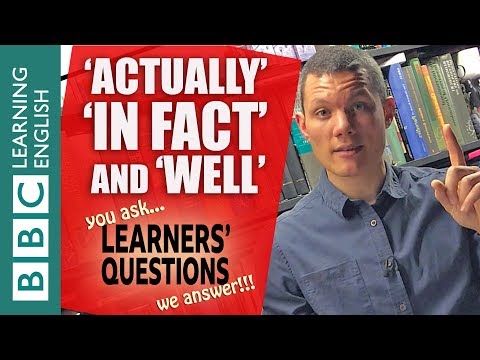
OK! This week’s learner question comes from Yukki from Japan, who says, “Could you please
tell me the difference between ‘actually’, ‘in fact’ and ‘well’? I think all of them can be
used to correct the previous utterance. Is there any difference between them?”
Well, Yukki, they’re all very similar, but there are slight differences in use. Both
‘actually’ and ‘in fact’ can be used to modify or contradict a previous statement. For example,
my friend, here, thinks I’m a doctor but in fact I’m a dentist.
‘Actually’ and ‘in fact’ can also be used to introduce more detailed information or to make things
clearer or more precise. For example, my friend, here, is so boring that I actually I fell
asleep while he was talking to me.
Well is more widely used as a discourse marker than ‘actually’ or ‘in fact’ are. It is most often
used to indicate that we’re about to say something. And it’s sometimes used to give
the speaker more time to think. For example, how much are you looking to spend? Well, about
£200.
It can also introduce a statement which shows that expectations have not been fulfilled.
For example, have you finished your homework? Well, I’ve half-finished it!
Finally, it can be used to soften corrections or criticisms. For example, you do like my
dress don’t you? Well, it’s not your best.
I hope that answers your question, Yukki. Thank you very much for writing. If anybody
else out there has a question for Learners’ Questions, you can email us on: learning.english@bbc.co.uk.
Please remember to put Learners’ Questions in the subject box and your name and where
you’re writing from. We can’t answer every single question, guys, we just get too many,
but we do read every single one of them. And, for more information, go to our website: bbclearningenglish.com.
That’s it for this week’s Learners’ Questions. I’ll see you next time. Bye!
”
Be First to Comment