
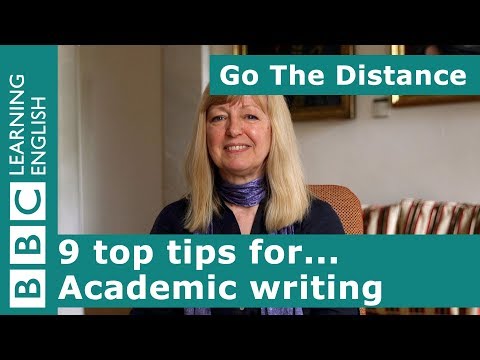
and I work as a distance learning tutor
for a university.
Some assignments can be as
short as one and a half thousand words,
but they can go up
to 3000 words in length.
At the end of reading an essay,
is when I’ve heard the student’s
individual voice throughout
the essay, not just
the voice of the material that they’ve read.
A main problem with academic writing
is actually structuring,
so you’ve got a clear thread
of argument throughout the essay.
We have things like glossaries
where they can look up particular terms
and what they mean,
so they don’t have to
learn them off by heart,
but they need to be able to show
that they’re familiar with them,
that they understand them,
and to show that they can
use them when they’re
constructing an argument.
I don’t think students should
worry too much about making errors
in grammar and punctuation
and spelling,
because that’s just one
of the marking criteria.
The main thing is: we’re
looking for ideas.
If we can understand it,
then that’s the main thing.
I’ve marked some really
good essays from non-native
speakers of English where they’ve been able
to show a really deep understanding
of English globally,
because they’ve come across English
in global contexts themselves.
I have to balance giving
them lots of development points
with still encouraging them and showing
them actually what they
have done well at the same time.
Every university has its own website
for helping with things like
paragraphs and punctuation
and structuring essays.
So it’s just a case of finding
which site works for you.
One first step would
be to go to their local library
and get a good study skills book out.
A second step would be
to go onto the internet
and find a university
academic writing website
and there are many of those.
But if they have specific queries
about structuring or punctuation
or grammar or something
it would be logical to ask
their distance learning tutor for help
because we’re only too happy to help them.
Go the distance.
”
Be First to Comment