
went into something else I just was so unhappy.
But even within the careers that we’re pursuing
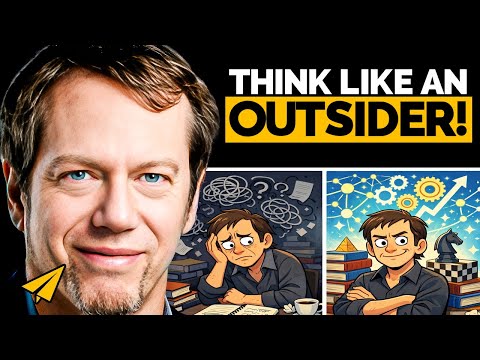
we can train ourselves to think like outsiders
and help loosen up the mind in the process.
I once counted with a girlfriend that I had probably
over 80 jobs.
You have this like wealth of information
and knowledge and ability to acquire skills
that nobody a hundred years ago,
20 years ago could dream about.
Often what separates creative from conventional thinkers
is that they simply search wider.
Self-reliance is to me
the most, if you’re going to develop anything in life
that that has to be it
that’s the most important skill.
You need to be able to put up with fools and
laugh at them and not take them seriously.
Life is inherently chaotic and it
doesn’t fit into our tidy formulas.
Self-transformation we think comes
through a spiritual journey.
Therapy, a guru who tells us what to do.
When you are motivated,
when you feel yourself emotionally engaged
in the subject you learn faster.
– He’s an American author and speaker
known for his books on strategy
power and seduction.
He has written five international bestsellers.
His work has been featured in the New York Times
the New Yorker, CNN, USA Today
and many more media publications.
He’s Robert Greene and here are his
top ten rules for success.
The difference between people who are successful and not
although those who are successful seem to know from
the age of seven or eight, maybe older.
You know they’re very in tune with what they love.
They, I compare it to a voice inside their head.
Not literally a voice
but something saying you really are
drawn to this subject.
And they hear it throughout their lives.
And for me, it was it was writing and books.
Since I was a kid.
And you know at anytime I deviated
from that love and went into something else
I just was so unhappy.
I knew that I wasn’t doing the right thing.
And so it’s just like this voice that keeps drawing
you back to what you really really love.
Some of the most important discoveries,
inventions and innovations
cut within a field, come from people who are trained
in a much different field.
And who have an outsider’s approach.
Louis Pasteur was a classic example of this.
He was trained as a chemist in mineralogist
so he brought amidst a much different way of thinking
to the subject of medicine and germs.
A method that was infinitely more creative.
Albert Einstein was a complete outsider.
His two most important discoveries came
when he was working at the Swiss Patent Office.
Google itself exemplifies this idea.
It is perhaps the most successful business
on the planet founded by two men who are
relatively complete outsiders to business
and who therefore structured
and directed their company in a very
novel and creative fashion.
I could go on and on and on with this list
including many great artists.
There are two important reasons why outsiders
generally have a creative advantage.
First, they are less steeped in and burdened
by the conventions of the field
that they are attacking.
They ask a different set of questions.
They approach problems from unconventional angles.
And second, they are often trained in totally
unrelated fields, and so can make
interesting and creative connections
between two very different forms of thinking.
Like science and business
or chemistry and medicine
or engineering and design.
Now we can’t all consciously
follow such a path.
But even within the careers that we’re pursuing
we can train ourselves to think like outsiders
and help loosen up the mind in the process.
I once counted with a girlfriend that I had
probably over 80 jobs. (laughs)
You know I like was a guide for Greek ruins.
When I worked construction in Crete.
I taught English here and in Spain.
I did the first like encyclopedia for
the Internet, I helped write an encyclopedia.
I was a busboy, a waiter.
God I’m not leaving out something juicy.
Oh, I was a skip tracer I worked for a detective agency
helping find people who left town you know
without telling (mumbling) where they were.
– Yeah. – You know.
– With all those things if you think about it helps
because it’s like doing research for a book.
Or? – Well the thing
about being a writer is that
you have interesting people. – Yeah.
– In life.
And so I’m always wanting to know what it’s like
you know what it’s like to be Shira.
You know. – Would you want to know?
– Yeah I really would. (laughing)
Because then if I really knew what made Shira tick
then Shira would become a character in my next book.
– Mmm. – So
you got to be curious about people.
– You do. – And having
a lot of different jobs helped out, yeah.
There’s differences and then there’s
there’s not differences.
So you know the brain is the same.
The brain evolved over the course of millions of years.
So I try to make the point that you know
what da Vinci was going through the process is
that there’s a template there and it’s the same.
Because our brains haven’t
really changed in an evolutionary sense
in four or 500 years.
On the other hand, the circumstances are different
and people now live in a world
where there’s many more distractions
so it’s harder to do that kind of focus
that I was mentioning.
So in some ways it’s a little bit harder.
And the people that I’ve interviewed are really good
at shutting out all of the distractions of the world.
That’s sort of what separates them
every single one of them.
Paul Graham, you know Paul Graham?
Paul doesn’t have a smartphone.
You know.
He doesn’t spend time on the Internet.
He’s extremely focused.
The woman Yōsuke Matsuoka,
she she does all of her writing with a pen and paper.
She’s not sitting there day in and day out on the computer
checking her Facebook or Twitter page or whatever.
I could go through all of them that way.
Steve Jobs is sort of the ultimate
icon of mastery of our era.
And he said the only thing that’s differentiated me
from everyone else was my level of focus.
I could take a problem and I could focus on it
and burrow into it
and everybody else was so distracted.
He knew how to close his door get away from
his wife, his kids, everyone
and just focus.
So the all of these people
have to overcome the intense distractions in our world.
They and they’re able to do it.
On the other hand, what you can get with
a click on the Internet, with a Google search
compared to what da Vinci had to do
or a scientist in the 19th or 20th century
is absolutely astounding.
So what you have at your fingertips the knowledge,
the things that you can connect and learn about
the potential for learning skills is out of this world.
So if you’re able to overcome the distracting elements
that are.
My girlfriend and I compare it to
if you ever watch a basketball game
and you see the opposing team shooting free throw.
And everyone behind him and the stands
are all going like this with those big
you know, trying to distract him,
there’s like hundreds of people.
That’s what the world is like now.
You’ve got thousands of people waving those things,
you’ve got so many distractions.
If you’re able to overcome that
and be a person that can focus
you have this like wealth of information and knowledge
and ability to acquire skills
that nobody a hundred years ago,
20 years ago could dream about.
Use active imagination is deceptively simple.
Often what separates creative from
conventional thinkers
is that they simply search wider.
They use their minds to generate possibilities
that others don’t think of.
Then they work to verify what they came up with.
We saw a classic example of this with Pasteur.
Another great example is with Henry Ford.
Early on in his career in the earliest years
of what would later become the Ford Motor Company,
Ford was anxious to into speed up
the production of cars.
It was he saw the automobile as the ultimate
consumer product.
But in order for it to become that,
he had to greatly increase production rate in his factory.
So he spent a couple days looking at his employees
on the factory floor and trying to imagine
how he could get them to move faster from car to car.
Suddenly one day he imagined something completely different.
He imagined the men standing still
and the cars coming to them.
He didn’t know what that really meant
but he decided to try it out and lo and behold,
it increased productivity
by such an incredible exponential rate
that it could now become the consumer product
that he envisioned.
Things like antibodies or assembly lines,
they seemed so obvious to us now
but they are never obvious in the present.
And they involve an incredible leap
of what I call active imagination.
The difference between regular and active imagination
is that the latter is used consciously to reach
very very practical results.
It’s not imagination for coming up with wild things
it’s imagination used for very practical results.
Think of the active imagination as a kind of
creative muscle that you’re developing.
First, within the loose constraints
of what you’re working on
you open your mind up to you give a complete free rein.
You entertain almost every possibility that you could
imagine or visualize.
You engage in what Charles Darwin
calls fools experiment, fools experiments.
This is the fun play
part of serious play.
You use notebooks, sketches,
diagrams, models, prototypes
to help externalize the products of your imagination.
Once you have gone through this
you now enter the second serious part
of the process.
First you choose one or few of the more
promising possibilities that were
generated by your imagination.
And now you actively work to test verify or confirm it.
This might entail launching a
beta version on the public.
Once you have feedback you now go back into
the first part of the process in a shortened form
using your imagination to perhaps take
what you have into an even better
and higher form circling constantly through
this process in shorter and shorter cycles
until you’ve got something that’s both
incredibly imaginative and incredibly realistic
and practical.
By developing this by going through this over and over
and over again you will
develop your imagination into an
incredibly powerful creative muscle.
What really impressed me with someone like 50
is he grows up in a world without any parents.
I mean it’s a hard thing to imagine in life
but try for a moment.
Put yourself in those shoes
he never knew his father to this day
he doesn’t know whose father is.
His mother was murdered when he was eight-years-old.
She was a hustler.
His grandparents take him in
but they have nine other kids
that they’re looking after from various different
extended families.
So he’s basically has no parental supervision
from the age of eight and even before then
he had very little.
And so he has to find and discover
everything for himself.
He can’t depend on other people to give him anything.
They won’t give him money,
they won’t give him clothing
they won’t give him education .
And so he on his own as if
that metaphor being on a desert island
is his life, he’s on a desert island.
He has to develop everything for himself.
And he does, and that is what has made him
a person of incredible power.
Now he doesn’t feel dependent on anybody
or anything he knows that if anything goes
wrong in life he has the resources
within himself to find the right answer.
And so I think this is an idea that
applies to an individual.
It applies to a company, to a leader, to a CEO.
It applies to relationships, self-reliance is,
to me, the most, if you’re going to develop
anything in life, that that has to be it.
That’s the most important skill.
There’s a phrase in the Bible that’s become
kind of an expression called suffer fools gladly.
And somehow in our modern world
to cut totally inverted
which is something that it kind of bothers me.
The original expression meant that
you’re constantly surrounded by fools.
Half the world are fools
or whatever the percentage is.
And and maybe you’re a bit of a fool
and what you need to do is
you need to suck.
You need to be able to put up with fools
and laugh at them and not take them seriously.
That’s what it means in the Bible and that’s
the wisdom in the Bible.
And then somehow it got turned around in modern times
where where it seems to be a virtue that
you don’t suffer fools gladly.
That you don’t put up with them.
That you get angry about them,
that you confront them, and you try to change them
and on and on and on and on and on.
And the idea that I try to say it’s part of my
chapter on social intelligence which is
I try and tell you that you’re not going
to be a master in this world unless you
know how to get along with people.
We’re social animals.
You can’t just be a nerd,
a tech guy that has no contact with people
you have to learn how to be with people
and be socially intelligent.
And it’s actually a beautiful form of intelligence.
And one of the aspects is
to learn how to suffer fools gladly.
And I tell you what I think a fool is.
A fool is somebody that doesn’t have the right
kind of sense of priorities in life.
They magnify the little things that we should
just not worry about into some huge dramatic thing.
And the huge dramatic things that completely ignore.
They have no sense of proportion and we encounter
them every day in our lives.
And in fact, we encounter a little bit
of them in ourselves.
We all have a foolish side.
So let’s all be patient with fools.
If you try and change them or fight them
you’re only going to waste valuable time
and energy in your short life.
Learn to laugh at them, learn to know it’s
a part of the human comedy.
I find that that’s going to
save you energy in the end.
And I have stories in there of how not only do you
suffer fools gladly, but you turn it around to an advantage.
So I have a story in there
Daniel Everett, who’s a great kind of anthropologist
and linguist, and he came out with a radical new
theory on linguistics
and suddenly he finds himself being attacked by everyone
in the field.
But they’re attacking him
in this ad hominine manner
as if he’s a charlatan.
And they’re not attacking his ideas
and it’s driving him crazy
and now he’s dealing with fools.
And he decides that what he’s going to do
is he’s going to turn it to his advantage.
He’s going to make sure it out from now on
that anything he presents in a book or a
lecture is airtight.
They would usually pinpoint one little small thing
in something he said that could be inconsistent
and say therefore your whole theory is wrong.
Okay from now on I’m not going to be anything inconsistent.
So he took the foolish aspect of these attacks
and he decided he would make it would make him stronger
and would make his ideas stronger.
That’s what suffer fools gladly is about
and I have other examples there in the book.
You learn to embrace uncertainty and chaos.
Life is inherently chaotic and it
doesn’t fit into our tidy formulas.
Not only does this not make you anxious
but you find chaos and uncertainty deeply exciting
and stimulating.
Slowly adopting this as an overall philosophy
will naturally loosen the mind up
and give it greater creative flow.
You will naturally consider more options and possibilities.
The way to transform yourself is through your work.
Now I know this runs counter to our
prevailing cultural prejudices.
Work is too ugly, too boring, too banal.
Self-transformation, we think, comes through
a spiritual journey.
Therapy, a guru who tells us what to do.
Intense group experiences and social experiences and drugs.
But most of these are ways of running away from ourselves
and relieving our chronic boredom.
They are not connected to process and so any
changes that occur don’t last.
Instead through our work we can actually connect
to who we are instead of running away.
And by entering that slow organic process
we can actually change ourselves
from the inside out in a way that’s very real
and very lasting.
This process involves a journey of self-discovery
that can be seen as quite spiritual, if you like.
And in the end of this process
we contribute something unique
and meaningful to our culture through our work
which is hardly ugly, boring or banal.
I want you to get over this notion
that I find so annoying, that so many people have
that success and power in life is dependent on
something like genetics.
Like some people are born with a larger brain
or they have wealthy parents who are able
to send them to the right school.
Or or it’s a lot a matter of luck.
What really makes people successful and powerful
in life, and it’s not just me saying this.
I read hundreds of books on the subject.
What makes people successful is their degree of motivation.
Okay I could repeat it a hundred times but it’s true
every time I say it.
When you are motivated, when you feel yourself
emotionally engaged in the subject, you learn faster.
You learn what could take somebody 10 years to learn
you can learn in two years.
When you feel emotionally engaged with something
you’re able to push past off all the obstacles.
The sense that it’s genetics or the size of our brain
or our parents money, you can’t control any of that,
obviously.
And they could become kind of crutches for some people.
But the amount of motivation you feel, the emotional
connection you have to what you’re studying or doing,
that is something within your control.
That is something you can choose to take.
And it is you’re going to find people giving you all
kinds of great advice about your careers
about where you should go, you know,
for your MBA et cetera.
But if there’s one piece of advice that I think
is more important than that is that
is it is this idea of following these
natural inclinations and creating your own career path
and finding a way to engage the deepest motivating
parts of your psyche.
– Thank you so much for watching.
I made this video because Owen Forbes asked me to.
So if there’s a famous entrepreneur that you
want me to profile next leave in the comments below
I’ll see what I can do.
I’d also love to know which of Robert Greene’s
top ten rules have the biggest impact on you.
Leave it in the comments, I’ll join in the discussion.
Thank you so much for watching, continue to believe
and we’ll see you soon.
”
Be First to Comment