
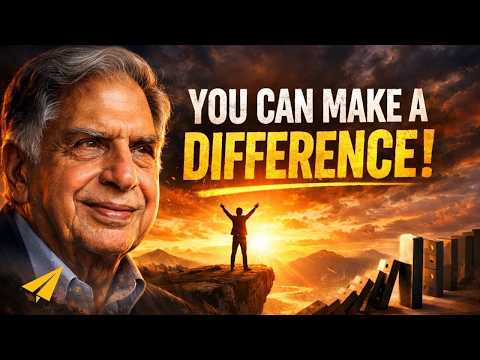
He was the chairman of the Tata Group,
a Mumbai-based company, from 1991 to 2012.
The current revenues of the Tata Companies
taken together are over $100 billion annually.
He’s Ratan Tata, and here are his top 10 rules for success.
– Far more is gained by walking on the shop floor
and talking to the people and trying to communicate.
One of my weaknesses has been, I think,
I have never communicated enough or adequately
with our people.
Partly because I am a shy person,
and, secondly, because I didn’t realize
the importance of communication.
But I think communication with the employees is
an exceedingly important function that any company chairman
has to do and be visible in that sense.
The great successes, the large companies of this world,
and there are many, and many successful companies.
Or are they the companies that took chances,
where individual started in garages,
where ideas were born.
Where did Microsoft, where did Apple, where did Amazon,
where did Google, where did Facebook come from?
They came from ideas that people felt something
could be done, and that they could make a difference.
I probably would not have returned to India,
except my grandmother fell ill.
So I came back because she was ill.
Had I stayed in the United States,
my life probably would have been very different.
I was very happy there and very comfortable.
I had a very satisfying job and when I came back here,
I mentioned the first eight years were frustration.
My masters thought that the best way
to teach me how to operate,
when I don’t think anyone at that time
had thought that I would be Mr. J.R.D. Tata’s successor.
So, I was one the shop floor, shoveling limestone,
working the furnaces,
and I kept asking myself, “Why am I doing this?”
And so, perhaps, looking back, the most significant incident
in my life was just my obstinacy
to remain here, rather than to go back.
My view is that trust is an underlying foundation
for the way people look at you,
people look at your business,
people look at the way you operate your business.
Trust is the basis on which you live
by your contractual obligations,
and I think trust is more important than anything else.
Your psychological bond with your customer and your worker
and your stake holders in general.
I think without that, you run the risk of being
a superficial business entrepreneur, based on criteria,
which are not, in fact, truly fundamental
to the manner in which you do business.
– Because, globally, Indians,
whether they are government or businessmen,
don’t quite have the reputation
of being the most ethical, fairly or unfairly.
– I don’t know whether one can generalize.
But I would just say that if you don’t have
trust in your partner, in your worker, in your management,
and vice versa, if there’s no trust in the person
at the top, either, for what he or she stands for
or what their value system is,
then you have a business
that supports that level of trust or lack of trust
and that goes all the way to the consumer.
He doesn’t trust you for what you provide him,
he doesn’t believe in you claims and you have,
in fact, a poorer form of business.
And, yet, ethics and values becomes a very major part of it.
If you think you cannot make a difference,
I say you very well can make a difference, if you so desire.
That you are humble as you look forward.
If you speak or sit next to a Nobel laureate,
he never tells you that he won a Nobel prize.
Other people tell you.
So, let humility be your best.
I do know one hero I’ve always had that
who no longer lives has been John Kennedy.
– Oh, yes.
– Of course, I was very much in the US at that time.
That person stands out still as very much my hero
at that time and continues to get me emotionally nostalgic
about the days that I was there.
– [Interviewer] That’s true.
– I mentioned when you took over
that many external observers there
thought you had large shoes to fill
in taking over from your uncle.
Now, with another transition of power, Cyrus Pallonji Mistry
has his own large shoes to fill, that of yourself.
I wonder what advice you would give Cyrus
as he takes on this task as chairman.
– I’ve told Cyrus that he needs to be his own person,
that finally it was something I did.
I realized the shoes that I had to fill were far
too big for me to mimic the person I was following,
and I just decided to be myself
and do what I thought was right would be the way to go.
I’ve told Cyrus the same thing.
I think he should feel that he is being his own person
and let his personality and his conscience,
if you might, drive him.
And you shouldn’t really consider yourself successful
based on the prosperity you’re getting for yourself.
But you should go home at night feeling satisfied,
if you have made a difference.
That difference is something each one of use can make,
that we’ll have failures and we’ve had frustrations,
but it’s a continued commitment
that we have to the world around us.
My own personal feeling is that it is not a trick,
provided it is looked as a driver for competition
and a driver for innovation
on the part of an Indian company.
I’ll take the automobile industry as an example.
Despite the fact that we produce
about two million cars a year,
there are only two manufacturers of Indian cars.
It’s Mahindra and Tatas.
Every other international manufacturer
is here in one form or another.
Yes, there are disadvantages because scale, et cetera,
is far bigger in the foreign manufacturers.
But if you look before that, the fifty years of automobiles,
we had two manufacturers who never increased
their production for more than 50,000 cars.
Who never changed their model,
who never innovated, who never gave the market
anything other than what they produced,
and the market just bought what they,
you waited seven years for a car, 10 years for a car.
So, if you look at the two examples,
has India benefited?
I would say yes.
Do the two Indian manufacturers gain
anything from this open market?
Yes, because we are driven to compete with those people.
And the day we look at that they’re meant to drive us out,
I think we, as a nation, would lose out.
All of you are being trained be innovative
and hopefully out-do their (mumbles) when they come here.
It’s our job as employers to encourage you to do that,
to encourage you to break new ground,
to think out of the box.
And it’s for you to do it and for us to support it.
So, I don’t think we should look
at them and see as a threat.
I think we should look at them
as a motivator to be more competitive and beat them.
The greatest pleasure I’ve had is trying to do something
that everybody says could not be done.
I’ll just share, perhaps,
a moment in time which I will always cherish.
I decided that India could produce its own car.
Everybody, my friends overseas in the automobile business,
said that this couldn’t be done,
we had to go through a collaboration
to get know-how, get technology.
But we undertook to produce this car.
You saw images of it in the video,
it was called the Indica.
And we produced it in India, totally off Indian content.
As we got close to putting it in the market,
my friends in India somewhat distanced themselves from me.
Otherwise known as distancing
yourself from failure. (audience laughs)
And when the car came out,
I suddenly felt that I didn’t have a friend in the world,
and that all the warnings that people
had given me were probably going to come true.
But the car did come out.
It did earn a 20% market share
and we showed that we could do something.
Throughout the time I’ve been involved in business,
there hasn’t been anything that has equaled the excitement,
the reward, and the exhilaration
that the car industry has provided, and can provide.
– Thank you so much for watching.
I made this video because HiLo asked me to,
so if there is a famous entrepreneur
that you want me to profile next,
leave it in the comments below, and I’ll see what I can do.
I’d also love to know which of the top 10 rules
had the biggest impact on you.
Leave it in the comments, I will join in the discussion.
Thank you so much for watching, continue to believe,
and I’ll see you soon.
”
Be First to Comment