
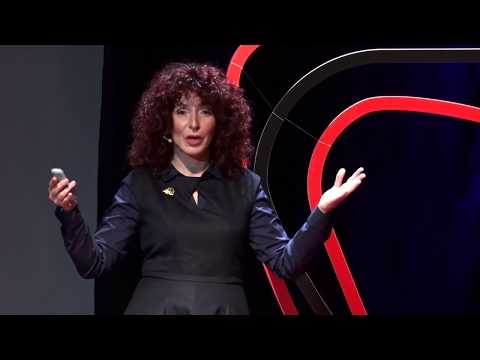
Thank you for warm welcome and I am honored
to be with you today with a subject
perhaps not the most agreeable and the most popular.
Why learn math?
This question we hear today, not only from students, but also from parents
or civil society.
Why learn numeric computing when we can open the phone at any time
and can we always make a calculation?
Why learn formulas in the iCloud of any smartphone
can we store thousands of formulas?
In my opinion, all these voices, and you, are right.
The problem is not mathematics.
The problem is how we learn math.
And this is the idea I want to talk to you today.
Because math is more than a series of abilities.
It is the way we think,
the way we think, and sometimes the one we are in.
However, why learn math and what does it have to do with our real life?
Money, love, job … What brings us happiness?
Whatever the question, the answer lies in solving the problem.
And life is a continual problem solving.
How do we solve a life problem?
Five steps.
We identify the problem, analyze input data,
think and search for potential solutions, select the best solution,
and implement it.
Mathematics, through its specificity, teaches us with the ability
to solve thousands of problems.
How do we solve a math problem? Five steps.
We read the problem, we understand the assumptions and conclusions,
we seek ideas, select the best idea,
we build the solution and check it out.
Mathematics also gets us accustomed to a series of skills
which we now need in real life, the skills we need
on the labor market,
for example basic, operational, numerical, statistical skills,
probabilistic, geometric, trigonometric, algebraic …
However, mathematics is more than a series of skills,
because she, after all, the math that interests us all,
refers to how we think about how we react.
And not often, math is the way we become.
And the most important acquisition of mathematical learning,
are thinking, not calculus, reasoning, and not memorizing,
creativity, not repetition.
“Learn the right thinking and the skills will come from it!”
says Professor Keith Devlin of Stanford University.
If we were to teach mathematics for the 21st century,
for its applicability and utility in the economic, human or scientific sphere,
we should start with some major changes in the way math
is being taught today in classrooms.
First, minimize the time and energy resources allocated to learning
numerical calculations and memorization.
We are talking today about the fourth industrial revolution …
We are talking today about taking jobs by robots …
And we are still wasting years of education in a child
teaching him to calculate as humanity calculated hundreds of years ago.
Today, a simple smartphone can perform any calculation,
huge amounts of information are stored in the virtual space,
and the intelligence of mankind is a few clicks away from us.
We live in a society that excels by providing services.
And we still teach the children to compute, as humanity calculates
before the invention of computers.
Why not pass the student exams with tables and spreadsheets on the table
and instead of being interested in their computing skills,
to give us more insight into their ability to think, to solve problems.
The school would thus become a laboratory of innovation and creation,
an area of ideas where students, using mathematical knowledge,
could solve problems related to real life,
problems related to the future of humanity, even problems related to the future job.
Because today math is no longer a science in itself.
Today, mathematics is the way in which the other sciences complete themselves.
Second, to learn more math for thinking,
reasoning and creativity.
Why?
Calculate, memorize, and repeat the same iterative steps
has already been taken over by technology.
But thinking, reasoning, creativity,
still belong exclusively to the human mind.
Research, association, simplification, determination of the logical path,
consideration of alternatives, verification,
are acts and processes specific to mathematical thinking
and inherent in any act or process that involves thinking or deciding.
Imagine, instead of endlessly calculating students,
for a week of countless areas of lateral areas,
prisms and pyramids …
Why not challenge them to create, for example,
the layout of a more spacious home, say a piece of cardboard,
of predetermined dimensions.
Thus, students, using the knowledge of prisms, pyramids and bodies,
could think, compute, imagine, create a project
and justify it.
How would we use more thinking, reasoning and creativity,
not in formal and abstract contexts, as we have been accustomed to now,
but more in contexts related to life, in contexts related to the future job.
How about learning mathematics, the one that teaches us to think,
than what teaches us more to compute and practice?
Thirdly, we should come to the students,
not just with the classic results of traditional mathematics,
with the theorems and definitions and everything we learn for years.
We should also come up with the spectacular results of applied mathematics,
in DNA replication, in the treatment of cancer,
or concepts that work behind the business
and capital markets.
How our pupils are attracted to math
when they are set to solve a series of uninteresting problems.
And you certainly remember all of us,
of those problems in primary classes, for example,
when we were asked to determine the number of beacons and quadrupeds in a building,
from a courtyard where I do not know how many heads and I do not know how many feet.
Who would be interested in such a challenge in the 21st century?
Imagine, however, how to organize from time to time,
to form teams of students imagined by NASA,
to propose to save mankind
from a catastrophe caused by a huge solar explosion,
which could lead to the fall of energy and the loss of telecommunications.
Like being with our students
to develop a mathematical model of the problem
and using the knowledge of geometry and trigonometry,
to determine the time required for the solar explosion to reach Earth,
so that mankind can take all precautions,
to avoid a catastrophe.
Imagine, my students have also benefited from programs,
in the Space Invaders program I created
at the Traian National College.
And what I can tell you for sure is that many of them
began to become more interested in mathematics,
and a good part of them even love math.
The third intervention in mathematics of the 21st century,
would be the interdisciplinary, creative and collaborative approach.
Otherwise, we could remain forever in the eternal paradox of today’s education.
Let’s form students skills of the 21st century,
teaching them in the nineteenth century.
In addition to the basic skills that maths form,
in life we need a series of personal abilities,
skills difficult to quantify and which mathematics, we can say,
map them, at least some of them, behind the scenes.
Critical Thinking, Prospective Thinking, Decision-Making, Analytical Thinking.
But I’m going to stop at an ability in appearance
unspecified mathematicians, communication.
In a sense, communication involves operations such as explaining, justifying,
argument.
Mathematical thinking specific operations.
In contemporary society, we speak of effective communication,
as long as we have an idea, a logic and a message.
And in this paradigm we can even speak of a mathematics of communication.
How did math appear?
From the need to solve the problems of life,
following a long process of coding and abstraction.
The problems of life have been translated into mathematics.
Conversely: decoding the mathematical results
and their transposition into real life, has been a few times
the path through which mankind has progressed.
Today, the chances of a love story, the hormonal level in the body,
stopping epidemics, curing cancer,
exploring space …
There are topics that are mathematically treated.
Translating real life into mathematics and translating mathematics into real life
is reason
for which we must learn mathematics in the 21st century.
Why love math?
Because beyond exercises, calculations, memories,
beyond the abilities that mathematics creates and helps us alive,
mathematics is ultimately, and the math we all need,
is the way we think and that is why we become the way we react.
And often, math becomes the way we are.
And if you still choose not to love math,
at least you learn to count your money with love.
And remember that math is not just solving problems.
Mathematics is also the decrease in sadness.
Mathematics is also the division of annoyance.
Mathematics is also the gathering of happiness.
Mathematics is also the multiplication of love and forgiveness.
Thank you!
(Applause)
”
Be First to Comment