
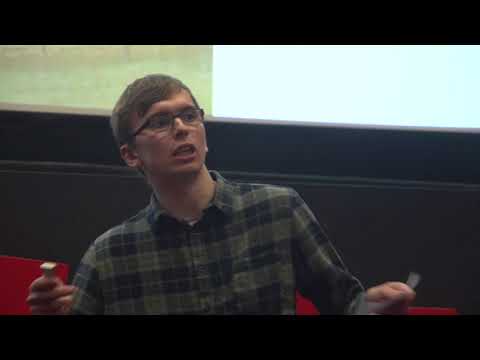
So I was about 13 when I experienced a shock.
It was something which, at the time, felt completely surprising,
and something that took quite a while to deal with.
It was an audiology appointment.
I was sat down with an audiologist,
and they told me that I may benefit from having hearing aids.
Now, I already have a couple things on my face to worry about:
glasses, and a couple of spots here and there,
so being told that I had to try out this new equipment did scare me.
Now, why is that? Well it’s because up until that point, my label of deafness
was something I could disclose to people as and when I wanted to.
Some people I would happily tell them, some I might keep quiet.
So, naturally, when I had to wear these hearing aids and put these on my face,
it was quite a concerning thought –
I even got curly hair in my attempt to conceal them.
(Laughter)
I can’t smile in photos.
(Laughter)
So, I actually did that, and what I realised is that hindsight and the fact
that this haircut was such a difficult task to maintain, I realised that
not only should I accept my labels, but I should also challenge them,
and it’s that balance which I want to talk to you about today.
Because we all have different labels, don’t we?
White, black, gay, straight, disabled … The list goes on.
What’s important is we’re told that we shouldn’t let these labels define us,
there shouldn’t be one thing that puts us in a certain box in society and limits us,
and we should live without restrictions, but that’s not entirely possible.
It’s more important that with these labels, we are introduced into wider
subcultures and communities, as it were.
and it’s about surrounding ourselves with others, because when we do,
we learn more about ourselves.
We learn more about each other, and more about the world we live in.
So in my case, I naturally wanted to find young people to talk to myself.
It took a while.
In my area, there wasn’t that many people I could talk to about this.
The number of deaf young people in Bedfordshire is limited.
So I found an opportunity with a charity,
the National Deaf Children’s Society,
and they have a Youth Advisory Board, which was about 17 deaf young people,
18 including myself,
and it was with them that I learnt more about my disability.
I was in a group for four residentials and that brought me out of my shell,
because I realised that in order to help the charity with its aims,
I had to open up to MPs, politicians, commissioners and tell them about
struggles that affected deaf young people in their everyday lives.
It made me realise that I learnt more about my deafness through these methods –
through surrounding myself with others,
than through any other YouTube video or blog article.
I learnt sign language, I went to party conferences, I did so much stuff
that brought me out of this shell
and took me away from this world of anxiety.
I also realised as well that there’s groups of people.
We achieve change so much with groups of people, don’t we?
It’s when we’re with others that we learn more about ourselves,
but also it’s through the power of collective action
that we bring about change and in terms of our labels,
that’s how we can change things.
We can work together as a group to make sure the labels such as deaf,
disabled, white, black, they truly represent us as a group of people.
It’s about using our collective action to change labels and change a narrative.
So, in terms of my labels, then.
Now, as you’ve probably heard,
I’m more than happy to tell people that I’m deaf or hard of hearing.
Sometimes, I change between the two,
because hard of hearing sometimes leads people to imagine
that it’s like a lighter level of hearing commonly associated with older people.
Meanwhile, if I was to use something along the lines of deaf,
instead of hard of hearing, people might assume I’m profoundly deaf,
when actually there’s different levels of deafness:
mild, moderate, severe, and profound.
So, with that in mind, I kind of use those two interchangeably,
but one that I’m reluctant to use, and I don’t use as much
is the label of disabled.
That’s because I don’t see my deafness as a disability,
I see it as things that allow me to achieve anything that I want to.
But, with that in mind, there have been times where I have used these.
Sometimes – and I say sometimes,
it’s important that we can use our disabilities as a ‘card’, as it were.
I realise that me telling you this doesn’t really help in terms
of certain opportunities down the line, saying that I can use this,
but for the sake of this talk, I sometimes use them.
But it’s important to remember, when using these cards – ‘the
race card’ or stuff like that, whatever you call it – that that’s
just a single foot in the door.
That is the one step that can get you into these opportunities.
After all, I apply for these schemes aimed at marginalised groups, disabled people
and stuff like that because they think they’ll have as much of a voice or as much
of a say as those in the
majority. But with these sort of schemes – and I’ve come to realise
– that as much as it’s important that you go for them as well, you need to make sure
that you tell them it’s not just about that.
It’s not just about the thing that’s down on a piece of paper, and
that’s why I’ve been reluctant to tick the word ‘disabled’ on a job
application because what you see on paper is more than what you are as a person.
So, I was reluctant to do that.
I make sure when I go into these areas on work experience
I’m happy to tell them about my deafness and disability.
I’m happy to use it to educate, but it’s much more important
that you show the real you.
‘Cause this whole work experience. You hear it from careers
advisors and stuff like that,
it’s more important about the relationships,
and the people you meet on these work experiences.
It’s about making those contacts, and so for me, every opportunity I would make
new contacts, I would probably educate –
it’s fantastic to educate people about your disability and
deafness whatever your label may be, but it’s
more important you build relationships
and contacts, because in my case, those led to bigger and better things.
‘Cause after all, in my case, I am an obsessive opportunist.
I often take opportunities – like this one here –
and often use it to get to the next stage in the process.
In actual fact, I think I’ve probably used my deafness a little bit to get on this
stage, and I feel a little bit bad about that, but we’ll roll with it.
It’s important to remember
we hear things and I don’t need to stand here and say
it, that labels oppress us.
We all know that that can be the case, that they can marginalise us,
but I think that there are certain times when we can use the labels – the
identities that we’ve been given – to elevate ourselves,
to get us the position we want to be in, the dreams we want to achieve,
and follow career paths, whatever journey we want to take.
Those labels do have the power to do that.
I want to talk about the other side. I’ve talked about my side, the minority labels.
It’s important to note those in the majority have identities and labels
to deal with themselves.
You know, there’s the terms ‘white’, and other majority labels like that have that
issue where they have to deal with being in the majority.
It’s important to get that perspective, but remember that
they actually have a platform.
Whilst minority people, as I’ve said, have to work on using that plaform to get
them to a position where they can achieve change and educate the people they’re
with, the majority don’t have to worry, because they’ve large groups of people,
they don’t have to worry about achieving change because
the amount of people
they have, they’re not as small as small communities
and that change doesn’t need to be so important to them.
So what can they do about it, then? What can they do with that?
They need to use their platforms to give a voice to those that don’t have one.
It’s about using that platform for good, and I believe we can do that.
That’s the problem though. Sometimes we hear a lot about this,
where people with majority labels feel a bit guilty about being in that position.
I know a disability charity which talked about this sense of awkwardness
surrounding disability and how we interact,
and then of course, with the recent social/political issues,
the whole issue of what it is to be white or to be a man
has led to some people feeling guilt.
But it’s important to remember that we can change those labels as and when we can.
When we open ourselves to other cultures – that’s the important thing
– by doing that, we learn more about the world.
I think that’s how we tackle the issue of guilt.
If we’re in a majority position and feel anxious, it’s about going
out and meeting other people. Much like I said about giving minority people a voice,
it’s about going out and meeting them, expanding our minds
and learning what exactly their lives are about.
It’s about expanding our knowledge, and by doing that,
we can reach that level playing field where everyone is equal,
which is an ideal scenario, I can imagine, for us all.
And in my case, I set myself the unofficial challenge –
or target – to try and meet as many people from minority communities as possible.
I tried to meet as many people from the LGBTQ+ spectrum,
different people from Black and Minority Ethnic groups.
And what I found is I learned more about the LGBTQ+ community,
I knew which words that I could use that were acceptable, I learned more about
disability and knew certain words such as retard and spastic
are no longer acceptable.
I learned now that after I abandoned all my stereotypes and misconceptions,
it opened my mind, and I introduced myself to new communities I could understand
as well. And that’s incredibly important.
Of course, it’s all well and good to talk about the individual labels that we have
and the expectations that others put on to us, but it’s important about the
expectations that we bring on to others.
Because that’s the thing, isn’t it? We all have, in society at the moment,
this whole idea of we want to fit in with the trend.
You know, we want be the next great thing, we want to fit in in terms of uniformity.
But the problem is, if we then force people to live in a certain way,
we’re robbing them of opportunities they can use and achieve, we’re robbing them
of that position – of their identity.
And so, from then, people’s expectations and this desire to fit in,
it gets in the way and it leads to them becoming a person that they are not.
In my case, I said at the start, that I was a socially awkward teenager.
So I had to embrace the label: ‘socially awkward’,
or more specifically, ‘dyspraxia’ and the labels that came with that.
And that’s the thing, with every opportunity that I had in the past,
I often used school or university, every semester or every term,
to reset my identity.
I knew that every year, there were a whole new cohort of people that I can try
and present myself in a totally different way.
I could try and present myself as this ‘social, outgoing communicator that’s
great at talking to people’, when in actual fact, that backfired… massively.
(Laughter)
I tried so hard to be that kid we always see that’s in the library,
spends all his lunch breaks reading the Harry Potter novels,
reading all these books – just seen as someone that’s quite shy.
I tried my hardest to present myself as sociable, but I know that that led to me
just failing completely, becoming someone that was seen as a ‘try-hard’ or again,
someone that I wasn’t.
And that’s important. It’s not about fitting in.
It’s not about trying to become this person that everyone thinks we’re
supposed to be. It’s not about becoming this whole one,
archetypal human that’s supposed to be amazing at everything,
supposed to be these good communicators. No way is it about that.
It’s more about, as I said, using the platforms that we’re given
to change the identities that we have to something that we are happy with.
I felt uncomfortable being socially awkward, but it wasn’t right to
become this ‘great, social communicator’, the answer was trying to find a way that I
was comfortable with being socially awkward.
And in fact, like I said, this idea of TEDx,
this is probably why I’m on this stage.
But it’s important this is a platform.
I’m using this platform to educate you all about my disability, I hope.
So, that being said, I’ve gone from being a shy 13-year-old, as I said,
to sometimes using my labels to achieve these new opportunities.
And that’s the thing, it’s not enough to embrace these – that’s important,
it’s not enough to completely embrace our labels and be happy with it.
That is a good thing, we are happy to accept our identity,
but it’s more important we challenge the bits we don’t like.
It’s more important we find things together and use our collective action,
like I said, to challenge those things.
So that’s my story. You know, I’ve gone from being a shy person to someone that’s
standing at the front of the stage and talking about my journey.
But it’s important to remember that we all have our own stories.
We all have our own stories, but it’s important to remember,
who actually is in control of our stories?
Because I’m sure you’ll all agree, we have friends and family members in our lives
that can shape the way we live our lives.
We like to think we can choose our career path, we can choose the friends we make,
we can choose the people to surround ourselves with,
But the opportunities, and the career opportunities, the work experience,
whatever, they all come because they are offered to us by other people.
And that’s important to remember, that we then choose to accept that.
It’s almost like, if you want to think of it as a book, like we are the editors,
and everyone else are authors.
We can choose what we want, whenever we want, but the people that actually make
the story and rewrite it for us are the other people.
And this is an interesting thought when you consider the words, or quote,
from the motivational speaker, Jim Rohn.
He said that we are the product of the five people
that we surround ourselves with the most.
Now, I’d like you to think about that, and think about who your five people are in
your world or in your lives that have shaped you into the person you are today.
What are their contributions? Are they a positive one,
or are they something you may want to ask about and see what
contribution they are providing to your life?
And that’s the important thing: the reason why we’ve embraced them
is when you embrace it, you have the power to change our future.
When we choose what to accept and what to deny, we can construct ourselves a future
based on other people’s suggestions, but by editing it,
we take ownership of that.
That’s the thing: we’re all editors, as I keep saying.
So it’s time to take out our pens, question ourselves,
and question the identity we’ve been given.
Thanks very much for listening.
(Applause)
(Music)
”
Be First to Comment