
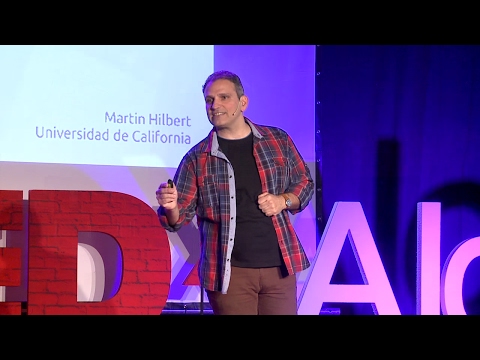
Hello.
I’ll talk about something you know very well:
the streets of our cities.
This is a space we use to move from one place to another,
but it is also a space where we meet, we talk,
that is: where we relate.
It’s interesting how there are many ways of relating,
not only: “Hi, how’s it going?”
And some forms are more complex than they seem.
So I suggest we walk the city with a different look.
and look for these other ways of relating
which are not so common.
Let’s start off down a street in the center of Madrid.
In it, you can see terraces, bars …
In recent times, tourism has grown
and prices also rose together.
But not everyone accepts this situation.
So up and to the left, you see a green poster.
Let’s get closer to see it better.
“God is a witness
that I will not pay three mangoes
for a drink. “
As you can see, someone who seems to like movies a lot,
and perhaps also of theater,
wanted to show us his complaint in this different and creative way.
This is a sample of what they call urban art,
or even subvertising.
You must remember to have seen something similar
in the streets of their cities,
even on few common stands.
For example, on a traffic sign.
This is a traffic sign on a street in Paris,
just before turning into this other traffic sign,
which may mean something like: “I am suffocated by prohibitions.”
But just as a sign can say something, it can also say exactly the opposite.
What would a sign say, “I love bans”?
So, for example?
I already see the slogan:
“Paris, the city of love forbidden”.
But what is interesting
is that this occurs much longer than it seems.
In fact, 10,000 entries were found
in a city like Pompeii.
In its streets, in the walls, in the walls …
The interesting thing is that there are from poetry, to jokes,
even insults with first and last names.
There is such a quantity of inscriptions,
that on the main wall of the basilica of Pompeii
there is an inscription that reads as follows:
“Oh, walls, you’ve endured so many stupid inscriptions,
which amazes me yet have not overthrown them. “
As you can see, there was irony back then.
And likewise
that these “graffiti” Romans,
let’s call them that,
are pieces of museums,
modern graffiti also became, little by little, in works of museums,
especially in contemporary museums.
Meanwhile, the works of the museums went out into the streets,
as in this case, to beautify the city walls,
or, as in this case, to protest,
for example,
against the treatment given to public education and culture.
But we must remember
that the most important space in the city
is advertising.
This is a commercial of the 1980s,
which is titled: “the perfect billboard”.
A collective of “subvertising” of the time,
as it clearly seemed to him to be a sexist and sexist campaign,
thought of a response to this ad, as you can see under the poster,
showing that the perfect billboard is blank, it does not exist.
Now imagine that we are walking on the street.
and we found a bus stop.
We see in it an ad that says: Knorr, the grandmother’s soup.
And we soon see some inscriptions that say:
“This is my grandmother’s soup”, “Grandmother, I love you”,
“See you Sunday to eat your broth.”
I guarantee that’s what they say, even if you can not read it.
But is this serious? It’s realy true?
Were the grandchildren here and wrote on the poster?
Of course, as we approach,
we realize that these subscriptions are part of the advertisement.
The truth is that Knorr does not have an army of grandmas
making broths in a traditional way inside a factory,
nor is advertising a type of dialogue.
In fact, advertising is a monologue.
But not everyone accepts this. Let me give you an example.
In San Francisco, there is a collective called BLF.
These are the initials, which would translate as:
Liberation Front of the Outdoors.
I’m serious, it’s a very pompous name.
This group has been carrying out actions like this for decades.
This is an announcement of a singer, whose name is Tank,
and which features his latest album.
Then the BLF appears,
this Front of Liberation of the Outdoors,
dressed as city clerks,
and surround the character with black ink.
Then they paint a balloon
with ink blackboard
and put beside boxes with chalk,
so that passersby can write
what Tank may be thinking.
Meanwhile, they are on the other side of the street taking photos.
And things like:
“Am I not handsome? What do you think?”
“I earn a lot and work little.”
“I want to work at the zoo watching penguins.”
There are from mathematical formulas to political slogans of all kinds.
Until the real city clerk comes
and end the exercise with this experience.
For a few minutes, or for a few hours,
this is an exercise where advertising becomes something more participatory.
It is also important to understand that advertising conveys models:
how we should dress, even how our body should be,
how we should achieve success, etc.
But it’s interesting as a little communicative action
can break with this great speech
and very fictional advertising.
I’ll give you a real example.
A small sticker in the city of Madrid placed in the right place,
to break away from this great speech with a single sticker.
What can a sticker say to achieve this?
For example:
“I poop too.”
(Laughs)
Yes, because, in the end,
the models and the models are people of flesh and blood,
and have their problems.
Maybe they need to pay the mortgage, even if it’s a bit higher.
Let’s look at another example of this type.
A beauty products chain tells us:
“Nobody has erotic dreams with someone nice.”
Want to see the answer?
“And superficial people die alone.
Signed: Someone nice. “
(Laughs)
(Applause)
You must agree that it is not something beautiful or artistic.
But these are things that need to be said.
And they need to be said on the street,
which is precisely the space where these things have to be said.
But what is happening is the other way around.
All this is in danger of extinction.
You know very well that what is happening today in communication
are the social networks, the internet, the cell phone.
Although we only looked down.
We do not look up to see the faces.
Look at this data.
In the year 2000, 75% of the information is analog, that is, it is not digital.
Just 7 years later, only 7% of the information is analog.
Only seven years.
So what’s happening is this:
every two days, so much digital information is produced
like all the conversations that have occurred in history.
It’s incredible, is not it?
Then we ask ourselves:
and the conversations?
Have not we talked?
Have not we used the street to talk anymore?
The street, which was such an important space to talk to,
is not good for that anymore?
If we look at the streets, we will understand soon.
They are clearly targeted locations for cars to pass through,
or for people to pass at full speed,
because we are always in a hurry,
We’re always running.
So we do not have more time to relate.
But it’s not all that. There are also some positive data.
There are people who claim the street as a place of coexistence,
a space to share and also to communicate.
They leave their messages on the street, waiting for someone to find them,
like messages inside bottles that they threw to the sea,
hoping someone could read them.
I will conclude with this last example.
You know that ten years ago the economic crisis set in.
Many jobs have been lost,
many people have experienced difficulties,
and, in fact, still pass.
And someone was able to capture all of this
and express it in a very sensitive way,
in a way that everyone would agree.
At the entrance of a bank branch,
someone put some footprints of shoes coming in,
and others with bare feet coming out.
You can not say more with less.
Urban art, or “subvertising”, sometimes hits, sometimes not.
But it is clear that it is the response of the street,
and she is in danger.
So I say goodbye with sincere advice:
that we speak and, above all, that we talk a lot on the street.
Thank you very much.
(Applause)
”
Be First to Comment