
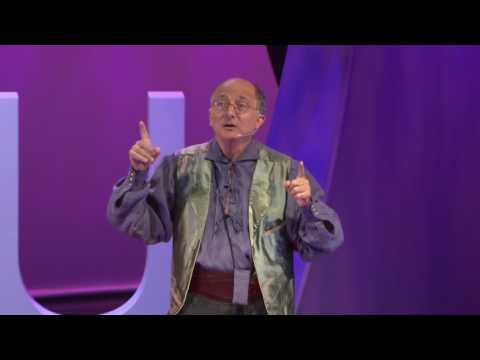
Have you stopped to think
what kind of relation we have with objects?
We deal with them all the time:
a loaf of bread,
a red carpet,
a violin,
a car,
a hammer.
But aren’t we always trying to impose upon them our own desires,
so they behave just the way we want?
My job as a puppeteer is to animate objects,
which means to impart “anima” or “life” into them.
I would like to show you
that a more sensitive behavior with objects
can change the way we relate to the material world,
and also among ourselves.
There is a quote by Albert Einstein that inspires me,
“You cannot love a car the way you love a horse.
The horse brings out human feelings the way machines cannot do”.
Interestingly,
marionettes happen to be in the threshold between the horse and the machine.
On one hand, we have a way to relate to them with affection:
we call them by name, recognize their faces,
and, when animated, they express emotions.
On the other hand, they have machinery,
sometimes complex, in their making and their crafting,
that produce their tricks, like for example a trapeze artist.
But how is it to lead a marionette?
Does it simply obey my orders?
There is a tendency in us to be just manipulators.
The word “manipulator” comes from “manus”, meaning “hand.”
We control it with our hands.
There is also a negative meaning in manipulation.
If you feel someone is trying to manipulate you,
you don’t like it.
You don’t like to be pushed,
you don’t like to lose control.
For marionettes, though,
in order to find their graceful movement,
a pushy attitude never works.
To animate a marionette, we pull strings.
I’ve been researching how to transpose this experience to people
so they could feel it.
I would like to invite
someone that is willing to experience
pulling and being pulled.
Oh…
Hello!
(Chuckling)
So, we can pull…
You can pull, I can pull…
We can listen to each other…
and let’s see what happens.
(Sounds of ropes and steps onstage)
We can be gentle…
We can feel light, light as a marionette.
(Chuckling)
Yeah!
Get into the mood, not thinking…
just enjoying being pulled.
We can go down, up –
Marionettes can fly, but we can’t.
(Laughter)
Thank you very much.
(Applause)
Thank you.
(Applause)
These are the “intercessor-ropes.”
So, to animate a marionette, we pull strings.
No pushing!
If you stop and think,
we push pedals, we push keys on our cellular phones,
we even push our feet heavily down,
instead of walking lightly as a marionette.
Pushing is a habit in our daily life.
The philosopher Soren Kierkegaard once said:
“The door to happiness opens to the outside”.
The more you push, the more it gets stuck.
So, why are we pushing everything all the time?
Perhaps because we live increasingly in a machine world.
Machines have buttons, triggers, pedals, screens
that, whenever pushed, behave in a very programed way.
It is hard to believe, but some kids nowadays
are finding all those programed gadgets boring.
They are looking for something else, something outside of that box.
I had an experience the other day.
A mother came up [to me] after a show
and told that she was impressed by her kid.
She tried to ask him something during the show,
and he quietly answered:
“Silence Mom! He is performing!
It’s happening right now!”
The connection between the puppet and me
made it possible for the kid to forget the strings
and enter into the present moment.
That is where life exists.
I am always a bit afraid when I perform with marionettes
because they have their own substance in movement,
and I have to listen carefully through the strings,
otherwise they may get tangled.
Sandra…
Oh, Sandra!
(Sound of the puppet walking)
Let’s fly!
(Music)
(Music ends)
(Applause) (Cheers)
You did very well, Sandra! Look at them!
Come on.
Some physicists in the room must have noticed
that Sandra has a natural frequency.
I chose a song that would fit with that rhythm
and, from there, create variety and, ultimately, life.
I have to confess something to you.
There is a division in me between my calculative heart…
no, no, no, no…
calculative brain and sensitive heart.
When I had to choose a career,
I wanted something more manipulating and controlling.
I chose physics.
I loved the equations,
thinking about the interactions between the matter and the material forces,
the natural forces…
the pulling force of gravity.
“Oh, that is also pulling! Eureka!”
But modern physics taught me
that I had to change my rigid frame of mind.
I could not just observe and make predictions
because the very action of observing
would interact with the object,
affecting it.
This new knowledge changed, deep within me,
the way I understood and related to the world.
In my recent research,
I developed some manipulated objects that function as instruments
for interaction and observation of our own persona.
I would like to invite someone now
that is willing to observe and interact
with his own mask.
Oh, yes, please.
(Applause)
Thank you very much.
Please sit.
We can see each other here.
And you can see yourself as a third person would see you.
Two mirrors make it possible.
Thank you.
(Laughter)
(Applause)
These were the “intercessor-mirrors.”
A few months after my graduation…
declining a master’s scholarship,
I boarded a small sailing boat departing from Rio to Lisbon,
with the objective of observing and interacting with the world
in a seven-year journey around the earth by land and sea.
To make my living, I worked as a baker,
baking buns.
We work the dough,
push it,
pull it,
beat it,
then let it grow.
It grows, it’s alive!!
Then we [bake] it.
They become delicious edible objects.
We can smell them,
taste them.
We can share them.
In Paris, I got a job in a circus.
The job was quite stressful,
so I would come back home by metro every night, tired and lonely.
One day, a musician came in the train.
He played a song that changed my mood completely.
After three months working with horses, elephants and bossy clowns backstage,
I had one day off.
So, gathering all my courage,
I picked up my violin,
entered a wagon and played…
It worked!
I could fill other people’s hearts with my music, and make a living!
Here, the object “violin” was singing,
was expressing melody and harmony.
Interestingly,
that is another kind of animation,
and my violin was alive again.
A few years later, in Tokyo,
I started building marionettes
to join the music performances.
That’s when I found out
that people loved to see animated objects coming to life.
I went deeper and invented a machine that behaved like a marionette:
The Marionette Machine,
a contraption with many pedals,
connected to levers,
that could transform rough pushing into gentle pulls,
so that I could animate the marionettes while playing the violin.
(Speaker hums)
(Cowbells and cymbals crash)
My teacher and great string puppeteer, Phillip Huber, says:
“String puppeteering is a surviving art form,
struggling against great odds.”
That makes me think, makes me wonder:
what is really struggling to survive in our society?
Is it the value of the craft and manipulation of a marionette
that is struggling?
We don’t make things by hand anymore.
Is it the playful relationship between people and animated objects
that is struggling?
Life has become so serious.
The idea that I’d like to share with you is this:
Let’s listen to the marionette,
let’s listen to the reaction of all those objects that we touch every day,
listen to our feet when we walk,
or even our hands when we meet someone.
It will show us the right strings to pull to open the door.
And let’s not be afraid to bring from deep within
that quiet little child that wants to play with real objects,
in real time.
(Sounds from the contraption)
(Balloon bursts)
(Laughter)
It is happening right now!
(Applause)
(Cheers)
Thank you!
(Applause)
”
Be First to Comment