
Hi people. It’s OK?
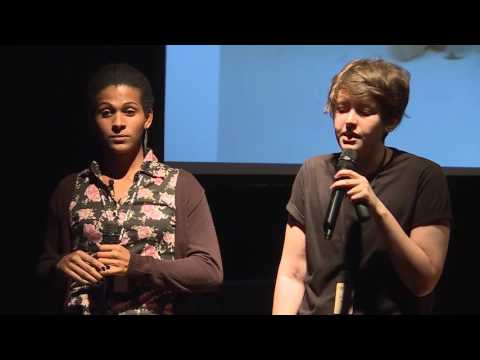
My name is Cali, I am editor and film director.
and I’m graduating from the Federal University of Rio de Janeiro,
in the School of Communication,
and I am a trans person, not binary.
We’re going to talk about issues of gender and sexuality.
It’s a very new topic and very controversial.
So everything I talk about here is very fluid,
and these definitions vary greatly,
depending on who you’re talking to.
I will speak based on my experience while within activism,
and within the academic theory with which I have some contact.
First, I’m going to talk about four aspects that people often confuse a lot,
and they are independent.
The first of these is gender identity.
Gender identity is how the person identifies himself:
if she is a man, if she is a woman, if she is a non-binary person –
within the non-binary, has several genres –
the sexual and romantic attraction,
which is by what genres people identify …
no, if they do not identify, by what genres people attract
and with which they relate.
There are also people who will not be attracted by any genre.
It’s the Asexual people.
Gender expression is how the person behaves,
the pronouns she prefers and the aesthetics she has.
And the genital is if the person has the ovarian reproductive system,
the testicular reproductive system, if the person is intersex.
Within these four aspects,
we live in a society that is straight and cis compulsory.
Cisgens are people who are not trans.
So it is a society
in which people are automatically cis and hetero.
People who are born with penises are automatically men,
people who are born with vulva are automatically women
and within that, men will like women
and women will like men.
But we know that despite this norm
and despite this attempt by society
of encompassing people within that binary,
we have people of the most diverse possible.
We will have bearded women, we will have men with vaginas,
we will have androgynous people, non-binary people,
men women who like men …
And that’s not the problem.
It’s not the problem that people are different.
The problem is this society
which encompasses people within these two places.
Even people who are not trans
and even people who behave within that binary
suffer from discomfort.
That’s where I showed, that binary, I think it’s more for that
than for something so regimented.
You may realize that, so far, I have not talked about surgeries,
and people harness trans people to surgeries,
What is not true.
There are trans people who will not want to hormone
and will not want to do surgeries,
and there are people, almost the vast majority of people do surgery surgeries,
be aesthetic, or for any reason.
Women cisgen, that is, they are not trans, put silicone,
men take their breast because it begins to grow,
do hormone replacement, and that’s not a problem.
The problem is trans people who decide to have surgery
pathological.
The problem is that trans people have to have reports to do these surgeries
and have to go through processes that are often stressful,
processes that are marginalized.
All this binarism that I have explained causes problems for deviants.
These problems
are from abuse, bullying, to death.
Trans and transvestite women have a life expectancy of 35 years in Brazil.
We are afraid to go to bathrooms.
and we suffer daily aggressions.
Last year, I won the RioFilme edict,
in a film that was contemplated,
and I made a point of calling trans people to work.
It was a movie about a transgender cartoonist.
Inside the set crew, all people were trans or cis women,
who are people who have difficulty entering the job market.
In this, the university has a role that is fundamental:
bring trans people into it.
And Dani will talk more about it.
To complement a little everything that Cali has exhibited here,
I wanted to discuss, in general, but punctual,
the importance of representativeness.
Our society, the way it is constituted,
our contemporary, capitalist society,
decides and determines who the “other” is.
This begins in the formation of our society,
in the beginnings of the formation of society, which exploits the capital of another,
and begins with identification of the female body
like that which is the pattern, the parameter of the other, of alterity.
From a little of that, if we think a little about the history of otherness,
of objectification, of silencing and oppression of the other,
it is from this movement of identification
of the feminine body and the feminine identity as “the other”,
as negative otherness,
that we can recover the movement of general oppression.
So our society walks a little bit from this,
the capitalist society,
which does not dispense with the need to exploit the other,
of placing the other in the place of exploitation,
will use this negative alterity to be effective and to constitute.
Of course, with the organic and living movement of society,
nothing is free and there is a lot of resistance.
The resistance movements throughout history are too much,
are enormous and sometimes very vigorous.
In a complex society like ours,
which has the vigor of a liberalism, at least a theoretical liberalism,
we live the contradiction of fascism.
When our liberal convictions do not lead
to empower the oppressed and marginalized segments,
fascism, with its phantasmagoria,
with the idea that the other must be repressed, that the other is wrong,
with its prejudices and stereotypes, arises to prevent these advances.
So we realize that the backward movements,
the containment of the advances of marginalized segments,
is always linked to a reaffirmation of a stereotype one wants to deny.
So when we, trans people,
we began to occupy certain positions in society, certain spaces,
immediately all those stereotypes are triggered,
or to silence us and to file us down
of the right of our full and effective citizenship.
So that’s why it’s so important that we vocalize what we are
and that we occupy space in our society,
that we actually reverse
and, in a way, we can occupy
a space that is taken away from us, which is denied us.
It was very important, for some time,
that transsexual men and women occupied spaces and positions
very connected to the maintenance of a feminine or masculine pattern,
and today it’s not like that anymore.
We need to move forward,
and we need to [deconstruct], restructure that representation.
What is the university’s role in all this?
The university is a great producer of knowledge
and it is in the university that they test themselves and that, in a certain way,
knowledge, which are “part pri”,
from which we will restore the foundations of our society.
And the university has a duty to
and to overthrow oppressive standards.
So it is important that the university embraces the LGBT segment in general,
the trans people.
And, more than today, the university, in recent years,
the original design of the university, which was an emancipatory project,
was a project of constant rearticulation of knowledge
and constant testing of the standards and parameters of truth,
This has been lost throughout history.
Today, the university, for some time,
with an immediate domination of nature,
of instrumentalization of knowledge,
is basically a trainer of technicians,
and we lose a little the critical horizon of the university,
the contestatory horizon,
which should be the cornerstone of what is produced here.
So it’s no use saying
that Cali as a producer or I as a teacher,
graduated from university,
fulfill or fulfill the role of inclusion
which society should fulfill in relation to the transsexual segment.
It’s up to the university …
and is a challenge not only for the transsexual segment,
for the ranks of the transsexual segments,
but in relation to all the oppressed segments of our society …
It is up to the university to
to displace, to upset the standards from what society frames
and the form and the stereotypes like the society,
which is the place, the “locus”, where the university is,
sees these marginalized and oppressed segments.
throughout history. As?
I want UFRJ, for example, to launch a permanent forum
of discussion and promotion of equity of the trans population.
I want to go to university … today I’m a teacher at the UFRJ’s CAp.
I want to get in there and I want to not be “passable”
from the point of view of being equal to all those teachers who are there.
Do you know why?
Because, to get there, I had to mutilate myself so much,
I had to leave so many things in this way …
When you are an oppressed and marginalized segment,
we lose so much and we give so much,
which does not satisfy us to reach a space called “privileged”
without that space being, in a way,
transformed, upset, reorganized by our experience.
I want to be there, and I think Cali too,
and all of us transsexuals, that’s the challenge …
and, to a greater extent, all oppressed and marginalized segments,
we want to be there because we mark that space with our identity,
with the affirmation of our identity, with the affirmation of what constitutes us.
So I do not want to be a little teacher anymore.
that arrives there and gives the content like all the other
and that, perhaps, much later, or by some sign,
a student realize that I am a transsexual woman.
I want to be there as a transsexual woman
and I want it to be taken over by university space.
So, I think the university that I want
it is the university that no longer obliges all those who bear the difference …
and the difference built for oppression …
I do not want a university anymore that makes us uneasy about this difference
and bring us closer to a pattern.
I want a university, a UFRJ, that can take us
to a place of constant challenge
and a place of constant deformulation of the patterns,
that will always deconstitute everything that oppresses us
and that constrains us to the unique formatting.
And there, the challenge is this, a university that launches and thinks:
“How am I not going to force the suburban transvestite …”
I always say, “I’m a suburban transvestite, I never stopped being.”
It’s not because I’m a doctoral student in literature.
that I stopped being a suburban transvestite,
but everything I had to leave my experience as a suburban travesti behind
to occupy a space “licensed” by society,
a space, in a way, of empowerment …
or even empowerment, but a sanction of citizenship …
All I had to leave behind is expensive.
At first, I thought wonderful: “Oh, I left those marks.”
We will never leave, and it is not good that we should leave.
I am a black and suburban transsexual woman,
and I do not want this to be behind, that the past experiences I’ve had
and who constitute me before I enter university
be left behind so that I can occupy certain spaces.
It is these experiences and these brands, as black and poor transsexual women
that I will take to the institutional spaces
and it is the assumption of my identity full of, finally, routes
which will transform that institutional space,
and I think the university needs to promote these tensions,
with permanent discussion forums on gender,
of sexual orientation.
For example, I come from the Faculty of Letters.
In Letras, this is problematic,
but much less than in other spaces of the university,
and I want, in spaces where this is not even thought,
even daily, even problematized,
that the university promote, in these spaces, these debates,
that transgender teachers, transgender students, to those places
and there constitute a permanent forum for discussion,
constitutes this problematization,
that creates research nuclei
which are committed to the emancipation of this segment,
and make this journey
so that the university is no longer the place of repression.
It is not good to be the transgenders who have managed to enter society,
which was not substantially modified.
It is good that we are, with all the marks that constitute us,
that we arrived in a place because this place was essentially transformed,
and this is the challenge of UFRJ that we want.
It is.
(Applause) (Live)
”
Be First to Comment