
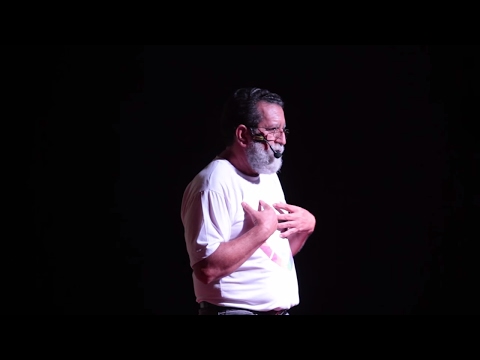
Goodnight to everyone.
(Plateia) Good evening.
I come from a traditional family, raised in the …
I’m a peasant, or at least I was until I was 12 years old …
where, when I cried,
I listened:
“Man, do not cry!”
If I wanted to play with my sister’s doll:
“This is bullshit, fagot thing!”
It was in a family set up to say that I was born.
And I lived a good part of my childhood,
because, on the ground, children are freer,
and I, with all the freedom of the country,
ran in the midst of the pastures, under rain,
like a new filly when it rains.
Whoever lives in the country knows this.
When I was 12 years old …
I, from a family of six brothers …
with my father’s dream that children should have a better life,
we were sent to the outskirts of a big city –
at the time, not so great –
where I lived my adolescence and my youth.
Today, I know I’m a survivor.
because during this period I spent the “golden” times of the military dictatorship.
I have sequels from that period,
because the “advice” the torturers gave was painful and left scars.
But all this too …
How I lived my youth at a time
where people were forbidden to think,
this made friendships more internalized,
were more pure,
because we could not think and we would throw each other’s arms.
Today, I meet with a group of former classmates
who are friends and have known each other for more than 40 years.
How many here can do that?
So it’s a privilege I have.
And in this period,
I lived until I was 28 when I got married.
Then I gave a bad luck.
I married a wonderful woman,
ten years younger than me,
and we live the best moments of my life.
We had two beautiful, wonderful,
one the opposite of the other.
The oldest, Lucas,
was fussy, of a very large presence.
Wherever he came, everyone knew, “Lucas has come.”
Hugo was the youngest, the most sensitive.
When he left, everyone noticed that he had left.
I even wrote a document that I call “The Gale and the Breeze”,
which is how I defined them both.
And they were a beautiful couple, they loved each other very much,
and lived a childhood with me,
because the hug that I could not receive from my father because of the training I had
I came to get my children.
We had, me and the two, a childhood together.
And life was leading, and only happiness.
Until one day…
I, as a good flamenco player, did not miss a broadcast on television …
although at the time, my Flamengo was not winning from anyone …
I, lying in bed, watching television,
and my eldest son, aged 16, came to me and said,
“Dad, we need to have a man-to-man talk.”
I said, “How’s it going, kid?”
He said, “We need to have a man-to-man talk.”
I said, “So let’s have this conversation,”
already with my ingrained machismo, brought of long dates.
“Let’s have this conversation, brat.”
Then he turns to me: “Father …
I’m gay.
Father, did you hear? I’m gay”.
At that moment, everything passed in my head.
First, the collection of the hypocritical society in which I was created
and which required that anyone born with a male organ between the legs
can not cry, must be macho,
It has to be the stallion, it has to be the “catcher”,
and my son was not that.
It was a shock.
In fact, we already knew, but tried to believe that no,
but there was a process
that was only possible
because we had a childhood together,
because I had freedom in my childhood,
I learned to value freedom
and learned to respect people
when I suffered at the hand of the military dictatorship.
And in all this, what did it weigh?
It weighed the love with which I had raised my children,
with which they had helped me to spend that time.
And the thing that, at that moment, touched me the most,
made me happy and changed my life
It was when my son, catching on my face,
looked into me, into my eye, and said:
“Dad, I’m gay, I’m gay,
but there may be a thousand men in my life,
but the only man I’m really going to love is you. “
There, I could see that my son was not what the society wanted,
that society charged him to be,
but he was perhaps the greatest human being, the greatest man I ever met.
And, from that moment,
I came to accept my son the way he was,
and this [did with] that of the one lying in bed with me,
he would stand up to a completely different person,
because before he was an extremely cheerful person,
but he was not happy because he was not him.
And, from that moment,
with happiness stamped on his face, with the will and the claw that he had,
he who, at the age of 16, was already a university student,
attended journalism at the Federal University of Goiás,
also became another person and became a militant for the LGBT cause,
militant for the freedom of the LGBT always to be who they are,
to be free to love as they please and whomever they choose.
And it was in this struggle that a symbol was created
which to this day runs everywhere as his mark.
In an activity
happened in a university in Brasilia …
an LGBT congress,
the rectory demanded that they separate the quarters of the girls and the boys,
and he, indignant, did not accept this separation.
And he protested,
and his protest was:
from that moment,
He put on a skirt.
to symbolize
their indignation against gender violence.
Today, the skirt runs through all that is singing in memory of it.
And he continued militating,
but since he was a lucky guy, he had his mother beside him,
who was with him all the time
and in all the movements to which he went,
she wore this beret
to accompany the child, to defend their rights.
Inside the university, he created a group
called the “Patchwork Quilt”,
which was how they identified themselves,
and they built by hand this flag.
This is the flag of the group he created.
But he wanted fate,
destination manufactured by that company,
that, on November 18, 2012,
when my son was at work
in Cabo de Santo Agostinho, in the great Recife,
whistling the games of the Brazilian championship of volleyball for wheelchair users, seated volleyball …
One night, he left the inn
to go and buy a cigarette
and was found the next morning floating in the sea.
He was violently beaten and thrown still alive in the sea.
With his death, there was tremendous pain,
but in memory
his story, his struggle and his mother,
I was thrown into the fight, having to get out of my comfort zone,
because I believe their struggle was an important struggle,
an essential struggle for human rights.
And I went to the fight, because I did not want to, I do not want to,
that a father has to fulfill the same mission that I had to fulfill,
to pick up my son and have to bury him with the sealed coffin.
Today, I find myself in this fight because I also found my support.
Today, I am part of a collective,
“Mothers for Diversity,” whose symbol is this,
who welcomed me and gave me the opportunity of some knowledge
to understand more the LGBT fight and seek to get the parents “out of the closet”
because it is more difficult for the father to leave the closet with his son,
because I have a conscience
that the father who does not leave the closet
is jointly responsible for signing the child’s death certificate.
Today, the collective Mothers for Diversity is spread throughout most of Brazil.
Unfortunately, here in Joao Pessoa, we still do not have a coordination,
but we certainly will.
And, in memory of my wife and my son, I am in this fight.
Because?
Because we were a family
that we decided that sadness was not part of our lives.
Joy and love were part of our lives.
And today I celebrate
the joy that was to have lived with the two for 28 years.
I am privileged for it, and consider myself privileged.
So I do not see myself out of this fight,
I do not have the right to stay out of this fight,
because I understand
and I firmly believe:
the death of my son was not in vain, it can not have been in vain.
He died,
but he, generously,
left me millions of children,
millions of LGBT children, who need a little care,
which need to be accepted,
mainly by the family,
which is where the first violence received by LGBT begins.
And I’m here today
to share this little story,
and I say and believe:
is a little story that I intend to turn into a great love.
Many thanks to everyone for having listened.
(Applause) (Live)
”
Be First to Comment