
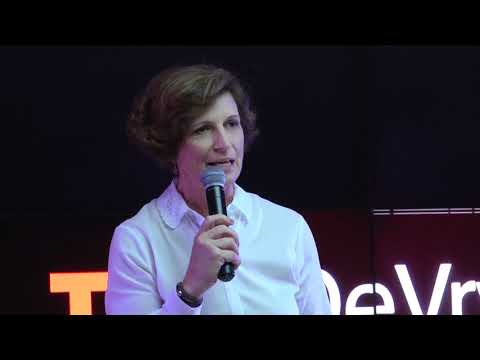
Good evening,
Management for me is example, presence and look.
And I think that today we live in this digital age,
that she has both at the same time:
she brings us closer and she distances us.
It brings us close because we use the network to learn, to research,
to make friends, to send messages,
which are instantly read anywhere in the world.
It distances us because we lose some of the emotion.
I’ll give you an example.
If I decide now to send a message
and in the end I want to send a laugh.
I would use the letter K several times,
or would use the letters AH.
Now, if we’re in this group of friends,
and suddenly the conversation is good
and we end with a laugh.
The effect of a given word and a written word
is completely different.
And I say this, I made this comparison
to return to the three pillars of management:
example, presence and look.
And I wonder,
how many ideas, how many proposals,
how many solutions
are in our teams
and we do not implant them in the company
because the manager is not close to these teams.
So I guess
the presence of this manager
in their place of work,
because when we find ourselves among managers, directors,
when you ask about the staff,
the first word that comes to mind are numbers.
I have 10, 20, 30, 50, 500, thousand employees.
Now when we got to the tip,
We’re going to look there for that.
which is there in the last step of the scale of our company,
we came to him and asked him:
“Who are your bosses? Who are your bosses?”
He remembers the name, he remembers the charge,
and he remembers the turn
in which the director or manager was at his place of work,
if at all.
Pros our employees, we are unique.
We are unique people.
And I can imagine the scene of a manager in the corridors of the company,
by the rooms,
at the cafe,
or even on the street, when the workplace is on the street.
The image that this collaborator has
and will remain in his memory for life.
And it is hardly the research that we order and elaborate
they will be able to capture
the image that remained of this manager with his team.
So, when we work now
with the blend of an older generation of contributors,
with the new,
this generation, which is restless, is unstable, intelligent, quick,
wants feedback almost every day,
wants immediate answers,
the presence of a manager next to them, of course, will potentiate the energy,
both for the happiness of the whole team and for the success of the company.
And I keep reminding myself too,
when we are proposing changes in our companies,
the first idea that comes to mind:
hire a skilled person,
or a company,
to start doing the project.
And we forget
that who knows what else he does, is who does that work every day.
It’s who’s on the edge.
These people are usually forgotten.
These teams are forgotten.
And as we pull these teams out, listen to them,
we will get
that the result of the change that we want is much better.
He’ll be much better.
Exactly because these people felt part, and, sure enough,
what we would like to see happen,
will happen much better, because we have their participation.
At this point, most of you must be imagining
that the director is at the base of the pyramid, let’s call it a company
it is a utopia.
So I’ll go there
to Paulo Freire, writer and educator from Pernambuco.
He talked a lot about utopia.
And he said that utopia is not something that is not achievable.
Utopia
it is a possible dream.
Are you understanding
that reality is not,
is being,
and it can be transformed.
And here the first claim that you hear, within a company,
When…
when managers and directors are asked to arrive at the base,
it is lack of time.
Only, when a crisis happens
in an office, in a branch, or even in a department,
What is the first decision made by the parent company?
For maximum management?
Let’s form a group, let’s go, let’s listen,
Let’s try to minimize this crisis.
Suddenly, time appeared.
The time that did not exist before, it appeared at that moment.
And I’ll say
that if we had made this passage
by that department, by that branch,
or by that office in crisis,
before,
probably the crisis would not have existed or it would have been minimized.
Certainly!
Because, to the extent that the presence of the manager is next to his,
there is a balance of forces and a delegation of importance:
you are important and I am important to you too.
So, the moment you argue equally,
You talk about the same,
the reaction of your team is completely different.
At the moment we charge a lot of our teams
innovation and creativity,
I keep imagining
that the first to give the example of creativity and innovation is the manager.
The first example has to start from it.
To innovate is to leave where he is.
Innovate is it go to the work environment of employees,
in all its instances,
and he shares moments with no marked day,
without an appointment, without a lecture.
Because on that day, he being together, he will find the reality of the company.
He will feel what the company really needs,
what people are needing.
If he makes that famous official visit,
little will do.
Because reality will not be the one that people are waiting for.
Nor will he reap, share,
he will not be able to know exactly what people’s opinion is,
what they talk about, what they discuss,
what are your wishes, what are your stories.
And then I go back to Paulo Freire,
that it is necessary to reduce the distance between what is said and what is done.
I believe that, by decreasing the distance
between what we say and what we do,
we will be able to have happier, happier teams,
more collaborative.
We will be able to have collaborating citizens.
That they will change not only the outcome of the company,
but, fundamentally, the place where they live.
Thank you.
(Applause)
”
Be First to Comment