
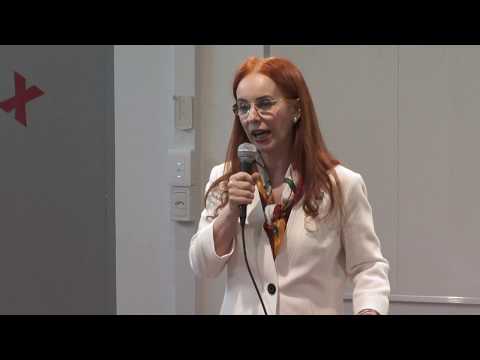
Today I come to talk about the Rondon Project.
I really like information technology.
When I graduated in medicine and started teaching in college,
I started to make some savings to buy a car,
but when it came time to buy the car,
I ended up investing in my first computer.
I have to make an effort to remember today
that when I was a student there were no cell phones,
there were no social networks.
I was in the Rondon project in the Amazon and I met a girl,
São Paulo, who had a doctorate in Physics at USP
and as the husband was a military man, he was transferred to the Amazon,
she came along with him and was very happy there.
I was curious and I asked
how she had managed to adapt in that small city
coming from São Paulo with so many differences.
And she looked at me very calmly and said:
“Look, actually, here we have no problems with the internet.
Here, in these far-flung cities of Brazil,
We have electricity from noon to seven at night.
Our problem is that at night our light is with lamps
and we need ice for food not to spoil.
The internet problem here has not even arrived yet.
I’m telling you this to understand.
the level of vulnerability of the cities where the rondonistas go.
These cities exist in our country.
And there we meet many people
who do not know what Google is.
I want to say that some of the rondonistas are here with me
of the Federal University of Health Sciences of Porto Alegre,
there of yellow, that came to prestige this TEDx.
Thank you people.
The first time I came to participate in a Rondon Project operation,
asked me to define Rondon in one word.
I thought of saying that Rondon does not define himself, Rondon if he lives.
But then, I remembered that in my professional life
I had been using three words:
knowledge, compassion and communication,
as pillars for us to attend,
take care of our patients in the best possible way;
from interviews, from listening to these patients,
with this make a diagnosis and manage to treat them well.
And this is what I had done throughout my professional life.
And I realized that I could carry those words,
which I call magical words, with my students,
also for the Rondon environment.
And from that moment,
these three words came to accompany me
by the Tocantins, by the Amazon, by the Sertão,
that was where I lived some stories
which today I would like to share with you,
based on these three keywords.
As for knowledge, we find
that in these places children need to walk many miles every day
until you reach the place where a bus
to take them to school.
Those who have the privilege of going to school.
And arriving on this bus,
they enjoy school transportation,
that may be this way.
In addition, in Rondon, I also scored
the overcoming of a young teenager,
that every day also had to travel during many hours, to arrive at the APAE,
and he came in with a smile,
and if it is not possible to draw with your hands,
We have feet.
These stories of overcoming,
sometimes they reach the fulfillment of their dreams.
We were in Minas Gerais
when it coincided with the period of the passage of the Rondon Project there
the graduation of a class of EJA students.
EJA is teaching for young adults,
people who were not in school at the time
and now work all day to support the family,
and at night they will study.
And we went;
I went with another rondonista to attend this graduation.
I’m doing it like this because the people back there remember too.
Arriving there, we were asked to say a few words at graduation,
which had a format equal to the graduation,
equal to the Pan American School graduation,
with the trainees all wearing toga,
very proud, family.
And in these small towns
they still had the advantage of being present the mayor, all the secretaries,
finally all the authorities.
And there, what did I say?
Knowledge, compassion and communication.
And I said that this was a class I gave to my students at the university,
so I was going to tell them quick.
And when I said that,
they got so excited,
That surprised me a lot, because to them
have a university professor, from Rio Grande do Sul
that she was going to tell them the class she taught college students.
For me, I did absolutely nothing.
But their gratitude, in fact, struck me like a reflection,
because I had to ask myself:
because I had the privilege of graduating, of being a university professor,
and these people were now just getting through high school,
because before they did not have that chance.
So the first lesson I learned in Rondon,
was how much we are privileged, how much we have to thank.
One sees many beauties of nature,
while we are in Rondon,
but this nature is also very imposing,
and it, for example, determines whether an indigenous village
people will be able to catch the boat
and go to a city in search of medical care or not.
Because, during a period of the year, the river dries.
And if the river dries, whoever is in the village does not go out,
and whoever left the village does not return.
In addition, we go in regions
which offer some degree of danger, of risk.
We are in very beautiful regions,
which can hide, mainly in the borders,
as we were now on the border with Bolivia,
serious problems with drug and arms trafficking.
So you will notice that on these boats
we are accompanied by the armed military.
This is the accommodation where people sleep during the Rondon Project.
I have a very dear colleague.
that he told me:
“Bah, Mara Rúbia, I think Rondon is cool,
but I like to sleep with a very scented sheet. “
I also like to sleep with a very scented sheet,
and I think he has every right, no problem.
But who goes to do the Rondon Project,
have to adapt to these imponencias of nature,
and you have to enjoy what you offer us.
And in fact these two points are not the ones that impact me the most,
are not the ones that most disturb me during the Rondon Project.
What most disturbs me is the domestic violence that we see,
especially against women.
What most moves us is to see
girls of 10 or 12 years pregnant.
In one of the missions in the Northeast,
we went to a place where a large wind farm had just been built.
For the construction of this wind farm,
many engineers, technicians from larger cities came to the small town.
When they left,
many women became pregnant.
The children were born, and on the face you could see
that they were daughters of people who were not of that ethnicity.
But these children will probably never see those parents.
And the population referred to these children,
with a surprising and incomprehensible resignation for me,
as the children of the wind.
Like the sons of the wind, there are the sons of the pink boto
and other stories you should know.
I do not know if it upsets me anymore
the circumstances in which these women became pregnant
or the resignation of the population
with this situation.
When we are participating in this project,
we find out
that it is not only cities that are vulnerable,
so are we.
We hit each day
and there is no internet
We can not call the family, friends, and ask for help.
Then there is born a very strong bond between us,
we do something that is like this:
all teams have an angel,
an angel who is from the Ministry of Defense,
who stays with us,
which is a bit for safety, but it is also our angel.
And each of us takes care of another colleague,
so we are his angel
and someone from the staff will take care of us.
That’s a learning I had there.
It is a learning that,
when we know that there is someone who will look after us,
that will take care of us, we face everything, we get stronger.
Because every day will have one that falls.
Or it was because it was very hot and dehydrated.
Or it is because he saw some very shocking scene and it passed badly.
But there will be a guardian angel who will help,
and we’re taking turns.
I can not squeeze here because I think it’s going to be all right,
but here in the arm of this rondonista,
has a painting done by the natives, with genipapo.
This painting ends up disappearing with time.
This moment, when we were already inside the boat
and has some representatives of this indigenous village
who came to say goodbye to the rondonistas,
after we stayed there for a few days,
this image, who was there will remember the rest of life,
will remain indelible.
With this, in addition to knowledge,
you must have seen
that we train a lot of compassion in the Rondon Project.
If compassion is like a muscle that can be trained,
the Rondon Project is a great gym
where we stay there doing this training.
And finally, communication.
In this photo, the four of this photo
counting, in the foreground, with the parrot,
do not understand each other’s language very much,
but you can see that we are communicating in some way.
So we have the communication of the look,
the smile communication,
and it does not matter if this indigenous lady speaks her tongue
and I speak portuguese.
In this village there are also people who learn Portuguese,
and these were indigenous people who, in clear Portuguese,
wrote to us, now in the Rondon operation of July 2017:
“I would like people who are not from the indigenous community
they would see us as normal people,
as a human being, not as bugs. “
But there are also some funny things,
and we also get a lot of laugh at Project Rondon.
We were in a community in the Brazilian Northeast
and we organize a joint effort on health.
And there in the day no one appeared,
we did not know why.
It is that a joint effort, for them, was a joint effort to clean the trash from the edge of the beach.
So we had to solve this communication problem.
Ending, I wanted to show you
this hospital of indigenous peoples,
where every family accompanies the patient when he goes to hospital,
showing the value of the family to these communities,
the value of humanized care.
And it is this reunion, when we return, with the family, transformed,
that makes us go again, when a new challenge appears,
which makes us practice these three words,
and that makes us carry forward the embrace of the rondonista
that here in the front we were almost giving,
and that makes us stronger as human beings
and with more hope that the planet can get better.
Thank you!
(Applause)
”
Be First to Comment