
At the beginning of my third university year,
on a fall day I woke up to numb my arms and legs.
I just spoke to my mom on the phone.
I looked down at my leg and saw a brown spot.
I told him.
He immediately instructed me to go to the hospital.
A few hours later I was in the intensive department of St. Ladislaus,
already in coma.
I woke up there in about a week, dead, with blackened limbs.
Over the next two months, during nearly 20 operations,
along with most of my skin and muscles, they were removed from me.
I had meningitis, followed by a septic shock.
Simply simplifying this means that the blood is bloated in my veins.
What is left is largely due to the fact that,
that my father’s expertise was accepted and recognized by doctors.
Risking me but leaving time for my body to heal itself.
Meanwhile, my family and friends were constantly next to me,
and kept my soul in me.
Although it was not a simple task in that situation.
I did not even know if I wanted to stay alive.
It was like I could not move.
I could not eat alone,
but if I accidentally mention something to wish,
wonderfully sometimes it appeared that day.
Once I mentioned to my friend,
that he would like to eat brownie,
what they did in their restaurant and we loved them,
and the next day he came with a towering tray.
I could eat a bite,
but among my friends,
some of whom were with me every day,
sold out.
I was completely out of touch with my family, my friends,
doctors and nurses,
not only in the hospital, but for months afterwards.
I could not eat alone, I could not keep myself alone.
I could hardly move and it was very difficult to accept this situation,
even though I did not have much choice.
I lost my independence,
as a twenty-year college student, I got it first in my life.
It was totally hopeless to be independent again.
But then the situation started to improve over time.
Once again I learned to eat alone, to dress alone, to go alone,
and I felt ready to go back to college.
At this time I moved away from home,
and although I still need a lot of help every day,
this was a big step towards independence.
I learned from engineer,
and there has always been scientific thinking in the family,
helped a lot in making the problems,
such as opening the fridge door or taking the shoes,
not as an annoying challenge but as a puzzle to be solved.
Then I got a lot of help from college too
both my students and my professors.
Here, I was lucky enough to give back to my new classmates.
I could tell who did not go to talk to,
or if you had to really say what to say,
to be convicted of a double.
At this time I got to know my wife,
who is supportive and motivated in everything,
to bring my life back to the original basin.
A little over three years after amputations,
I got my degree in command theory and robotics specialization.
At the same time I applied for a Fulbright scholarship.
This is a US scholarship program.
The point is that American students are not in US universities,
non-American students are placed in American universities.
In addition to cultural exchanges,
provides a very good opportunity to
to learn from the best universities in the world.
However, this requires a very narrow set of goals.
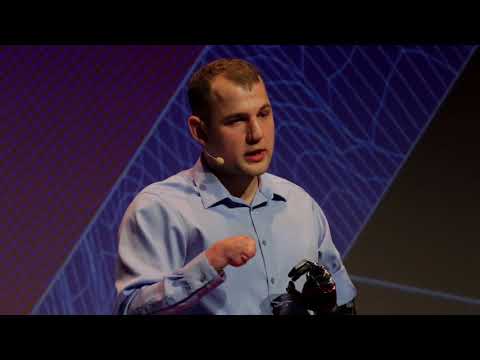
Then I had my first prosthesis. Not that.
I used it, but I did not like it.
It was very uncomfortable and difficult to control.
Many times he was obstructed in everyday life.
It was partly because of its management, which worked,
that electrodes were placed in the skin above a larger left over muscle.
I had biceps and triceps.
These electrodes have EMG signals measured.
This is like the ECG,
just read the electrical signals from the muscles instead of the heart.
If I tried one or the other muscle,
then the hand is opened or closed.
This does not work that way, but it would be open or closed, but that’s all.
This is not a natural control,
because no one controls the hand with the biceps or triceps.
On the other hand, it is very limited,
because in human hands there are 22 degrees of freedom,
ie 22 points where we can rotate or bend it,
and we try to replace it with two.
In practice,
that if I wanted to drink a glass of water with my prosthesis,
it took about half a minute,
while without prostheses for just a few seconds as anyone else.
It seemed to me completely outrageous and unacceptable.
That’s why I started dealing with management strategies.
Then I won the scholarship,
and almost five years after amputations –
then with my bride – we moved to the United States.
When we learned that they were admitted to Johns Hopkins University,
then we did not have to look at the map of Baltimore where it is,
it was enough to turn the news on,
because its inhabitants had just lit the city on some of its streets,
where we are going to move.
The university applied for a fee of 18 million forints each year.
This is not uncommon, but the scholarship covered only a part of it.
I could get the other part from the university,
if I was looking for and teaching by learning.
In addition,
I finish all my subjects in the first year of the two year training,
so that the second year can only be devoted to research.
This task quantity could only be done,
that with those we walked in a shoe,
we all helped each other, as we could,
everyone in what he knew the best.
It did not matter that I did not have my hands.
This was also clarified by the university at the beginning.
They told me that if I needed anything,
any means for my prosperity, I just have to ask.
But they’re going to measure me just like anybody else.
That was the way it was.
I was asking for a tablet so I could type it easier.
They had paid for a BSc as a student,
to program for me instead of research.
I also had to study it over time,
but there in that situation
I could not have accomplished my tasks without fingers in time.
And the university helped me as he promised.
After the first year I married my bride in Las Vegas.
(Laughter)
Not under the influence of alcohol, it was designed.
Although there were some interesting faces in front of us in the office.
(Laughter)
Then he came home and continued working.
I stayed out and dedicated my second year to research.
It was here that seven days a week,
We worked 12 hours a day with 5-6 people,
with whom we searched closely for a purpose.
We’ll find, identify, and possibly fix,
which is why more than 30% of those who use upper arm prostheses to date
he would place his arm in the closet rather than carry it.
That’s why this is so, there are plenty of reasons for that.
A whole separate lecture could be devoted to both the engineering and the human side.
But the same problems,
than being uncomfortable, difficult to use,
is often a barrier and not part of our body.
I deal with management strategies.
Here, the goal is to find the methods,
the most effective way to give my prosthesis my will.
This may seem easy,
but the complexity of human perception and control
between man and machine
it was an incredibly difficult task.
The devices themselves already exist.
We also had a man in the lab,
which was capable of all the moves a human hand,
the only problem is that there was not one who could control it.
That’s why they started dealing with it,
instead of a double-deformation system with pattern recognition.
The essence of this is that eight electrodes are placed around the remaining limbs.
It is constantly reading signals,
and at the same time look at the eight electrodes,
what emerging individual patterns are coming into.
I feel – here and there is darker, to see it not so much –
if you press your forearms fist,
then relax and bend your wrist,
then different muscle groups are strained in the forearm.
This will transmit a different kind of electrical signal.
For these – even if the hand does not already exist –
it can be calculated and taught
machine learning, that is MI algorithm,
which then tries to recognize it, in my case,
that I try to open or close it,
I rotate the wrist in either direction,
or I’ll stretch my face or bend it.
This is intuitive control, because it does the same.
Sometimes they make a mistake.
You should then catch it and turn it on again.
This is a mechanical part, not a management problem.
We’re off again.
Now it will be good.
You have to fight this.
But this is intuitive control,
he thinks he is trying to track those movements,
which I would have done with my original hand.
There are only problems with him.
The problem that we have seen can not be attributed to this.
Most of the guidance comes from teaching.
The process of teaching is,
that a picture of a motion appears on my monitor,
let’s say I clench my hand.
While I see the picture,
I’m trying to make that move with the cut arm.
In this case the signals are read by the machine,
and you can link that move.
So in the future you can predict if you see a similar pattern,
then I probably tried to do the fist clamping motion.
But from now on it is a law in a stone,
that if I want to change it, I have to re-teach it all.
If I come to a door-tree,
Sometimes, it may be a bit more often than it should,
then the electrodes move, signs change.
The predictions become inaccurate.
The hand does not work as I would expect.
If I get four glasses out of ten,
or instead of being tricked, I’m starting to rotate the wrist,
and what was in my glass was pouring into my lap –
which in the best case is cold water, but worse hot coffee,
then I will not use that device.
There is no possibility of dynamic adaptation.
It’s up to these little bugs to be fixed when they’re coming up.
This is what I tried to include in my research.
To develop a method,
which builds a two-way communication between man and machine.
It gives you the opportunity to see if there is a problem,
then fix it when it comes to it,
and we can rest assured that,
so we can use it as long as we want.
Although I still can not present this to myself,
but experiments have shown that,
that communication can help a lot with machines.
Another research direction in the lab was perception.
Here, mostly, I was an experimental rabbit.
It came as we put electrodes on the upper arm,
and we tried to stimulate emotions with electrodes
in my unfinished hands.
When I did not jump out of my chair, I managed to feel things,
but not the same things I would have thought otherwise,
or I would have originally felt it.
What do we think of when we are talking about perception?
Usually touch, softness, moisture, temperature, these things.
If they were in the prosthesis, I would not be fine at all.
But it lacks something more important, much more elementary,
which is with us constantly, but we do not really realize it.
That’s what I want to involve everyone in a little experiment.
Close your eyes,
and stretch your arms toward the back of the chair in front of you.
It will not take long.
With everyone’s eyes closed, everyone feels where his hand is in space.
If you start slowly moving sideways,
you will collide with your neighbors,
and you know that they are pretty much where they are in space.
This consciousness or feeling is called a propriocepció,
and the prosthesis can not do this.
Everyone can open their eyes. Thank you for taking part.
I always have to keep my eyes open,
to know what the hand is doing and where it is,
because the visual is my only feedback about its operation.
There is something I can do in exchange, and you do not.
(Laughter)
(Applause)
Although I confess that this has little use in real life.
(Laughter)
What evolution has shaped over billions of years,
what we are trying to import in a few decades.
I’m not saying this is an impossible task.
But the finished product is still far away.
Even during our life there has been a lot of perception,
mechanics, management.
But it is still in all of the infants in comparison with the original.
There is something missing that connects us to the machines.
There must be a continuous and natural communication.
When it happens, it will no longer count,
that someone has no hands or does not see or hear,
because the tools to replace them,
already exist, only the connection is missing.
Sometimes something happens to the man that forces him to change.
There is when it does not look from the outside.
There is when it just seems.
Regardless of which one applies to us,
in this case, we face a decision: whether we adapt or not.
If so, then we are confronted with our own enemies.
If we defeat them, then we can go further on our own.
For this, we must learn to accept the help of others,
and we should be grateful for that,
that there is always someone who can help the trouble.
With my wife I learned a lot about this.
When is it better to give me help when I have to accept it.
When to solve problems together when it is better not to speak.
We’re expecting a baby now.
I know it will be difficult,
but I’m sure we will solve everything,
just as it has been: communication, cooperation and adaptation.
I try to transfer it to my research,
to make this kind of adaptation with machines,
because they are here constantly, every day.
A phone, a tablet, a hand can be a disadvantage or an advantage.
There is no point in resisting the technological wave.
It is up to us to adapt to the world.
If not, all the elements of our lives become our enemies.
But if so, then all obstacles,
is just another way to benefit from it.
The saying goes: What does not kill, it confirms.
I would change this a bit:
What does not kill us gives us the opportunity to be strengthened.
But whether we live with this option, it just depends on us.
(Applause)
”
Be First to Comment