
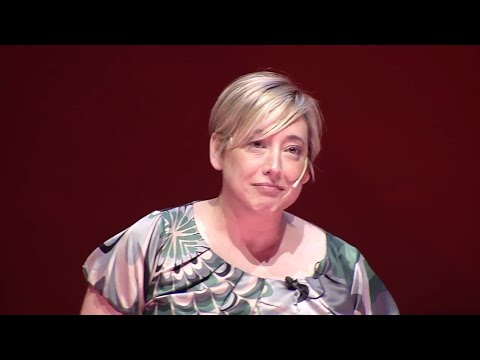
I recently had a date.
I will spare you the details, for good.
It was awful.
It started more or less like this, with him asking me:
– And, what do you for a living?
– Well, I’m a researcher at CONICET, I’m a scientist
and I am currently working on the study and development
of liposomal formulations that encapsulate mucolytics
for the treatment of lung diseases,
both chronic and acute.
(Laughter)
(Applause)
– And what about you?
He never called back, can you believe it?
But why was he so scared? What?
Aren’t there female scientists?
There are a lot, but it seems to be
that for every famous female scientist that we all know,
there are many more famous male scientists.
There are female scientists, but it seems to be
that men go further.
And why does this happen?
Well, in the mid-1800s there were scientists
that after weighing the brains of women and men,
came to the conclusion that women,
we are less intelligent for having a lighter brain.
So let’s see, you Mr. Objectivity, the brain of the woman
is lighter than a man’s brain,
but the whole woman is lighter than the man, right?
(Applause)
Not me, maybe, but it doesn’t matter.
The summer season is complicated, it can happen to anyone.
(Laughter)
Intelligence doesn’t have to do with the brain’s weight.
Women are not less smarter than men.
But they in fact are more sensitive.
And it seems that this is a big problem.
Recently, a scientist called Tim Hunt,
was awarded a Nobel Prize.
He said the following:
“It’s not good that men and women
work together in a laboratory
because three things happen when there are women.
First, you fall in love with them.”
I won’t question that, I’m quite adorable.
(Laughter)
“Second, they fall in love with you.
Third, if you criticize them, they cry.”
I’m not going to stop at the third point
because it already makes me violent.
But let’s go to the second point: “they fall in love with you.”
This is Tim Hunt.
(Laughter)
(Applause)
Do they really fall in love with you, Tim Hunt?
Come on, Brad Pitt, give me a break!
Many women complained about Tim’s sayings,
and he had to quit his position at the University of London.
The only thing he regrets is of having said all this
in front of the media, not of what he said.
Sometimes, I start thinking what was it that led me
to pursue a career in science.
I remember a couple of things.
I remember it was Children’s Day and I would be about six years old,
and all my friends were given dolls,
those that look like real babies —
because, when were are girls they give us dolls or mirrors,
never magnifying glasses or a meccano —
When I was six years old, on that Children’s Day,
my mom gave me a chemistry game.
I didn’t expect a chemistry game.
I couldn’t believe the amount of things it could do.
I was happy with that chemistry game.
My mom later realized that it would’ve been better
if she had given me a doll.
The house would’ve been cleaner and tidier.
Chemistry in the hands of a six-year-old is quite messy.
But maybe that led me to pursue
a career in science, I don’t know.
I love stories of women of science
who achieved a lot of things because they were able
to overcome a lot of prejudice.
Elvira Rawson, for example.
Elvira Rawson was one of the first Argentine doctors.
In 1890, during the Revolution of the Park in Buenos Aires,
she was treating the injured for three days.
They say that she even changed the horseshoe to one of the horses
in the ambulance she was working.
And this earned her a recognition by Leandro N. Alem,
who said that women like Elvira were an inspiration
for their husband and children.
An inspiration!
(Laughter)
She changed the horseshoe to a horse and that’s just an inspiration?
What else did she have to do?
Alignment and balance?
(Laughter) (Applause)
I love stories.
There are a lot of women in science with great stories.
Anyway, note that Leandro N. Alem
was one of the most open minded guys of that time.
What he said about Elvira was a real compliment.
There were worse people.
I love them.
There are many women in science so interesting, take Rosalind Franklin.
Rosalind Franklin was the one who helped discovering
how the DNA’s structure was.
And this discovery was worth a Nobel,
not awarded to Rosalind, obviously,
but to three scientists called
James Watson, Francis Crick and Maurice Wilkins.
This happened: Rosalind was the one who took the photo
of the DNA molecule.
And this is not an easy thing to do.
It’s not that you stand in front of the DNA molecule
and you say firmly:
– Freeze and say cheese!
No, it’s a very difficult image to obtain
and very difficult to analyze.
And it’s done with X-rays.
Rosalind obtained this image and it seems that Wilkins
stole it and took it to his friends Watson and Crick.
They published the results
and, for when they were given the Nobel Prize,
they didn’t even remember mentioning Rosalind.
She had already died from ovarian cancer,
probably caused by working with X-rays
to take pictures of DNA molecules.
Today, the DNA structure is known as Watson and Crick’s double helix.
I call it double helix of Rosalind, okay?
(Applause)
I always hear about that women are neater, more orderly
and get more in the details than men.
That if such a minister of economy
manages the country’s funds like my aunt Adela,
we come out of the crisis.
I don’t know if we are tidier, orderly or look more into details than men.
What I do know is that many labs,
use us as secretaries.
Men are the ones who have the great ideas.
It would seem that we are good at accompanying,
but that we are not good leaders.
A bit strange.
When I got my degree, my mom was happy to have
a professional daughter, very happy.
And she gave me this, see how nice.
This little black suit. Beautiful, right?
I used it for the graduation day,
because all my thesis I worked with mice,
and mice pee and poop, which doesn’t bode pretty well with that suit.
Anyway I would love to use it again,
because, besides, it would mean that it fits!
(Laughter)
It would make me very happy.
In the Researcher Scientist career at CONICET
there are a lot of women,
but only in the initial levels of the career.
In the higher levels the majority are men.
We are good at accompanying.
And because we accompany,
many women were overshadowed.
She is Mileva Marić.
Mileva Marić was the most outstanding mathematician of her time,
She was incredible.
She wasn’t quite in the knowledge for using accessories, right?
That ribbon there, Mileva!
She didn’t have girlfriends to tell her:
“Less is more, Mileva.”
(Laughter)
She was Einstein’s wife.
This that behind a great man there is always a great woman,
in the case of Mileva, it was very real.
She was always behind Einstein.
Not because she wanted to, obviously.
They were married until 1914, then they broke up.
In 1922, Einstein was awarded a Nobel Prize
for describing the photoelectric effect.
And they say that everything was with the help of Mileva
with whom he had scientific discussions when they lived together in Zurich.
Mileva doesn’t appear in any of Einstein’s works.
But if I tell you: “female scientist”,
Marie Curie comes to mind
and it’s good that it’s like that, she even won two Nobel Prizes,
Two Nobel Prizes!
She was the first person to achieve that.
Not the first woman. The first person.
And besides all this, Marie Curie had two daughters, she was a mother.
These are the daughters of Marie Curie.
One is Ève and the other is Irène.
Ève never stepped on a research lab in her whole life.
Irène was a scientist like her mother.
Which is which?
It’s obvious, isn’t it?
(Laughter)
At that time, science was still more of a men’s field.
Then Irène had to be one of them,
and it seems it went pretty well for her.
Einstein wrote in a letter that Irène looked like a “grenadier”.
And watch out, Irène won a Nobel Prize, too.
To give you an idea, since they began to give them until now,
they were around 900 Nobel Prizes given.
Of those 900, only 50 were given to women.
Of those 50, the vast majority are Nobel Peace Prize Laureate
and only six are Chemistry and Physics.
And of those six, half are Curie’s,
two of the mother and one of the daughter.
How difficult must have been to be Ève Curie!
They didn’t give you a Nobel, nothing.
– Mom, I got an A in chemistry.
– Your sister got a Nobel, sorry.
(Laughter)
But anyone would think
that science is so demanding, that Irène didn’t have time
to fix herself up.
But I think it’s the other way around.
To be credible, Irène had to pay little attention to her looks.
To be credible, Irène had to look like a man.
Let’s be clear: we can be leaders, without a doubt, we can be leaders.
We can be Rosalind and Mileva, being duly recognized.
And we can be Irène, earning us a Nobel Prize
with lipstick.
If you ask any child today to draw you a person
who works in science, they surely draw you someone old,
with glasses and male.
Never a little chubby blonde who goes on bad dates.
(Laughter)
But I’m not old — no, I’m not old! —
I don’t wear glasses and I’m not a man,
but I am indeed a scientist.
And this is not against scientists, at least not against every one,
but in favor of us, women in science,
for we have a lot of things to say.
Because we can be missing out ideas.
Imagine what would’ve happened
if Einstein, instead of listening to Mileva, ignored her
and asked her a capuccino.
Let’s be careful, because we can be missing out on great discoveries
and revolutionary ideas,
just because they come from a lighter brain.
Thank you!
(Applause)
”
Be First to Comment