
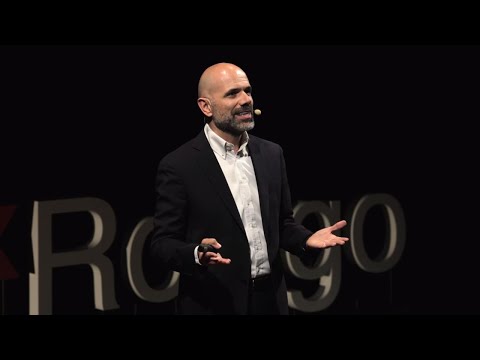
Some of the most attentive members of the audience might guess
I come from this region…
We keep a low profile!
I am a healthy carrier of optimism
and I like challenges,
so when I was asked to choose where I wanted to talk about optimism
– if in Silicon Valley or Rovigo, Polesine, Italy
I had no doubts
because it might be provocative
to talk about optimism at this time
Actually, what we believe this time to be is very important
and also the idea we have for our future is very important.
Why does the future have much to do with it?
The future has to do with it
because it depends on how you see your future
because actions you make in the present come from that vision,
think for example when choosing a course of study:
the first thing we think is
“Will it be helpful when I finish it? Will it help me find work?
Will it help me have a better life?”
So, it is very important that we have the consciousness
of what we are experiencing, if it is true
that “we are living the best era in the history of humanity”,
not of the last 50-100 years, but of humanity.
I am passionate about coaching.
I know many coaches,
But it was all invented by Socrates.
Socrates was the only real coach,
then we prepare slides by changing the things he said,
but this is his reasoning.
I just want to make people think
in order to have a different vision.
First of all, let’s clear the field from any possible misunderstanding:
I am not mad at pessimists.
Pessimists and optimists make their contribution to the world;
thanks to optimists and to those who dreamed of flying
the plane was invented,
while pessimists have devised the parachute,
and it is crucial that they have done it.
It is true that if you parachute you have to be optimistic,
because then…
Well, let’s stop here.
What is our vision of the world?
If we look at the world as we have always seen it,
for example on a geographical map,
what is the idea we have of this world?
With what eyes are we looking at it?
Maybe someone here, an expert in geography,
knows that this geographical map is not completely correct,
and somehow reflects the area where the first maps were built,
indeed, some continents are not the size they really are.
There is a map, called Peters map,
which is more faithful to the size of individual continents.
Can you see Italy on this map?
Even those in the loggia
who paid little?
Do you also see from above?
Well, those who do not see can zoom…
And now ?
Well, we just need a few more seconds.
Did you find it? We can’t wait for everyone…
Well, there is Italy, it is just turned.
This map is reversed,
but actually this is the geographical map
the primary school students have in their school books in Australia.
So, who is upside down?
The kangaroos or us?
Neither them nor us, but it is the vision that is different.
If we get a little bit out
of our usual way of seeing things,
maybe we can pick up some of the things we might miss.
We are living a revolution.
There have been many revolutions
in the world,
such as the Industrial Revolution,
just think about the First Industrial Revolution,
at the end of the 17th century: the steam engine, the loom,
which completely changed not only the production processes
but also the interpersonal relationships, the structure of society itself.
Two centuries later there was another revolution,
called Second Industrial Revolution,
which spread the assembly line and an extensive use of electricity,
which changed further, causing traumas, fractures
and subsequent well-being.
Think about the Third Industrial Revolution
which I think we all have lived,
with the advent of the Internet
and then the last one we are experiencing now,
which many define
as the Fourth Industrial Revolution
where we talk about genEtics
and that capital E is not a typographical mistake,
it gives the sense of new issues
we will have to face.
Just think that Google is not hiring
just IT engineers right now, it is hiring philosophers
to figure out where our future world will go.
We are talking about 3D printing
different connection speeds.
When we experience a revolution
our first reaction is always fear.
I remember my grandmother with the first cordless phone,
it was a phone that no longer had the wire,
she was worried and she thought
“If words are not in there, where are they going?”
Changes are worrying, even smaller ones.
An economist has written, I would like to read it with you,
“We are suffering from an attack of pessimism.
Technical improvements have been proceeding at a greater rate
in the last ten years than ever before in history.
The rapidity of this change is bringing difficult problems to solve,
countries suffering the most are those
not in the vanguard of progress.
We are being afflicted with a new disease:
technological unemployment.
A form of unemployment caused by the fact that we find new ways
to save work at a higher speed than that at which we find
new ways to employ work.”
This could be an article of today
but it was written in 1930.
And I do not need to tell you
what happened in the decades that have elapsed since 1930.
It is just to let you know how much a change can create fears,
often unfounded worries,
if it is not correctly interpreted
or not well framed.
One fear, the classic one, is that sooner or later progress will end.
This is the argument that pessimists, those of the parachute, obviously support:
sooner or later progress will end.
In reality, we must think of progress as something accumulating
not exhausting,
something adding to discovered things, inventions, capabilities
that we had before,
something that adds up, not ends.
Obviously, progress can be divided into different areas of life
and then we see that there are different rhythms.
While technological progress is under everyone’s eyes,
as if it had a very steep curve,
social progress,
not to mention the progress at the political level,
are slower because this is precisely the characteristic of this era.
The characteristic of this era is speed.
Changes are so fast
that our brain struggles to interpret and realize them,
and for this reason we think that
things cannot change quickly for the better.
Actually, technological progress is offering us
incredible solutions for the well-being of everyone.
There are thousands of examples, look at the graph
of the cost of the human genome mapping:
100 million dollars
to make a human genome mapping in the 2000s.
100 million dollars.
It could be afforded by the 2-3 richest people in the world.
A few years later it dropped with a very optimistic forecast
following the Moore’s law,
according to which the performance of microprocessors
are doubling every year.
So, it was a very positive forecast,
“We will soon get from 100 million to 10 million”
means that instead of the two richest people in the world,
many other millionaires will be able to afford it.
Then an amazing thing has happened,
not even predicted by the most optimistic scientists.
This price has dropped very fast and the mapping,
which cost 100 million dollars a few years ago,
today costs less than a tablet, it is within the reach of many people.
What happened?
Studies by Frederick Sanger’s,
one of the pioneers in this industry,
the fourth person in the world winning a Nobel Prize for Chemistry,
were put online.
We moved from a series of concentrated intelligences,
from 5, 10, 15 researchers closed in a laboratory,
to a 5, 10, 15, 50 thousand researchers around the world,
and this has accelerated the ability to reason on this issue,
providing far cheaper and more affordable solutions.
For example, one of the extraordinary features our future will have
is that it will be completely transparent.
I know it is provocative to talk about transparency here, but it will be so.
This is a bus stop in Singapore.
With cigarette butts taken from the ground,
through DNA traces,
the profiles of people who had thrown them have been reconstructed.
People took the picture from this profile,
they put it on the bus stop and wrote “If you see this dirty person,
tell him that cigarette butts must not be thrown on the ground.”
This is the transparency we are seeing in so many things,
even in politics, in communication, and, as we said before,
we cannot erase things from the internet and then they become transparent,
a world where we control and we are increasingly playing a leading role.
Obviously, it is difficult to perceive this because maybe we see
that there are taxi strikes in Rome or Milan,
and we did not see
that in July the first drone taxi was inaugurated in Dubai
– it travels alone and is handled with a joystick.
You may say, “I would never get in there,”
but it’s the same thing we said
the first time we took a plane.
We will use it because it will work.
There are paradoxical aspects, perhaps we may think
that today’s great feature
is that we have generations of people glued to a smartphone screen,
and it is true that China and now Belgium have devised
special lanes on the sidewalks for people who are chatting.
So, one might even say,
“This progress does not really seem so clever.”
Actually, there are things behind this progress
that should make us think,
for example when we talk about 5G.
Those with 4G are probably thinking
“How will the 5G be? The connection will be a bit faster,
I will be able to download for example a movie – I mean legally – very quickly,
so once I pay it I will download 1 giga in seven or eight seconds.
That’s wonderful!”
Actually, it’s not just that, because this only changes an evening
when you have nothing to do at home.
Actually, 5G networks will have
a wider and more powerful capacity
than the optical fibre, so they will eventually allow
automatic driving of cars,
to operate remotely more easily
and with even more precision
will enter our lives
the Internet of things will be a reality
because these objects will interact with each other at unthinkable speeds.
If you are not optimistic with all we have,
it is because you probably lack data.
Today the irrational person,
the person looking to the future, is the pessimist.
And what do we teach our children?
What can we teach our children
if statistics and research tell us
that 65% of primary school students
will do a job
that does not exist today?
What can we teach them?
I believe we can teach them, and we can learn,
to be better people
optimistic people
or those who transmit positive energy,
these people have common features
and I would like to briefly analyze them with you.
First of all, they are honest people
– this is a revolutionary word at this time –
they are normal people,
they do not have a paresis.
No!
Well, an optimist person has ups and downs,
has a different point of view.
It is true that they often smile
optimistic people often smile
and then they have the ability
to share their good mood with other people,
they never stop to make plans.
Optimistic people never stop to make plans
whether they are 20, 30, or 70 years old.
They have a unique and extraordinary feature:
they emphasize positive things.
We all have negative things in our lives
and probably if we do a list they come out right away.
But how much would it take to make a list
of positive things in our lives?
But if you have a parent,
a son,
a friend who loves you,
a hospital within a 50-km radius,
electricity, drinking water…
They are things that should not be taken for granted.
Obviously, a person cannot come home,
open the tap and say “Hurray to aqueduct society!”,
it would be an exaggeration,
but you have to realize that
this makes you a lucky person.
People who transmit positive energy are generous people
who help others,
this is what we can teach and what we can practice.
They do not have prejudices,
and they are not afraid to transmit,
and to show their affection.
So, today being optimistic
maybe means just one thing:
believe in people again,
not because man is able
to create a 5G network
or to transport passengers with a drone,
but because man is able
to make the most wonderful thing
that has ever appeared on this Earth:
another human being.
And a person with this ability obviously makes you think
positively about the future.
So, what can I do to change the world?
There are many who want to change the world,
few think about how to change themselves.
I believe that if we really want to change the world,
we just need to be
the best version of ourselves.
Thank you
(Applause)
”
Be First to Comment