
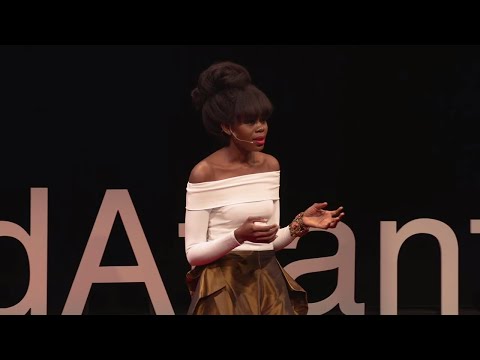
My name is Desirée, and I know we just met,
but in 2013,
you funded my immigration detention.
In 2013, I learned,
on a cold January day in a federal courthouse in Baltimore, Maryland,
that I was an aggravated felon.
Me! Look at me for God’s sake.
I’m always in heels and clothes that are quite impractical.
How could I be an aggravated felon?
I learned that day
that my time here in the United States of America,
that the community that I was a part of,
the community that nurtured me, that informed my understanding of myself,
the community that I so loved and felt a part of,
that that very community now saw me as a threat –
a threat to their very existence,
a threat to their way of life.
That’s a lot to swallow, if that happens to you.
That’s a lot to swallow, when your entire life shifts,
when ICE agents – Immigration and Customs Enforcement –
approach you,
they pull out handcuffs,
and they tell you that they are ordered to take you into custody.
It’s a lot to swallow when you are processed
and shackles are placed on your ankles.
Mind you, on this cold January day in 2013,
I had a vintage wool jumpsuit on; it was orange color.
You know I had to come right. We already know.
It was an orange wool jumpsuit, one of my favorites.
It’s still hanging in in my closet today;
however, I’ve never worn it since that day.
They told me to take off my snakeskin pumps.
They gave me sandals. They told me to lift up my jumpsuit.
They placed shackles on my ankles.
It was in that very moment
that I saw myself the way that this government sees me.
It was that very moment that I realized that I was a criminal.
Backstory: I was born in Freetown, Sierra Leone.
I am of Geechee and Maroon ancestry.
I immigrated to the US at age seven.
I had all intentions of becoming a pediatric neurosurgeon
because when you’re African, that’s what you do.
(Laughter) You go into the medical field.
On a merit scholarship, I was told that I could no longer attend school,
that I had to pay upwards of about 60,000 dollars within two weeks,
or else I would have to drop out.
My scholarship was revoked
because I, at that time, discovered that I was undocumented.
You become undocumented not on your own accord but policy changes,
law changes.
I was given TPS status
because the country from which I came underwent a 15-year civil war.
In fact, two weeks prior to my departure date,
I entered the country on a visitor’s visa to visit my parents, who were living here.
My maternal grandparents were caring for me in Sierra Leone.
Two weeks prior to my departure, the civil war started in Freetown.
No mother and no father would send their child into a war zone,
so they kept me here.
They started the naturalization process.
I entered the third grade in a Catholic school –
we’ll talk about the harms of that later.
(Laughter)
I enter the third grade,
and I was just like everyone else,
or so I thought.
I excelled academically
because that’s what you do when you’re African.
And by the time I went into college,
all of a sudden, this new identity, this new understanding was thrown at me:
that I did not belong.
Not belonging does a lot of things to you.
It does a lot of things to your psychology
because when you see yourself as one among many,
when you see yourself as a part of the fabric of this country –
and in fact, a contributing member of this country –
I volunteered, I participated on all the Little League teams,
and actually, I don’t know why, but I was Little League coach for a while.
Right …
Now, you see yourself very much as part of this community,
and when you’re told that you’re something outside,
that you are an outsider,
and that you had to convince everyone else of why you belonged,
why you should be a part of this human experience,
why you deserved to participate,
I found myself baffled and at a loss for words.
I was trying to convince the government why I belonged.
But I grew very quickly to understand –
particularly during my detention.
I was detained for a total of six months.
The first two months, I was kept in solitary confinement
because I am a threat.
I mean, look at me! I’m a threat, right?
I was kept in solitary confinement,
and during those days, I remember asking myself:
how could I love a country that does not love me back?
How could you be so foolish, girl?
How could you want to be here?
Why did you fight for seven years
to correct this mistake that happened as a child, that took place as a child?
Why would you fight for those seven years
to stay in a country that would do this to you,
that would treat you worse than we treat our pets?
Why do you want to be here?
And as I struggled with the effects,
the psychological effects of solitary confinement –
there are many.
It’s a trauma.
It’s a very deep trauma,
and one that does not simply go away when you’re released.
As I struggled to negotiate my own reasoning
for being in this country and for wanting to participate,
I grew to understand that it was the very people:
people like you;
people whose taxpayer dollars were being used to detain people like me;
people who, when I’m among the community, I’m just like you;
people with whom I can chat about my love for ethnic fashion,
my love for sushi, my love for faux – faux is my new thing
and ramen.
People with whom I can relate, people from whom I can learn.
So, although unbeknownst to you,
you were paying for my detention.
Mind you,
there’s a mandate that 34,000 immigrants are to be detained each year.
There’s an economic aspect of this.
But unbeknownst to you, your tax dollars are contributing to this.
As we have dialogue around immigration,
as we deal with this very real threat as it relates to our current administration,
I want you to keep in mind the economic aspect of this,
and why immigrants have become the new market.
See, when crime started to decline in the early 21st century,
immigrants became that new market.
You can criminalize someone’s existence for having been born somewhere,
and you can arrest them,
and you can put them in jail for upwards of three years.
No process. No court dates. No nothing. They just sit there, forgotten.
$180 was spent every single day to keep me in detention
in the state of Maryland.
And it varies state to state.
So as we have a conversation about immigration detention,
please keep in mind the very human effect but also the economics of it.
These institutions that detain people like me are private businesses.
They’re private corporations.
And they are mandated to hold 34,000 people like me every single year.
It is a quota.
Is that how you want your money spent?
I didn’t think so.
I stand here today
because it was the very idea
that people like you want me among you,
want me to contribute to this community, and want what’s best for me.
What kept me alive during solitary confinement
was the idea that I could return home, and I could open a vintage shop.
That shop manifested and materialized into what is Nomad Yard.
My love for vintage does not come from my admiration of some mere fashion.
It’s my value for people and their stories.
It’s my value for their histories.
It’s my way of archiving the contributions that people like you and I will make
and those before us have made to this human story.
I ask you that as you read the papers tomorrow morning about another immigrant,
you remember people like me
and that we are one human-kind.
Thank you.
(Applause)
”
Be First to Comment