
Instagram …
(Clap)
Thank you.
Instagram, Facebook comments, hashtags on Twitter.
Most of us, especially those who are under 40,
we spend about two to three hours a day on social media and media.
Have you considered what is what ultimately shapes our conscience?
The fear of the other, of the difference, of the stranger,
is – at least as I remember – more intense than ever in the world.
Many times this fear is justified.
The changes that we have as citizens are great, they are intense
and are often unfair.
This fear is often based on logic,
but most of the time is based on emotion,
and I think it’s when it’s a little dangerous.
Historically, politicians have taken advantage of this fear.
Great Britain, France and the United States are the last examples.
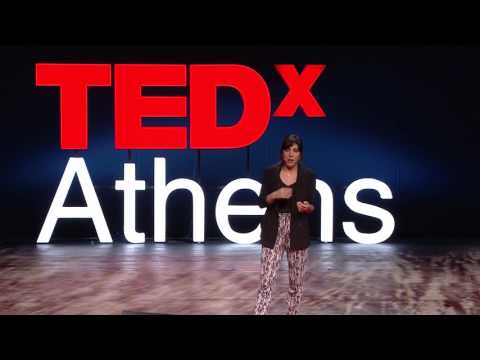
I am Daphne Maggiaraki, I have been born and raised in Athens.
I live in the USA, I’m a documentary director,
and maybe some of you have heard about my documentary “4.1 miles”.
My work is not teaching nor condemnation.
What I always try to do is motivate a conversation,
a conversation inside and between us
on some issues that we might think are self-evident
but it is often very difficult and very rarely to discuss it.
[Video] Things were controlled, calm.
We are called to do doctors while we are not.
[The Largest Migration Crisis After World War I]
(Heart beat)
Neither we have been trained for First Aid and that.
[CANDIDATE FOR SMALL LONG DOCUMENTARY DOCUMENTARY]
(Horn Board)
[“You keep your mouth open and hold your breath. Excellent movie. “]
There are people in the boat that do not wear lifejackets.
Bring a person, get out for the kid!
[Would you act like this to save a stranger’s life?]
[Or would you have turned your eyes?]
[4,1 MILLION]
Nightmare. This anxiety to …
Where we went, we found people at sea,
and I wish there were no missing persons.
(Clap)
Daphne Magiaraki: I always wanted to make a documentary,
I have gone through various adventures and journalism for some years
and five years ago I moved to the US for personal reasons,
that is, I was a sexual immigrant,
and I realized that one of the best universities in the world
It was 10 minutes from my house.
And that the best, in my opinion, documentary program
is at this university, the University of Berkeley.
And so after ten years I was away from universities
I decided to return for a second postgraduate degree in the documentary.
It was during the second and final year of my studies,
ie in the winter of 2015,
where the immigration crisis was at its zenith.
Not only in Greece, in all the headlines,
in all newsletters, in all magazines, on all covers,
in all the photojournalism, in all social media, comments everywhere.
And Greece is at the center.
And of course, as a Greek woman abroad, I could not resist,
I read what was there, and all my attention was there.
It was then that I realized something that shook me a lot.
Something very obvious, however, that shook me.
There were two worlds:
My reality and everyday life
as a Greek abroad, watching my news
and the reality of those people who experienced a tragedy.
The void between these two worlds seemed unbridgeable.
Of course, because I think I’m a person with sensitivities,
humanity existed.
So, I thought all of them with great compassion,
and I was sad, but I was not these people.
We are not these people.
There were others.
They became even more “other”
when the fear began to enter the debate.
That is, what we will do, where we will put them,
it is not, we are afraid of them.
In all countries, not only in Greece, of course.
Legitimate fear and unjustified.
So I decided to make a documentary about the immigration crisis
which would aim to bridge this gap between these two worlds,
between these two realities.
I knew as a Greek for drowning in the Aegean
and I learned that the port body did not even have first aid training.
And because of the crisis in our country
the possibilities for these people to respond
to this huge need was very few, very small.
There was no equipment, there was no support.
I knew that a handful of people,
a small crew from the harbor in Mytilene,
and Kyriakos Papadopoulos, the captain of this crew, was at the center.
And Lesbos, mentally and truly, connected these two worlds.
These two worlds were coming face to face.
So I decided to go to Lesvos, and after many attempts,
I managed to get the license for months, to board the boat.
Before I get to Lesvos,
I had not yet spoken to Kyriakos Papadopoulos.
I spoke with him when I was at San Francisco airport,
I was getting ready to fly.
And I remember the conversation that we did.
Because the issue had somehow left the media,
I asked him, “Kyriakos, are there still boats?
How is the situation;”
And I remember the tone of his voice when he told me,
“Come here and you will see yourself,
I have no words to describe to you what is happening. “
When I got there with my colleague,
the American who made the sound in the documentary,
we decided on the first day without cameras, go to the other end of the island,
to see what is happening in Molyvos, where the waves of immigrants were coming.
It was a one-hour journey, two hours through the mountains of Lesvos,
bends, classic, we reach the beach,
and suddenly as we go down to the beach we see about ten people,
wrapped with these blankets, plastic, characteristic,
dripping with water and going up the road.
It shook me, it was the image I’ve been seeing for so long on the Internet.
Suddenly, someone opens the door of my car, a man,
and pushes into a very old woman,
which was purple, ran the water from everywhere,
she was wet to the bone, and she almost lost her senses.
And the man says to me, “Hospital, hospital.”
I banged.
I could not do anything,
and I could not push the debris into the car.
I am ashamed to say, I could not cope,
I could not drive and could not go to the hospital.
Suddenly, what I read so long, that I was so up-to-date,
became reality.
These people were in a fine line between life and death
and I saw the second face right away.
Fortunately, another gentleman came
and he told me that there was a rough first aid station
so I could go there to the woman,
and fortunately, because I think I would not have been able to get her to the hospital.
I stayed there till night,
where the boats came almost every hour.
And really, I remember looking at the sky
and say, “Where are the helicopters? Where is everybody;”
Apart from five to ten volunteers and the body of the port,
ten people in the sea, there was no one.
Everyone knew and there was no one.
The next day, I met Kyriakos Papadopoulos for the first time.
She was a very low-key man, 43 years old with two young girls,
who had a normal life before this crisis began.
He lived on a Greek island, a closed society.
Of course he was informed and had his views,
and what happened confided to me that he did not like it,
-what he listened to- and he did not know who these people were.
Also, as I said before, he did not have any first aid training,
and he had never thought he would be in the middle
of the greatest humanitarian crisis in recent years.
Suddenly, however, he found himself.
I met Stella.
Stella still works in Molivos café.
I was confused that when the first waves of immigrants began to come,
she did not like it at all.
She had never seen women with headscarves.
She felt this thing as a descent,
because suddenly hundreds of people were coming,
and she looked strange to her.
On the evening of October 28, 2015, a very large shipwreck happened,
with hundreds of people at sea.
Kyriakos Papadopoulos and the fishermen and the body of the harbor there
they were constantly pulling people,
children, wet to the bone, with their unconscious senses.
Fortunately, there was a doctor there from Thessaloniki completely random,
had come for tourism, who managed to recover all the children,
turning them upside down and banging them on the back
and so the water came out of their lungs.
The whole village had come to the pier and was trying to do everything he can.
Suddenly, Kyriakos came in with another dose of people
and began to shout “Stella! Stella!”
and took a pregnant woman out of the boat.
She imagined that Stella would help her as a woman.
And so it happened, of course.
Stella took this Syrian woman into the cafe,
which was in the water for four hours, in the chilled water, was winter.
Of course, there were no doctors, so with various alcohol rubbish
he tried to see if he would kick the baby.
After hours of effort, the baby finally kicked
and when that happened, her wife said, “My husband is in the wreck.”
Naturally, many people had come out and saved
but there were hundreds still in the sea.
And Stella tells her, write me on a paper of his name and I will find him.
In fact, Stella left the woman in the cafe
and went out and for hours he was looking for this man.
And eventually, he found him.
And he brought him to the cafe.
The pair stood up and hugged each other so tightly,
the man kneeling,
and Stella, of course, was moved very much and all who were there.
A few months ago, Stella sent me a photo.
She was the baby of the Syrians.
They called it Stella.
Our recruits are many.
Especially when we watch one minute video,
or when we read the headlines,
very normal, because we all have jobs.
Sometimes, our feelings about a situation that’s so far
they are transformed into fear, and that’s what I find justifiable.
I tried to see reality.
And when I did the “4.1 miles”
I realized that the line between life and death is very thin.
I realized we all experienced it this way:
Terror, death, joy, rejoicing, survival,
we all experience it all, all mans and all children.
I tried to do my job in the most honest way
and just to observe people to be able to figure out the situation.
And what I understood
it is finally that these two worlds,
these two realities can be bridged,
whatever limits we build.
Thanks.
(Clap)
”
Be First to Comment