
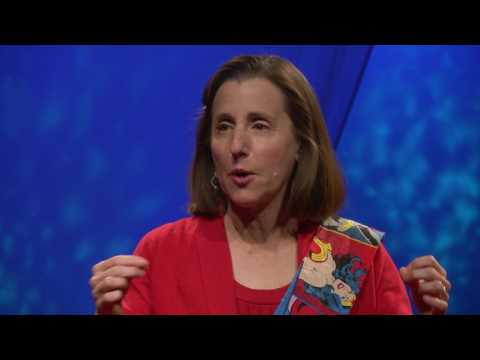
I’m delighted to be here, and I have a question for each of you.
When your parents sent you off to college,
did they tell you to take care of yourself?
Mine sure did, and surprisingly,
I did the same thing when I sent each of my four kids off to college.
But now that I think back what exactly is self-care,
as you can see here,
I’m the proud mom to four amazing adults,
and the bubby, or grandma, to four lovely grandchildren.
Being a bubby is an indescribable joy,
but my parents, like many of their generations,
suffered from multiple chronic diseases.
They did what their doctors told them to do
while putting aside their suffering for the sake of their kids.
They believed that food was one of life’s pleasures.
It never occurred to them that food could be used as medicine,
exercise was not for them,
and they thought that self-care was selfish.
To put it another way, taking care of themselves
in the form of healthy eating,
daily exercise, stress reduction, and good sleep
was never a priority for my parents.
So my dad became obese.
He developed cardiovascular disease, high blood pressure, diabetes,
and a wide variety of indeterminant blood tests.
In other words, he was a mess.
So was my mom.
She was first diagnosed with diverticular disease and depression.
We now think she had untreated celiac disease,
which is an autoimmune disease.
Sadly, in her later years,
she developed first, cancer, and then, Alzheimer’s.
And my siblings –
although we didn’t know it at the time –
developed a variety of autoimmune or autoimmune-like conditions.
Given my family history, I was sure that my fate
was destined to repeat the same dire fate as my parents,
but even without genetic predisposition, I would have a reason to worry.
Right now, Americans – one out of two of us –
suffer from a chronic disease,
and 60% of us suffer from multiple chronic diseases
just like my parents.
Did this affect your parents, too?
Autoimmune diseases –
which are the least visible of these chronic diseases –
surprisingly, affects 16% of the US population,
which most people do not realize
is more than cancer and heart disease combined.
Despite the fact
that there’s 100 different kinds of autoimmune diseases,
they get less than 6% of the government research funding,
and this may go down even further.
With the prevalence of autoimmune and allergic diseases
increasing dramatically in the last two to three decades,
we now know that young adults just like you
are most likely to come with the common autoimmune diseases.
These include Crohn’s, lupus, psoriasis, multiple sclerosis,
type-1 diabetes, rheumatoid arthritis, and others.
Despite the fact that we have this increasing incidence,
it is most prevalent in women,
and autoimmune diseases are
the fourth largest cause of disability in women.
What makes it even more frustrating
is the initial symptoms can be vague and hard to pin down,
so it takes the average autoimmune patient
three and a half years and five doctors
to even get a diagnosis.
These stats are terrifying,
but what kind of a story would this be
if I said genes are my genes, nothing I can do about it, end of story?
The good news is it doesn’t end here.
Genes are not my destiny nor are they yours.
New scientific discoveries are showing us
we can’t change our genes, but we can modify our gene expression.
This is called epigenetics.
Epigenetics gives us a rationale that what we eat and do
can not only affect our gene expression but that of future generations.
At the same time, new understanding of the microbiome
is showing us that the gut is an organ of immunity.
This is key for autoimmune patients
because if we can learn how to manipulate our microbiomes with food,
we can figure out how to reverse and prevent these diseases.
So, as a trained scientist who’s worked as a practicing clinical dentist,
Wall Street analyst, and digital health consultant,
I set out with my parents’ voice in my ear
to prove to myself
that genes are not my destiny, and self-care is not selfish.
So I went to the Internet;
which we all know can be both helpful and harmful.
My first literature search was amazing.
Here I discovered that autoimmune diseases
have a prodromal period of two to ten years
where symptoms are milder before full-blown disease emerges.
This is key because if we can learn to identify disease earlier,
we can reverse and prevent autoimmune diseases.
With this in mind, I was very curious to dig further,
and I found a variety of stories showing individual patients
experimenting with personalized lifestyle modifications
and getting good results.
For example, in celiac disease,
those who go on a gluten-free diet reverse most of their symptoms.
This is on solid scientific footing.
In Crohn’s, lupus, psoriasis, and other autoimmune diseases,
there are a growing number of stories where patients are experimenting
with specific personalized lifestyle modifications
such as specific diets, exercise routines,
movement therapy, stress reduction, and sleep,
and they are getting good results
and abling them to maximize their well-being and thrive.
So, while part of me
didn’t want to dive in headfirst to this behavior change adventure,
I quickly realized that it was me and me alone
who could push myself to start this self-care journey
for the future.
Trying to put a positive spin on it, I said, “Maybe it’ll be a fun adventure.”
It was an adventure alright filled with ups, downs, and arounds.
Behavior change is complicated and tough.
Think about daily food choices.
In my prior life, my favorite fruit
was chocolate pudding pie with graham cracker crust,
but not just one piece –
the entire pie while I studied for my calculus exams.
But fast forward, even today, I will readily admit
that it is so much easier to dig into a bag of chips
than bite into that apple.
This is not good self-care.
So as I faced my ups, downs, and arounds,
I had to be tough and really push myself to overcome obstacles
that precluded me from caring for myself.
There were many days when my progress spiraled downhill,
shown here just like in chutes and ladders.
I struggled to make new commitments while prioritizing time for myself
and remembering that self-care is not self-indulgent.
And then, even if after I got into the swing of things,
I had to find more reasons compelling enough to push myself
to not only keep up these good habits but to look for new ones.
Just because behavior change is complicated and hard
doesn’t mean it has to be hard for the next generation.
Remember epigenetics?
What we do today can not only help us have better well-being today
but can give future generations a more optimistic destiny.
So where am I on this journey today?
I’m still figuring out the optimal pattern,
but now I can say to you
what I would have loved to say to my parents:
it is not pointless to take action because there is hope.
You do have hope,
and I am on the stage because you are the hope.
New research on resilience in university students tells us
that those who practice self-care in college
carry forward these key habits of resiliency
to meet life’s challenges after college.
It is all up to each of us.
If each of us can make one small step to practice self-care,
our combined actions will affect the actions of others,
and maybe our kids and grandkids
will know how to avoid chronic disease all together.
Knowing how hard behavior change can be,
what if we started earlier with school-aged kids?
Could we create a culture that values self-care?
I think we can and let me tell you why.
One day,
after reading science books to my granddaughter
and marveling over her natural curiosity about how the body works,
I took her to the dentist, and the light bulb went off.
In this dental office,
kids were enthusiastically interacting with their dentists
as they taught them to take care of their teeth.
But when you think about it,
pediatricians don’t interact with kids in this way.
They poke, they prod, they measure, they persuade parents to vaccinate,
but they seldom teach parents and kids how to care for their bodies.
They don’t advise on diet and nutrition, they don’t talk about exercise,
and sadly, they don’t talk much about mental health.
We need to change this dynamic.
What if pediatricians involved kids in self-care
in a similar way the dentists do?
If we gave our school-aged kids more tools in their self-care toolkit,
could we enable a culture of health
where self-care becomes
an important building block for personal empowerment?
If health is our most valuable asset,
can we create a culture that values prevention?
So let’s make a legacy of disease a thing of the past
and strive for a legacy of health.
It all starts with self-care.
Self-care is nothing more than a good set of health habits,
regardless of your age or state of health.
It is all about self-love.
For healthy young people,
good health habits today will pay off
with better well-being in the future and lower health care costs.
For chronic disease sufferers, especially those with autoimmune disease,
self-care is a key tool to combat life’s daily obstacles.
For all of us, if we can model a culture that values health,
we can give our next generations a more optimistic destiny.
What can you do right now as a small step in self-care
that will inspire the actions of others?
I’m doing two:
I’m sharing my meditation practice with my son,
and my yoga practice with my granddaughter.
So, join me as we work together
to co-create the next generation of sustainable health
where self-care is a foundation for personal empowerment.
Thank you.
(Applause)
”
Be First to Comment