
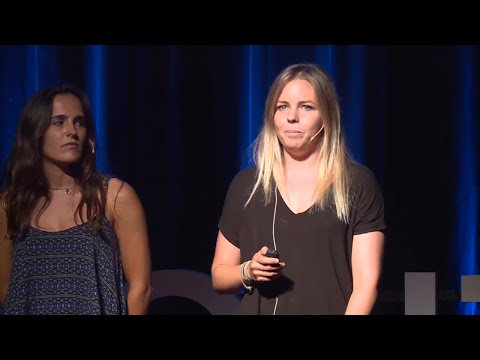
Carol Dickenson: Picture a girl.
A girl that grew up as a victim of domestic abuse,
both physical and emotional,
by both her mother and father.
A girl that grew up feeling voiceless,
feeling isolated, feeling lonely,
feeling she had no strength to face the world.
Well, this girl grows up and becomes a mother.
When she becomes a mother, she makes a very important decision,
she decides to break the cycle of domestic abuse.
She tells herself she wants to give her children what she never had:
unconditional love, unconditional support.
She always said to her daughter:
“Girl, you can handle more than you imagine,
you are a powerful little ant.”
What I’m telling you is that this girl who was a victim of domestic abuse,
was my mother and I am her daughter.
This story is very important because it’s the start
of a social project called Tribu del Sol, Tribe of the Sun.
Tribu del Sol was born out of a group of kite-surfing girls called KiteSirens.
These girls met in Barbados, they are from different countries,
Andrea, from Spain, Kelly, from Canada, the one in the middle who’s not here today,
and me from Barbados.
We met at the beach while kite-surfing, and supported each other,
and we saw how important the three of us were for each other
and so we said, “Hey, lets share this,
this support, with other girls who do kite-surfing
or girls interested in starting,”
and so that was how KiteSirens began.
Tribu del Sol is the heart of KiteSirens.
It’s a non-profit social project
in which we give the girls the opportunity to learn kite-surfing.
We use the sport as a tool
to teach them that they can believe in themselves,
that they have the abilities to achieve their goals.
[Tribu del Sol / Week 2 / #KiteSirens] (Music)
Andrea Rabasa: For those who don’t know what kite-surfing is,
it’s a water sport
in which we use the wind’s strength and a kite
to glide along the water with a board.
Today I can say this sport,
kite-surfing, is one of my greatest sources of happiness.
Every time I make a wish,
this word comes up: happines.
I wish happiness for myself, but not only for myself,
I also wish it for the ones around me
and I wish for them
to be happy with themselves
and to be able to share it with the people around them.
In Tribu del Sol, this is something called “shared happiness,”
a very important concept we always like to bring up.
When we bring our group of girls to the beach,
we present the environment to them as our home, as our habitat.
We present it as a positive environment,
one where we help one another.
An environment with good energy,
where comradeship comes first.
There is a very important little thing kite-surfers must learn,
if you want to be a kite-surfer, you have to learn how to play two roles:
First, the pilot, and second, the assistant.
The pilot is the person who navigates, the person who controls the kite.
But the assistant is the person who’ll be looking out for the pilot.
In water sports, since we are at sea,
we always need someone who checks up on us,
who, from the shore, keeps an eye on us.
Someone ready to help us at any moment, no matter what happens.
This is the role of the assistant.
The assistant helps bring the kite up and down.
And we say that you can’t be a kite-surfer if you don’t know how to be the assistant.
This idea of camaraderie,
has lots of importance when we talk about social inclusion.
Nowadays in Spain,
almost 3 in 10 people are at risk of social exclusion.
We at Tribu del Sol
want to open the doors for these girls so they can join a positive environment,
an inclusive environment where they can fit in,
where they fit in and can play an active role,
where they can prove to themselves that they are more capable than they think.
So, how does Tribu del Sol work?
Well, what we do is,
we first look for a place
where this sport is popular.
We then get in contact
with the councils and social services
and these refer us to other organisations which work for social inclusion.
And that’s how we get to meet these girls.
As Carolina said,
we began in Spain, something that really thrills me because it’s my country
and after this we want to bring this project to other countries every year.
You might wonder:
“OK, but how does the change take place through a sport like this?”
There’re lots of examples I’d share,
but there’s one that always comes to mind when we talk about it,
because it’s something that always happens, always repeats itself.
It’s the following:
when we start giving kite-surfing lessons at the beach, the girls arrive happy,
content, ready to do anything,
but it’s not until we confront them,
until we get them out of their comfort zone,
and we make them face a new skill,
an unknown skill,
a new conflict, that the first words come up.
And these are: “I cannot.”
Sometimes they don’t even have to say it,
we look them in the eyes and with that little face they are telling us:
Ground, swallow me up! Get me out of here!
Take me! Take me! I can’t! I give up!
It’s there that our role as qualified kite-surfing instructors,
becomes significant.
Because what we do, is transmit our knowledge,
share the tools, the unconditional support,
so that these girls are able to become successful.
But the road to success is full of failures
and this is something we work on too.
To understand failure as an opportunity to learn,
a part of the process to reach success.
OK, this is only an example.
I could give you many others,
but now, for example, this girl comes to my mind, Agatha.
During her first day, there was no way to make her smile.
She was super serious,
Carolina and I were doing all sorts of foolish things, horseplay,
we even told jokes and nothing worked,
until she, using her own skills,
raised the kite.
This was the moment when such a genuine smile spread across her face,
and in fact, it hasn’t gone away yet.
Then we’ve got this other girl, Georgiana,
whom we asked after her first contact with the sport:
“Gigi, tell us, what did you feel?”
And she turned all serious, and said:
“I felt free as a bird.”
These words, when we heard them, we couldn’t believe it,
because that’s our mission:
To make these girls live in the present,
make them whole
so that they believe in themselves, so that they live it.
All these evaluations and observations we do,
we do them together
with the social workers who work with us.
It would, in fact, not be possible without them,
they know the girls and they can describe
the past and the future of these girls upon going through Tribu del Sol.
One of them, a Caritas worker, summarised it well in one sentence,
she said: “Going through Tribu del Sol has been, for these girls, a progression
a bit like night and day”.
For some of them, it has led to
the sparking of an interest like a sport.
For others it has meant learning new skills
like perseverance, the fact that you have to fight,
that if you want something, you have to fight for it,
patience, self-esteem, believing in oneself.
But the most important thing these girls have taken away,
is the ability to say yes to the positive things in their lives.
C.D.: There’s a very good analogy about kite-surfing and life,
one I always remember from when I was learning to kite-surf,
and it’s something all us kite-surfers live.
The moment we arrive on the beach, we have to prepare the material.
One very important thing,
is connecting the board cables to the kite.
When we connect the cables to the kite, we put our safety
in our own hands.
Tribu del Sol is the voice of support,
the voice of motivation for the girls
helping them believe in their own abilities.
Tribu del Sol is a voice that repeats:
“Little ant, you can do it!
Choose your path and take control of your life!”
Thank you very much.
(Applause)
And thanks to the girls!
”
Be First to Comment