
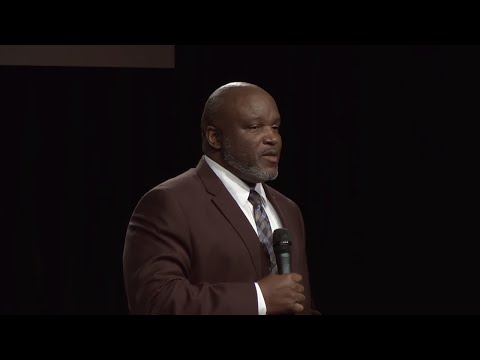
I don’t know what that guy’s talking about;
I’ve never spent a day in prison that I liked.
(Laughter)
A little over a year ago, I was serving a life sentence
with many of the men in the room today.
Any one of them who knows me knows how much I love my daughter.
And so, the first thing I want to do is take a little time to apologize to her.
Tori, I love you,
and I’m sorry for bringing harm to your life
and not being there when I should have been there.
I also want to apologize to the victims of my crime,
and, in the spirit of truth,
there’s a lot of people to whom I owe an apology,
but for the sake of time, I’ll just say that I vow to live my life in a way
that deters others from following in that footstep.
(Applause)
In 1994, I participated in the takeover robbery of a computer parts company.
I was eventually caught and sentenced to life in prison.
There are two types of life sentences:
one is life without the possibility of parole, and the other one is life with.
I was sentenced to 17 years to life.
I eventually did 18 years,
and after appearing before the Board of Prison Terms five times,
I was released.
What I’ve chosen to talk about is what it’s like to be released
back into a society that is not ready to receive me.
Parole in California looks a little something like this.
I was up all night because I couldn’t sleep.
I waited until five o’clock in the morning; the guard came by,
escorted me from North Block where I waited a couple of hours
and then,
a white van came, picked me up,
drove me to the front gate,
gave me 200 dollars in cash,
told me, “Congratulations!”,
and I was ordered to report to my parole agent’s office
within 24 hours.
Truth be told,
if it wasn’t for my ex-wife, I would’ve been totally lost.
I was paroled into an area I’ve never lived in, never been in before,
and with no instructions on how to get there.
Later that night,
I pulled up to the transitional house,
checked in.
One of the first things I did
was I called my daughter on the phone
and I told her that I was home,
and she thought
it was somebody playing a joke and almost hung the phone up.
We talked, and for the first time in a long time,
I could hear happiness in her voice.
I got my bedding,
went up to go to sleep; it was a dorm living environment
where 50 people are housed in this big house.
I was woken up about two o’clock in the morning with somebody screaming,
“I don’t give a damn if you’ve got a gun or not.
Somebody stole my phone.”
And I thought to myself: where the hell did they put me at?
The next day, as I walked out the front door that morning,
I quickly noticed
that there was a dope house right next door to the transitional place.
There were drug deals going down in broad daylight,
and on the corner, there were prostitutes jumping in and out of cars.
There were piles of trash on the corner
as though it were a dump site.
And all I could think about was that I had been placed in a dump with throwaways.
One thing that went through my mind
was about me trying to protect myself.
And the way that I had protected myself in the past was for me to pick up a pistol
and fight anything and everything that came my way I thought was a threat,
but that was out of the question.
I’d just signed a trigger lock law.
My intent is to stay free, which I will stay free
irregardless of what happens.
(Applause)
Because of the tools that I had,
I knew that I had to protect what was essential:
to protect my heart from the trauma I had been accustomed to experiencing,
the trauma of feeling like I was worthless,
like nobody cared about me, like nobody valued me.
Within the first 60 days of being in that house,
I watched no less than 30 men
succumb to the pressures of that environment.
They either ran away from the transitional house
or were either arrested.
Some of them were out on dope, roaming up and down the street;
lost.
On one hand, I was just happy to be free.
And when things got rough, I thought about my daughter,
I thought about my mother, my biggest supporter
– without her support over the past 18 years,
I would have been totally lost –
and I thought about all the people that were depending on my success.
And on the other hand, I had a plan that I had waited 20 years to get to,
and I was putting that plan in action.
And then, I ran out of hands.
I knew that I needed to build me a support group.
I knew that I couldn’t do it alone,
and in fact, I was tired of being alone.
So, I started to reach out to the only community I knew,
and most of that community came from volunteers in this audience today.
But,
there’s this impression,
as though there’s one kind of man getting out of prison.
And most of society have these expectations on us
that we’re getting out of prison, and we’re these hardened criminals,
and we need to be in a program
that teaches you how to fill out a job resume.
I was beyond filling out a job resume.
I had taught plenty of people how to fill out resumes.
I had founded programs, I had production skills,
but people seemed to think that they knew better for me
than what I knew for myself,
and that is a difficult thing to deal with
when you’re forced to sit in an elementary program,
and you’re working at college level.
In addition to
communities or people not fully understanding
what it was that I needed after prison,
there was also the thought
that if organizations
that had previously worked inside of the prison
were to embrace a returning citizen
that it would jeopardize the standing of their programs
currently operating inside of the institution.
I had to put together a support team of different people
and different organizations that were willing to work with me.
Thanks to those people who went out on a limb to embrace me,
I’m able to do the work that I’m doing out in the community today.
In closing,
I want to say that most of society is missing the benefit
that the men coming home and many of the men in this room
have to offer society.
(Applause)
Most people seem to want to hire people
who have undergone theoretical models
as opposed to lived practical experience.
I challenge any professor in the United States of America or beyond
that until you’ve spent 25 years inside of a prison system,
you don’t know more than what we know in this room about the prison system.
(Applause)
My request is that we really take a look
at the models that are being created,
the models that say it’s OK for me to show up to a speaking engagement
or it’s OK for me to be a student,
but somehow, it’s not OK for the student to become a teacher.
There are men who I have learned from,
there are men I continue to learn from,
and since being home
there are about at least 50 men that I know
who have paroled from San Quentin
who are out in the community, and they’re doing great work.
They’re trailblazing, they’re working with youth,
they’re building organizations, and that’s what we need when we come home.
We need to learn how to take the entrepreneur skills
that men have talked about here today
and transfer that into a corporate environment and be our own bosses.
I don’t understand why
over the 18-year period of my incarceration,
over 900,000 dollars were paid to keep me in prison,
but when I paroled, I was given 200 dollars and told “good luck.”
Thank you.
(Applause)
”
Be First to Comment