
According to the laws of hospitality, I must thank the organizers,
I must thank our previous speakers
for very interesting performances,
thank you for taking the time to come,
and must necessarily invite you to the restaurant “Gloria”.
Come more often.
Continuing a very interesting topic about treasures,
Estonian cuisine is the next treasure to be found.
He somewhere virtually we have,
but when we ask someone, even those who need to know something about it,
those dispensed with three or four notations:
it’s sprat, Baltic herring, black bread and something else.
They say: “There is no dispute about tastes.”
However, they argue, and yes even so.
My conscious life was all in the restaurant.
Normal people go to the restaurant once or twice a week or a month,
I go every day.
But believe me, this is not such a holiday,
as for those people who come to a restaurant.
I have eaten a lot of different foods,
touched them from all sides,
sat in many international juries,
overeat all the interesting cuisine,
all very scarce, very unique products.
I worked at the bar, worked in the restaurant,
worked in the kitchen,
studied with the most famous chefs of the world,
but when I touched the kitchen, to Estonian cuisine, to Estonian dishes,
I always had a kind of vibration inside me,
I realized that I was doing something very meaningful
not for yourself, not for your kitchen, but for the state.
I cooked for the Pope, for Prince Charles,
that is for very many presidents, for very many very important people,
but I never felt this when I worked with any of the world’s products.
Estonian cuisine for me was always some kind of deep state secret,
which is well guarded.
And to find out something about it, you need to get into a server,
hack it, divide it into molecules, bytes, kilobytes,
to find out what it is made of.
And anyway, is there Estonian cuisine?
What do you think?
Audience: Yes.
Dmitry Demyanov: It is, right.
Even sprat, Baltic herring, bread, cold and blood sausage,
even from these products you can create
excellent competitive dishes at the world level.
Moreover, there is a very simple example.
An example of a new northern cuisine,
which is only 15 years old,
and in the gastronomy it is very small and very short term,
for 15 years began to excite minds of all cooks
and which came out as a star, like a comet in the gastronomic world,
and today not only all the northern countries work,
but Estonia also works in this field.
And already in America she came, because she brought freshness,
brought a color, a lot appeared natural products
and quite another attitude to the kitchen.
Can we repeat this? We can.
If we look at the geographic location of Estonia
and see how much water we have, how much forest we have,
how much we have different products, not yet open products.
We will speculate on how many remaining unassembled berries,
how many remain unassembled mushrooms.
We sell berries to Finns who make good berries from jams
and sell to us doubly back or at a triple price.
We sell mushrooms to Italians, they dry them and sell them back to us,
when we can do it ourselves
and give them added value.
Let’s look at this simple dish.
This mashed potatoes with porcini mushrooms.
Here this simple minimalism, it seems, that here such especial?
In Estonia, more than 200 varieties of potatoes.
From one potato you can make a good salad,
another – to fry well, another – to boil and so on.
But in France I observed such a scene,
that the granny chooses potatoes,
and the seller is already nervous, says:
“What are you, Grandma, choose so much here?
Take the potatoes, all of us are good. “
She says, “No, dear. I need a potato for mashed potatoes. “
And so for mashed potatoes special.
And this we must know.
So, if we make this puree from the right potato,
on the right technology,
we will make it air – through a sieve,
during cooking, we add laurels, add garlic,
thank him then a good farmer’s village oil,
we will salivate correctly,
this fungus is cut in exactly the way that he left the form,
we will fry this fungus together with garlic,
do not overcook and put only three mushrooms,
and it can be a masterpiece, such a diamond, that it will conquer the whole world.
And only three components.
And so it will be necessary to do with all the details of Estonian cuisine.
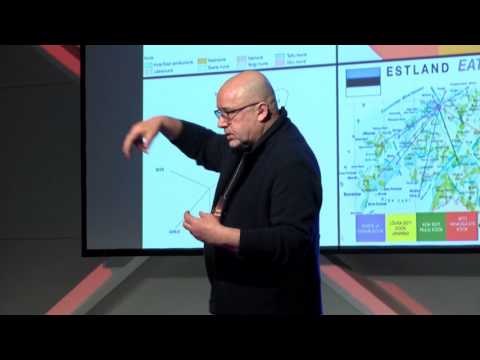
We will look at the map of Estonia.
Here we have a map of dialects.
And here is the previous speaker, looking for treasures …
That’s in every area of this dialect,
and, therefore, their tastes, and their own cooking techniques,
their little hamlets,
where every housewife has some kind of a recipe in her stash,
she does it somehow in a special way.
So, here there are about 10-12 dialects,
but for 10-12 cuisines we do not assemble so many Estonian products.
But we will collect all the same for four kitchens, that’s for sure.
How does this all justify?
Because the cuisine of the islands and the coast
differed from the kitchen of the Old Believers
and differed from the cuisine of southern Estonia.
Everywhere there were small nuances,
which are now not very much exploited, but in vain.
It would be very interesting for us to go every summer …
In Estonia, a very fine summer time for holidays and vacations,
and riding in Estonia – it’s just nice.
And that in every hamlet in which we would stop,
In the morning we did not find “Kelloggs” and “Nutella”
what we offer, sliced tomatoes and cucumbers for breakfast,
and there would be their own Estonian products,
which would be in the radius of this hamlet for 100 km.
This is all we can do.
When we find these taste buds,
we will find out what color the Estonian cuisine is,
what kind of taste, what tonality it has, what features.
We will divide these dishes, which we will find all over Estonia,
we divide them into molecules,
or we divide this dish into details, with which it is combined.
After all, the main thing that guarantees success?
Success does not guarantee that we do the right things,
we choose and do the right things.
We must do them right,
this means that we must be
intellectually prepared gastronomically:
know your kitchen and know the nature of the products, how they combine with each other,
from this, the basic taste of the product is created,
and it then works as a difference from another product.
If we determine that in Estonia, for example, a sour taste, sweet,
or some other combination, caraway, “with a smoke” and so on,
then we can build on this already such different dishes,
which will be interesting not only to us, but also to others.
Today, the kitchens are the pride of any nationality,
and not only pride, but also a very large argument in the competition between countries.
We have characteristic dishes in such areas,
like islands and coastal Estonia.
Very excellent and very good palette of products, kitchens and features
in southern Estonia, [for example, products] Uma Mekk.
Central Estonia – mulgiköök [barley cuisine],
Setu [dishes of the indigenous population Setu] and Vanausuliste köök [kitchen of the Old Believers].
These kitchens may in due time
to be divided into a village, a Mysovsk [mõisa – a latch] and a city one,
and also cultivate them, as a village,
because the more brutal, the older the kitchen,
the more she interests us and tourists.
And make it according to the old methods,
say, in large pots, on an open fire and so on.
Now we meet all the same in some small tourist farm
mozzarella and basil and so on,
such a palette of all … and these things are very simple.
To reach them, it is necessary to know, and this must be very well desired,
and when we very well wish, we always achieve this.
Central Estonia – Mulgimaa is the heart of Estonia.
Viljandi and Paide from whence theoretically came the mulgi-kapsad.
Do you know the mulgiqapsad?
(Laugh)
Raise your hand.
Oh great. And who tried?
(Laugh)
Super! And who liked it?
Perfectly.
So, I can not go on, I can sit down, and there will be another one.
Take the mulgikapsad, how can they be done?
After all, as well as potatoes of 200 varieties,
and cabbage there are 10-15-20-30 varieties.
In order to take cabbage for a mulgikappsad,
there is such strong, white, it is not friable.
If we cut it with the same tools, the same knives,
How do the Japanese work with their kitchen,
these knives do not force vegetables, and they cut them very thinly,
so that we see the texture of this vegetable, and when it leaves juice to itself.
These technologies, too, need to be known.
When we prepare this cabbage in a special oak barrel,
pickle with special Estonian spices,
which we are in the process of promoting Estonian cuisine,
and when we are looking for the basic tastes of this kitchen,
we will find them, and then we will find and tastes,
how to smoke smoke,
and what spices to sour cabbage.
So, if we cut this cabbage
long African braids or like spaghetti,
we pick it up when it’s ready, we put it on a plate,
it does not need to be peretushivat.
Very simple thing with all the kitchens is,
that all the old ancient interesting recipes,
they are, as it were, deconstructed and then constructed in a new way.
Because we now eat completely differently.
If earlier food had to compensate for physical labor,
then today our technologists, computer specialists want a completely different,
they need a completely different food.
But we are good, and all is well.
Food genetically – one that is within a radius of 100 km from us,
and the climate in which we live.
And another important thing is that the ecological footprint is also shorter.
What do I need to do?
We have an absolute base, there are a lot of products.
We take Alice Mora’s book.
The Danes said that they do not have such a book.
The Danes are the ones who were the architects of the new northern cuisine.
But they did it, they did it with beautiful marketing,
they promote it well, made it world famous.
There are no recipes in this book.
Alice Mora was a householder, historian.
She wrote that, where they ate, how they ate,
and this is a treasure, again the previous speaker recalling,
it’s a treasure for Estonian cooks – to fill this book with recipes.
And naturally,
we all need some kind of agreement in this matter,
in the promotion of Estonian cuisine,
Consent is the same as the manifesto of Mediterranean cuisine
and a manifesto of northern cuisine,
this should be repeated for Estonian cuisine.
We all need to know what we want to achieve,
where we want to go.
This should be known to those who implement the policy of nutrition, those who write about it,
and those who use it.
And we need to know that we want it.
If we come to a village farm to rest,
then an Estonian breakfast, just like an English breakfast,
just like an intercontinental breakfast, just like a French breakfast, –
this is one of the ways to promote Estonian cuisine.
If we have Estonian fast food at every corner.
But the fact is that all Estonian products of the new Estonian cuisine
must be of higher quality than any others.
Then they will be in demand.
Again, what is needed for this?
This requires a master plan and promotion.
For this, unfortunately, we need to come up with a new bicycle,
new electric, without driver,
a bicycle that will take us to the wrong place where it’s warm, light, good and cheap,
and will take us where there are very high demands, a very high culture,
and where you can sell it all more expensively.
This is not an easy task, but it is feasible,
because if you want to, you can do it.
We already have a small step, here is this book:
1000 products that you need to try before,
than we go to a better light.
And this is Tallinn’s sprat.
Here, unfortunately, the authors who published this book,
they took off herring,
(Laugh)
but it does not matter, the very essence is important.
(Applause)
There is an Estonian flag.
My performance is of such a slightly philistine nature.
(English) Life is good, but good life is better.
(Russian) So let’s live together, and let’s live better.
It’s good to eat well, and it’s very good to eat [- even better].
Do you agree? Thank you!
(Applause)
”
Be First to Comment