
Imagine.
Imagine a living room.
It’s evening.
A TV that broadcasts a cartoon in black and white.
We are in the 60’s, it’s an old film by Émile Cohl.
A four-year-old girl is sitting, she is watching TV.
A hand on a black screen
draws a character, with white lines.
The gesture of the hand is fluid and with each drawing, the character comes alive.
Something special is happening tonight.
The little girl is captivated.
Its concentration is maximum.
What she sees is magic:
a space in which drawing would become reality,
a space in which the drawing would come to life.
Can such a space really exist?
And if so, how to make the drawing right?
That the drawing is so successful
that he would gain the right to exist in the real?
Something happened that she did not understand.
But it was obvious: she would be this hand that draws
and it would be through drawing that she would realize her dreams
and, by the same token, would come true.
This little girl,
it was me.
Since that day, I have never stopped drawing.
I looked at everything around me, I captured it, I caught it,
I returned it.
I wanted to create my world.
And then I realized quite quickly
that drawing was not considered a very serious thing.
I even felt guilty at times when I drew.
Until a meeting, with my drawing teacher in sixth grade.
By noting the very intensive use I made of Canson pouches,
quarter Grape,
she invited me to her house.
I felt very special.
I entered his studio,
totally unknown and yet so immediately familiar.
She presents me a big blank drawing board.
A huge panel.
In the end, that’s the effect he made me, I was only eleven years old.
It was a universe format.
And there, she said to me: “Go go, express yourself”.
And she planted me there.
I was facing the infinite,
the infinity of possibilities.
I felt a feeling of both excitement and anguish.
Because it was obvious,
I really did not know how to do it.
And it was crippling.
I did not have any notion of technique.
How was I going to represent the ideas I had in my head?
Well, I was not going to back down.
I had come here … I started.
I started to project what I had in my head on the panel.
I covered it without limits.
And there,
I understood.
The key was to do without asking questions,
without trying to master the technique,
just to be what I was doing.
And there extraordinary,
everything around me has disappeared.
I was what I did.
I was immersed in the world of possibilities.
And it was beautiful.
Since that day, I knew that nothing would be good enough,
big enough, crazy enough.
This permission to draw
offered by my drawing teacher in college
finally freed me from one thing,
an essential thing:
it is that the drawing,
It’s not difficult.
She freed me from the fact that drawing was good.
Because, in the end, what is drawing?
What is drawing?
Drawing is basically three things:
observation,
internalization,
and restitution –
observation, internalization, restitution.
We start by observing what surrounds us, it is the observation,
then we wear what we observed in ourselves,
it is nourished by our personal experiences, our imaginations,
that is the phase of internalization.
And then we express it outside of us, with lines, colors, forms.
And that’s the restitution.
And that, we make it child, naturally.
Look at the child who draws:
he looks around,
to understand it, to grasp it, to modify it,
like when he throws a stone into the water
and that he observes the undulatory effects, to feel himself exist.
He sees the essential.
He sees how he feels.
He sees in 3D.
And 2D rendering on paper is not a problem.
He draws in intuition.
He represents his world in his own way.
It is from this round trip that he draws the pleasure of drawing.
So why, as a child, drawing is such a pleasure,
do we stop drawing in adulthood?
So we grow up, we grow old,
and we go to school.
And here, the serious things happen.
They arrive when the child tries to communicate,
to be understood by adults.
Because to be understood, we need benchmarks, recognition.
And in iterations with these exchanges with adults,
As a child, we soon realize that there is a good way to go.
We integrate what I would call the notion of efficiency.
We reproduce, we do like everyone else.
And the beautiful sun with green tentacles that covered the page
becomes a yellow quarter-circle at the top right.
Encouraged by adults, the technique gradually becomes
a know-how,
something that kills intuition, originality.
We look and we now learn the world through knowledge:
anatomy, the lessons of things,
physics, abstraction …
And then we forget everything.
We do not know how to restore as we did when we were children.
We restore a code.
And here, a simple observation is that the more the observation, the internalization,
the restitution of what has been represented becomes more complex
by the accumulation of knowledge,
the more the technique to achieve this becomes insurmountable,
unless you spend, of course, all your time, all your energy,
even his whole life.
And that’s why we stop drawing.
And that’s why you stopped drawing.
Drawing has become an order, an instruction, a discipline,
an act of specialist painful and difficult in his learning.
It is also very commonly used words like “rendering”,
“Execution”.
These are the terms we use, we, the designers.
I think these are words that express quite well
what I’m trying to make you understand.
And this peculiarity which is this iterative, experimental process,
which is the heart of the drawing
is reduced to technical know-how,
technical know-how which, for the most part,
have always tried to render 3D in 2D –
to quote them: perspective,
the plans,
the orthonormal spaces,
up to digital 3D.
They have been so many manifestations in history,
the attempt to find this universal language,
in order to communicate with the drawing.
And do you figure that this code
that we still use today when we draw in 2D,
We apprehend the world in 3D,
with our senses.
Mastery, however, of the technique can become at a certain moment of pleasure,
to put it another way, when the technique becomes a controlled means again.
And at that moment, he becomes the vector of a quest,
the playground an expression of creativity.
In my case, I can not even imagine thinking without drawing.
The drawing, the sketch, the diagram, whatever the forms of drawing,
are all processes of thought for me,
because it has nothing to do with the fact that I’m a designer.
It has to do with one thing, it is that I move.
When I draw, my hand moves.
Nietzsche said he thought better when he walked,
because we engage his body.
So, we are apprehending the world in 3D,
and so we can ask ourselves: basic research,
it’s possible to try to restore it in 3D.
where our imaginary arises – they arise in 3D.
And finding, again:
if you take the paper, the painting,
our screens, whether they are very small, they are very big,
are all flat surfaces.
We think in 3D,
we interact in 2D.
So to imagine our cities, our homes,
our vehicles, our life preferences,
you can imagine that the ultimate quest,
it is to think in 3D and to have a restitution in 3D.
It is this quest that has animated a lot of artists.
They sought to deconstruct this convention of the 16th century,
to break the code.
For that, they only had collage, painting,
to represent the model in 3D.
And Picasso wanted to go further.
he invented a luminous pen that, when he was drawing,
captured the trace of his thought by the snapshot of the photo.
Picasso challenged the technique like the designers today,
we challenge the technique.
Because what we have to represent
is always bigger than the technique allows us.
So, I am currently working
with a team of designers and developers,
a multidisciplinary team,
and we share a dream:
to make drawing accessible to all,
and at the same time to live it in 3D.
What I am going to present to you now,
it is the research that led to this device
I’m really going to have the chance to present you live.
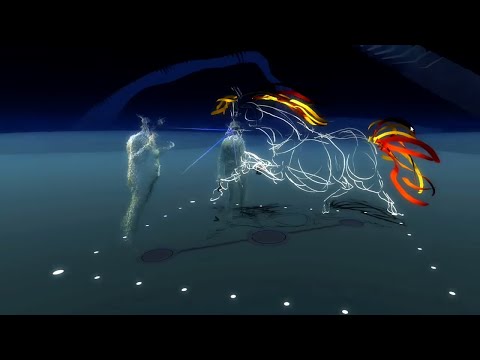
I am in a 3D world in which I will draw for you.
(Solfeggio music)
I will draw for you …
horse.
As you can see,
I feel, I know it’s a horse
but I saw this drawing, I build it
by lines.
He is as he is.
And the pleasure I draw drawing, it’s drawing.
And so what is wonderful, see, is that I have a drawing in 3D.
Do you remember the little girl?
Do you remember the little girl, the drawing hand?
And the life that arises?
I’m going to do a little mane …
of fire !
A little yellow …
There you go.
I could stay for hours in this space.
But I think you’re waiting for me!
I will still make sure that the horse does not escape,
so I’m going to give him some reins.
That’s it, I’m obviously going to hang them on my hands.
So see, this little girl’s dream has come true.
This drawing, this space, this technology is now available,
and I’m pretty sure you’ll be encouraged to use it.
I am a designer.
I work on the border between art and technique.
And I believe that my role,
it’s about being mediated between technologies
and the creation of desirable, relevant,
like to create and realize devices
that will allow you all
go further,
to make sure that technology is never a problem again.
I took up arms for your pleasure at all.
If you consider that you no longer need, now
to stop drawing,
if you can imagine drawing the world you love,
to find your child’s soul,
iM asking you :
at what age will you start drawing again?
Thank you.
(Applause)
”
Be First to Comment