
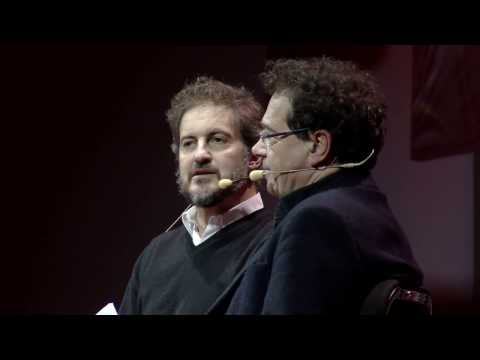
Moderator: Welcome! Jose Maria Aranaz: Thank you!
Moderator: So, tell me, Jose.
You’ve heard Eva [Brems]: local authorities are important.
Do you agree with that?
JMA: Not only I agree. I think they have a huge responsibility.
A lot of repressions of human rights take place at local level.
As we see, for example, currently in the Democratic Republic of Congo,
we’ve also seen that in Bosnia or in Rwanda
where the level of accountability is huge.
But local communities also offer opportunities
to create human rights islands and places of opportunities.
Moderator: I caught one thing Eva said which shocked me a bit.
She said, “A lot of people say, human rights is an utopia of the past.”
Very strong sentence.
My question to you is:
Is the concept of human rights as such not under threat?
JMA: I tend to agree with that.
There is a big threat for human rights as we’ve seen up until now,
and this is a moment
where both multilateralism and values need to be reinforced.
That’s one of the roles the United Nations can play.
Moderator: Do you think there is universal non-respect of human rights?
JMA: In many countries around the world I have seen a push from governments
to escape and backpedal on their own commitments
and find excuses and ways to shortcut to commitments they made
when they signed treaties and obligations.
Moderator: I mentioned the countries where you have been working.
Can you tell us a nice anecdote about something that shocked you?
JMA: Some of the current work, the efforts from the authorities in Congo
with regard to the recognition of the albino community.
The push of the civil society to have their constitution and rights recognised,
the movement for return to Bosnia by internally displaced persons
across different communities
was something quite moving.
Moderator: This is about “no limits”. You are the guy with the mud on the shoes.
Don’t you sometimes have to go beyond your limits to do something?
JMA: Absolutely. Human rights offer a good framework for action
but it all depends on how you implement it in the field.
There is no manual for that.
You need to think completely out of the box to get it implemented,
sometimes that requires going beyond what your bosses have told you to do,
but obviously there are certain limits, moral and human life limits, to that.
Moderator: Speaking about bosses, do you think the United Nations
can make the difference?
JMA: I think so. United Nations and its human rights architecture
is more necessary now than it has ever been,
precisely because of these threats and the questioning of the system.
That requires a strong voice on human rights
for the United Nations.
Moderator: You have devoted more than 20 years of your life to human rights,
what is it you’d say, “This is what I want to achieve before I die?”
JMA: I’d like to see universal recognition and less questioning of human rights,
I’d like to see multilateral organisations like the European Union,
the African Union or the United Nations
more principle based, more effective, more activist and less diplomatic
because, I think, in many ways
that serves as an excuse for sacrificing the principles.
Moderator: Do you think that’s realistic, if you have all these institutions?
We see that people don’t like the big institutions anymore,
that there’s a big issue there.
JMA: I think the civil society and the population demand that.
If the governments want to bridge the gap with the population
they need to push for that type of intervention and advocacy.
Moderator: Eva is a professor, you are there in the field.
A lot of people here dream about a nice career in a bank or finance,
earning a lot of money.
What would be your message to them?
JMA: I think young people are the future and they have the possibility
to make a difference.
Young people have a level of creativity
that many people who are working in bureaucracies don’t have.
I think the role of senior people in organizations
is to create a space for that creativity to come out rather than to repress it.
That level of creativity is something you learn to admire.
Moderator: It’s nice to speak of creativity,
and I could imagine myself working on that,
but do you really see an evolution in the respect of human rights?
Can you say that now human rights are more respected
than five – ten years ago? I would say it’s the contrary.
JMA: What keeps me doing what I do is to see civil society organisations,
youth groups that face an incredible level of repression by governments,
be more aware, better prepared, more sophisticated in their arguments.
They know their rights, they fight for their rights,
they argue their rights, and that’s what makes them effective.
But that’s also why they are perceived as threats by governments.
Moderator: So, if I can translate your statement,
if you want respect the human rights, it won’t be international organizations,
or the political level, it will be the people, the citizens?
JMA: Human rights are about people, people need to argue for their rights.
I sincerely hope the organisations become mechanisms
to support this anxiety of the population to have their rights respected.
Moderator: So the organizations’ role is to push the people to go further?
JMA: They are supposed to provide mechanisms for people
to have their voices heard.
For example, in Sudan, we were able to get local communities
to express their concerns, to be transmitted to the Human Rights Council
of places that otherwise nobody would have heard of.
That’s exactly what the role of organisations is supposed to be.
To get the voices from the field heard in places far away,
so those concerns don’t get isolated.
The moment a human rights problem
is isolated or confined to a specific place,
it is at the expanse of authorities.
That’s one of the roles that organisations can play.
They can get the voices heard outside their local communities.
Moderator: In the list of what you did, I didn’t mention you worked in Stockholm.
Can you say something about the organization in Stockholm
and its role?
JMA: It was a very interesting working and living experience.
Coming from the field to live in a society that is so well organized
as the Swedish one,
which takes a lot of pride in promoting human rights abroad,
is something absolutely commendable.
Yet, on the other hand many people in the society
are stuck in their welfare,
and sometimes that leads to a level of selfishness
and tolerance of human rights abuses that needs to be addressed,
and that’s a mismatch that shocked me.
Moderator: People who came to TEDxBrussels today,
heard a lot of messages, so their heads are going to be like that.
But you can finish by giving that one message
people should take home from the field of human rights?
JMA: The work of human rights needs to be done every day,
it’s everybody’s duty to fight for human rights,
and there can be no conformism in it.
Human rights, as we know, right now are under threat;
under threat by security, under threat by unilateralism,
under threat by private companies,
and it is everybody’s duty
to defend, protect and advocate for human rights.
Moderator: It is very nice to have someone like Jose with us.
He doesn’t just talk about it, he’s there all the time,
he goes to places not very safe, but he works for human rights.
Thank you Jose.
JMA: Thank you very much.
(Applause)
”
Be First to Comment