
Well, I wanted to start this talk by asking you this question:
What do you think Peru and Mars look like?
And it’s a strange question,
It would be more logical to ask what the US looks like loving You,
or Russia to Mars,
for its development in space matters.
And some think that the only thing
that we have in common with Mars
is this, right? Let’s see.
(Laughter)
The Martians.
But not really,
We have many more things in common.
Arequipa has much in common with Mars.
But to tell you this story
we’re not going to start here in Arequipa
nor here in Peru,
Let’s start here on Mars.
Why is it that we are interested in Mars?
Mars is one of the seven planets,
besides the Earth, from the solar system
and it’s the only one where you could
develop life through a technological civilization.
Mars has poles covered
of frozen water that melt
They could cover the surface about 9 meters.
In addition, it is believed that there are rivers
of frozen water below the surface.
It has important amounts
of hydrogen, nitrogen, carbon, oxygen,
that beyond being fundamental
for water and for food,
they are fundamental for wood,
for plastic, for fuels.
Mars has a 24-hour day,
has many sources that
could allow the human being to live there
and it has a lot of the minerals
in which today the industry has interest.
That is, it is even commercially attractive.
But perhaps the most important
it must be that Mars, finally,
could give us the answer to an unknown
that we have had for a very long time
and that is if we are alone in the universe.
For 1000 million years
Mars was very similar to Earth:
He had oceans, as we have here.
Life took a fifth of that time
arise here, therefore,
there could be traces of life on Mars
and if we find vestiges of life
we could know if life is an event
highly probable in places with water or otherwise;
we could know if life is what we are
or if what we are is one of many ways.
But, without a doubt, the expectation is in the first manned trip
that is planned, more or less, in the 2030s.
Actually there are many dates,
but I think it will be 2030 for space development.
And now, if we talk about the study of the trip to Mars,
we have to talk about two blocks.
The first one is the whole subject related to the trip itself,
that is, the development of spacecraft,
not only in terms of fuel efficiency;
that’s what companies like SpaceX, Boeing,
from the hand of space agencies.
And the other big research block is:
What will we humans do when we arrive?
What will be the experiments,
the procedures, which ones will be
the protocols that will have to be followed.
And one of the organizations
that has generated a lot of information in this regard is The Mars Society.
It’s a US organization
that studies habitability on Mars.
As part of their investigations
he built an experiment station
in the desert of Utah, in the USA,
where engineers, scientists and experts
from all over the world they are going to make simulations of trips to Mars.
They have even prepared astronauts there.
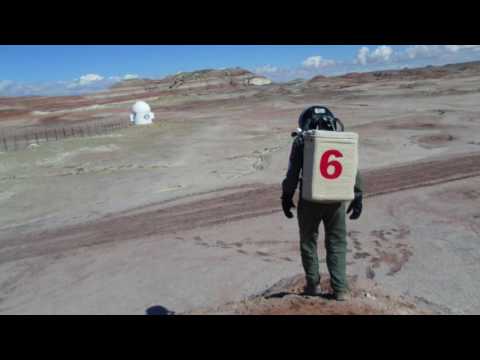
I had the opportunity to go
in 2015 as part of a simulation mission.
I went with other Peruvians.
I proposed a project
and they understood that I could contribute,
therefore, they selected me together with a group of Peruvians.
And, well, it was a great experience, right?
The truth is that you live as if you were an astronaut:
We ate dehydrated foods,
we followed a series of protocols,
We could not leave the station
without having costumes that simulated …
we could not go out
without depressurizing or entering without pressurizing us,
It was a complete simulation.
And well, we generate information
through our projects
and, above all, through how
we interacted with people,
what it is like to live in such a closed environment
for so long
We were there for three weeks.
And all that information accumulates
in a database
which will be used as a resource
when humans travel to Mars.
This place, the Utah desert,
It is not selected at random.
This area has many characteristics
that make it similar to Mars.
You can see here: up is Mars,
Below is the Utah desert.
It’s a picture I took, you’ll see the similarity.
To these places
they are called Martian analogs
and they are very important because this is where you can
perform simulations of trips to Mars.
All protocols and procedures
They have to be carried out in places like that.
The Curiosity, which is the rover
that is currently on Mars,
was tested in Utah, therefore,
You may notice that it is very important
perform simulations.
The space agencies understood
that you had to look for more places
worldwide
where we could do simulations.
This is how, based on satellite images,
NASA finds a place here in Peru,
here in Arequipa,
that by its particularities,
in terms of soil composition
and geography,
It could be a place similar to Mars,
but this was a hypothesis.
Therefore, a group of scientists was sent
led by Dr. Julio Valdivia,
that is an Arequipeño who was at NASA,
and did the relevant experiments
and discovered that, indeed, it was a Martian analog.
In fact, it’s the Martian analog
more like the world.
Well, the idea arises why not …
this is the exact place that was found
that it was the most similar area in the world
loving You.
You must have gone to the side
many times, well, close,
road to Mollendo, you have to throw yourself
About 40 minutes in the desert.
And this is where the idea of why
not make a station similar to Utah
in Peru, so that the same thing could be done:
so that scientists from all over the world
could come to organize simulations,
with tracks to the trip to Mars,
in the most perished place in the world.
And it is a project that is now being developed by The Mars Society Peru Chapter,
which is the company’s subsidiary
at the level of South America;
the Astrobiology Scientific Society,
among other organizations.
And it is a project that is calculated
to get ahead in 2021.
But, of course, a project like this,
in a country like ours,
it must be handled in a different way.
For example, a month ago we went to the area
with a group of scientists that had arrived,
there were even people from NASA,
and we found that the invasions
They had advanced a lot.
They are not in the exact area, as I say, you have to go deep into the desert,
but the problem is the garbage they generate,
because the wind carries it for miles.
And when we arrive we find
some plastic remains
and the scientific value of the area decreases a lot because of this, it changes a lot.
Therefore, a process must be done
of intangibility of the area.
So we went to talk with the regional governor
and there were some interesting agreements
that must still materialize.
Another interesting point was that,
let’s imagine that we build the base
and one day the astronauts leave
to do some exploration, some project
and they come back and there are no things; It can happen,
therefore, we need protection.
The good thing is that the base
of the Air Force
It’s relatively close, right?
Then we talked with the Air Force,
They were assertive in this topic:
that could help us
It is missing some time, but they could help us.
And they even gave us a fuselage
to be able to use it as a material.
This project already has plans
and it’s on track
The question arises as to why to do it.
It is the question that I am normally asked
and there is one thing that is something real:
Sputnik is the first satellite that is sent to space,
it leaves in 1957 of Russia.
The first Peruvian satellite, the PUCP-Sat 1,
comes to space in 2013, there is a huge time lag
with regard to space research.
But to have a station like that in Peru,
it would make us jump a huge jump,
would put us at the forefront of Latin America in the study of Mars,
which is the next great leap of humanity.
There is a comparison that always makes
Robert Zubrin, leader of The Mars Society,
He says: “What do you remember from 1492?”
We remember that Columbus arrived in America,
but many things happened in 1492:
England and France sign peace,
extremely important at the time;
Lorenzo de Médici, who was the man
richest in the world, dies;
A million things happened in 1492.
If there had been newspapers at that time, such as there are today,
probably those would have been
the headlines and not those of the Genovese madman
who left Europe to who knows where.
However, today we remember Columbus
because those are the things you’ll remember
the people in the future.
And we want people to remember that Peru helped,
that Peru, through this station,
could generate useful information
and that was part of the conquest of Mars.
I am from Arequipa, so this project
It has a very important value for me.
I am the only Arequipeño of the group
with Dr. Valdivia.
When we talk about space issues,
one feels a little oblivious to this
because it says “here in Peru, a little distant”,
but in reality, today it is not anymore.
I am operations director
in The Mars Society Peru
and thanks to the work we have done,
The Mars Society has opened a deadline
temporary, annual, fixed
so that Peruvians can go
to perform simulation missions to Utah.
And it is an important advance.
People who go, we can talk about that later,
the people that go will be able to collaborate with this project of La Joya.
So, now, when someone asks you
in what Peru and Mars are similar, you can say: in pampas of La Joya.
Thank you.
(Applause)
”
Be First to Comment