
I’ve got to get good grades,
I’ve got to get a good job,
I’ve got to get married at a certain point.
I know if I’m not given sort of obstacles,
I don’t really, I get kind of lazy.
I don’t need to base my sense of self on
what stranger’s opinions of me are.
Once your technique gets to a certain level,
the only thing that separates you from others
is your quirks, or even flaws.
I think it’s a really good tool too, just to
learn something from everyone you work with.
– She’s an actress, film director and producer,
and carries duel American and Israeli citizenship.
Her performance in Black Swan received widespread
critical acclaim, and won her her first Academy Award
for Best Actress.
She was cast as Padmé Amidala
in the Star Wars prequel trilogy.
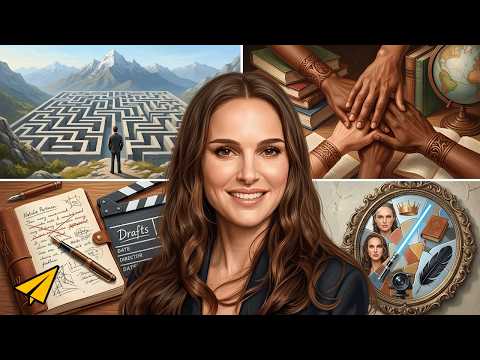
She’s Natalie Portman, and here’s my take
on her top ten rules for success.
My personal favorite is number eight,
and make sure to stick around all the way to the end
for some bonus footage.
(whoosh)
– It’s very hard to separate the …
You know the things that other people want for you,
the values that society tells you
you’re supposed to go after,
and the things that are really meaningful for you.
I definitely grew up being like,
I’ve got to get good grades,
I’ve got to get a good job,
I’ve got to get married at a certain point.
You feel like there’s these things that
you’re supposed to do and that you have to do.
It’s an amazing shift; I’m sure many of you
have gotten there,
or will get there if you haven’t but,
it’s an amazing thing when one day you’re just like,
oh this is what is important for me,
and I don’t care what they say, I don’t care
why other people think I’m doing it or not doing it,
the rest is sort of ego.
– Can you name that moment when that happened?
– I don’t know I think it really started happening
when I was doing parts that required
a real sort of emersion for me.
Working on things like Goya’s Ghost or
V for Vendetta, The Other Boleyn Girl,
I did so much sort of like …
I got so into the characters and the stories
and all the background research
and really living in it, and it made the
outcome
not important, when it did well, when it didn’t do well,
when it got positive feedback, when it didn’t
it was like, all that stuff faded away ’cause I had this
experience and the experience was like,
oh you can’t take away from me the fact that I spent
two months going to the Prado every day and living with
the Goya and El Greco and Velazquez paintings.
That was an experience forever that I will never
forget and,
the fact that four people saw the movie of course.
You know, obviously when you care about something
you want people to engage with it and it’s important
but it wasn’t devastating because
I had something that was with me forever.
So it changed the way I chose projects
’cause it wasn’t about,
you know it’s the worst when people are like,
oh, this is going to be really popular
or this is going to be an Oscar movie, and you’re like,
bad sign, bad sign, bad sign.
Why is this meaningful for me at this point in my life
that I want to live this experience?
People told me that Black Swan was an artistic risk,
a scary challenge to try to portray a professional
ballet dancer, but it didn’t feel like courage
or daring that drew me into it.
I was so oblivious to my own limits that I did things
I was woefully unprepared to do.
So the very inexperienced that in college
that had made me feel insecure,
and made me want to play by other’s rules,
now was making me actually take risks
I didn’t even realize were risks.
When Darren asked me if I could do ballet
I told him that I was basically a ballerina.
Which by the way, I wholeheartedly believed.
When it quickly became clear in preparing for the film
that I was maybe 15 years away from being a ballerina,
it made me work a million times harder, and of course,
the magic of cinema and body doubles helped
the final effect.
But the point is, if I had known my own limitations,
I never would have taken the risk,
and the risk led to one of my greatest artistic
and personal experiences, and that I not only felt
completely free, I also met my husband during filming.
– [Interviewer] And what compels you to get involved
in a project; I know that’s kind of a hard question
because it’s probably so many different things.
When you think about projects that you
get involved with, what are some of the
key elements?
– Well I think it can be really anything that gets
you interested.
I just want to make sure I’m going to be challenged
the whole time because, I know if I’m not given
sort of obstacles, I don’t really,
I get kind of lazy, I don’t really engage in the way
I want to, so.
If I know something’s going to constantly be
throwing challenges at me, not in like,
I want to have fun, you know.
I always want to enjoy what I’m doing.
Something that is going to be,
but that’s part of the fun I think,
is getting all of the challenges of it.
– [Man] Do you read criticism of yourself?
– No, I used to, I used to, and then I realized
it wasn’t helpful.
– [Man] Positive or negative?
– Mm-hmm.
– [Man] It’s just a distraction?
– Yeah.
I don’t look at anything anymore that’s written,
whether it’s interviews or I mean …
It’s also just too much focus on yourself.
I am far from the center of the world
and I don’t need to like,
I need to read about other things.
There’s a lot of really good things to read about and,
I know about myself and
if someone makes a mistake about me
I’m just going to get upset, so.
Or if they say something negative
I’m going to get upset and if they say something nice,
that’s friendly but I also don’t need to care,
I don’t need to base my sense of self on
what strangers opinions of me are.
It’s important to me that my friends and my family
think that I’m behaving correctly and,
they’ll let me know if I’m out of line and
everyone else’s opinions like,
it’s not my business.
By the time I got to making Black Swan,
the experience was entirely my own.
I felt immune to the worst things anyone could say
or write about me, and to whether an audience felt
like going to see my movie or not.
It was instructive for me to see that ballet dancers,
for ballet dancers once your technique gets to
a certain level, the only thing that separates you
from others is your quirks, or even flaws.
One ballerina was famous for how she turned
slightly off-balance.
You can never be the best technically.
Someone will always have a higher jump,
or a more beautiful line.
The only think you can be the best at
is developing your own self.
Writing, I …
I think everyone probably has a different process but,
my sort of experience is that,
I have an idea for a story in my head
for a very, very long time and little things
glob onto it.
I don’t write any notes or anything down,
and then after a couple years,
it sort of just comes out in one spurt.
It just sort of molds itself in my head and
then just comes out.
And so that is what happened with both occasions
and then once I get my first draft out,
I send it out to ten people I trust,
which I know a lot of writers don’t do,
this is not a normal process.
A lot of people really tinker with it a lot
but I do my like …
This crazy first draft and then get people’s feedback.
Then start doing all this very, very detailed work
using the feedback and then it sort of inspires me to;
because it gives me a kind of perspective
that I don’t have because,
I think this story is in my brain so long that
you get too close to it.
Amazing thing about Darren is that,
there’s not the ego that;
there’s some people who just, they’re like,
“I’m the boss, I’m going to make the rules.”
He asked questions, he listened and took
ideas when they were good and when they weren’t good
he’s like, that’s not a good idea and you just
wouldn’t do it and that’s fine
and that’s always what you’re doing as a cast
or crew member is like,
you bring your ideas and if
they’re right, great, and if they’re not, not.
I’ve definitely worked with people who are like,
don’t want to hear anything.
That’s not your job, just go do what I tell you to do, which
makes it less interesting of course and then of course
there’s people who listen too much and
they water down their own vision which is, of course
is not a problem for Darren.
That’s the joy; also, that was something I learned
when I was directing too, to just have an open ear
and use people’s best suggestions.
You have 100 people who are there for you,
to help you create your vision and sometimes they have
a good idea.
– [Reporter] What do you want from a director?
– I really, I love feedback.
I think artistic honesty is,
the key and I mean Darren is exactly that.
He’ll tell you when it’s not going well,
and he’ll tell you when it’s going well
and you can trust that it’s going well
when he says it is because he’ll tell you if it’s not.
He always had a million different ideas for every scene.
Was always on top of it and then at the end
would always say, do this one for yourself.
The last one, do it for yourself which was just
exactly the key to the character because
it was what Vincent says to,
Vincent’s character says to my character which is,
find your own pleasure.
Which is at the root of being an artist, which
Darren hands it to me. – Find your
own pleasure?
– Find your own pleasure, because you’re trying to;
so often as an actor you’re pleasing your director.
You know the kids at the pageants at the end
when they look at their mom right after
they finish doing their song?
Sometimes you’re like that as an actor.
You finish the scene, you’re like, how was it?
When they’re saying, just do it for yourself it’s,
a whole new world opens and Darren gave that to me,
because directors often say do a freebie or a free one.
But just putting those words, articulating it in that
particular way, do it for yourself.
I think it’s really …
I think it’s a really good tool too, to
learn something from everyone you work with.
Every person you work with, steal from them.
I think stealing from people when you’re acting
is really easy, because
it’s always going to be funneled through you.
It’s not plagiarism in any,
no one will ever know, unless you’re really not good.
At the risk of sounding like a Miss America contestant,
the most fulfilling things I’ve experienced have truly been
the human interactions, spending time with women
in village banks in Mexico with FICA,
microfinance organization, meeting young women
who were the first and only in their communities
to attend secondary school in rural Kenya
with Free the Children, a group that builds
sustainable schools in developing countries,
trekking with gorilla conservationists in Rwanda.
It’s a cliche, because it’s true, that helping others
ends up helping you more than anyone.
Getting out of your own concerns
and caring about someone else’s life for awhile
reminds you that you are not the center of the universe.
That in the ways we are generous or not.
We can change the course of someone’s life.
Even at work, the small feats of kindness
crew members, directors, fellow actors have shown me,
have had the most lasting impact.
– Thank you guys so much for watching.
I made this video because you guys asked me to.
So if there’s a famous entrepreneur you want me
to profile next, leave in the comments below
and I’ll see what I can do.
I’d also love to know which of Natalie Portman’s
top ten rules had the biggest impact on you.
How did they move you, how did they change
your mindset?
Leave it in the comments below and I will join
in the discussion.
Thank you so much for watching.
Continue to believe, and I’ll see you soon.
(whoosh)
– I think it’s always really helpful to just
incorporate anything that’s happening in life
into your work.
Obviously in a way that makes sense.
I think acknowledging it and sort of
threading it into what you’re doing is always helpful.
As we get older, we get more realistic.
That includes about our own abilities or lack thereof
and that realism does us no favors.
People always talk about diving into things
you’re afraid of; that never worked for me.
If I’m afraid, I run away, and I would probably urge
my child to do the same.
Fear protects us in many ways.
What has served me is diving into my own obliviousness.
Being more confident than I should be,
which everyone should tends to decry in American kids,
and those of us who have been grade-inflated
and ego-inflated, well it can be a good thing
if it makes you try things you never might have tried.
Your inexperience is an asset and will allow you
to think in original, unconventional ways.
Accept your lack of knowledge, and use it as your asset.
I know a famous violinist who told me
that he can’t compose, because he knows
too many pieces so when he starts thinking
of a note, an existing piece immediately comes to mind.
Just starting out, one of your biggest strengths
is not knowing how things are supposed to be.
You can compose freely because your mind isn’t cluttered
with too many pieces, and you don’t take for granted
the way things are.
The only way you know how to do things,
is your own way.
– [Male] What’s your ambition now?
– I think to …
To get back to enjoying not working.
I’ve been working so much and I think I’ve gotten
into a sort of,
workaholism that is unhealthy so, I’m learning to
enjoy my life without having to be busy all the time.
”
Be First to Comment