
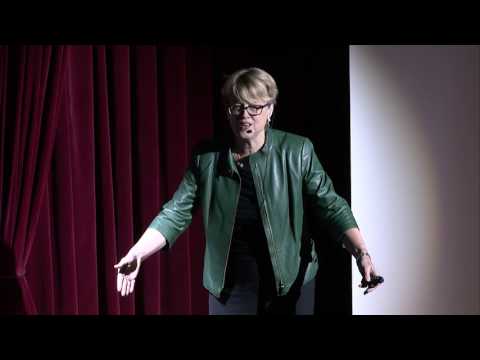
I’m Reverend Katharine Henderson.
What first comes to your mind
when I tell you I’m a minister?
Hands up, positive?
Hands up, negative?
I’m actually having trouble seeing hands,
but I imagine you’re just being a little polite.
You see, there’s always the dilemma,
when I get on an airplane and my seatmate asks me
what I do for a living.
Do I tell the truth and say that I am a minister?
Or do I go to the safer, “I’m in education?”
Because if you tell somebody that you’re in the God business,
you can immediately see their minds racing,
“Did I say any curse words as I was sitting down in my seat?
Or, “Is she going to try to convert me?”
Or they go to the place
where a religious leader hurt them or bored them,
or to the moment when the religious right took God captive;
or they go to extremism,
the bloodletting of those things in the name of God?
I can understand exactly why religion might give you pause,
because it did for me some time ago,
and sometimes it still does despite my profession.
You see, I grew up in the church;
my father was a seminary professor and a minister,
and although we weren’t conservative Christians,
we were serious, earnest, church-going folk.
So serious, that by the time I got to 16,
I was really ready to leave it all behind:
God, the church, Jesus,
the Bible, the hymns, the prayers.
I confess to you that I did keep Christmas.
(Laughter)
But I became sort of an nihilist,
and what comforted me most in those days
was that at bottom, nothing really mattered;
it was sort of a pared-down world view.
And that’s the world view that I took with me
during my sophomore year of college to Germany,
when I found myself standing outside of a Benedictine monastery,
talking to the priest at the door in a sort of in-your-face voice,
asking him if I could take communion,
since I wasn’t Catholic.
I expected him to say no, which would have been his right,
by church law and common practice then and even today,
but instead he said,
“Yes, you can if you want to. You won’t be turned aside.”
So without knowing it,
that priest whose name I never knew,
and who never knew my name,
chose my humanity over his rules of exclusion,
he welcomed me in when he could’ve set up barriers.
He let me know and led me on the way to being the minister I am today,
and I have never looked back.
And he also reminded me of what my parents were doing at the time,
marching with people of other religious traditions and races,
for civil rights, working on behalf of others.
That priest and my parents let me know
what good religion looks and feels like.
And so, today,
I find myself working with leaders of faith and moral courage
who represent that kind of big-hearted, warm-hearted,
embracing religions that that priest embodied for me so long ago,
and that really transformed me.
You see, I run a school some have called, “A school for prophets.”
We equipped leaders of faith and moral courage
to do the work of justice,
but they are not just the Christians of my childhood,
they are Jews, Muslims, and Sikhs,
humanists, and pagans.
And although we come from different traditions and perspectives,
we know that we are working together
to build multi-faith movements for justice,
based on the belief and the knowledge that we are all interdependent,
that we are connected to each other, and that we have to work
on behalf of each other, on behalf of all humanity,
and we have to work together fiercely.
One of our leaders has decided
we’re sort of like the X-Men,
the superheroes of comic book fame,
here to take on good and evil,
and to set things right in the world.
And so, he has given all of us a name,
superpower names, superhero names,
fit for our personalities.
There is “Professor Xavier,” and there is “Jubilee,”
and there is “Storm,” and there is “Banshee.”
Do you all know these names?
Great!
I have a name too, I have a superpower name,
I am Queen Lilandra,
I come from another planet, I’m telepathic,
and I can drive a mean starship.
(Laughter)
Now what our leaders have learned
is that none of them can change the world alone.
They have learned that although they have superpowers, individual superpowers
that together, they are unstoppable,
that those strengths that they have are more potent
when they work together for good.
They have learned that the priest needs the rabbi,
and the imam needs the minister,
and the Conservative needs the Progressive,
and the contemplative who knows so much about meditation and prayer
actually needs the activists on the front lines
to do the work of justice.
They have learned, and they know what all of us know here:
that it takes all of us to change the world.
So here’s what it can look like up close.
Do you all remember that climate change march
in New York City about two years ago
when 500,000 people gathered here,
on the streets of New York City
to fight climate change together?
We decided we needed to build an ark,
a wooden ark, a 28-foot ark,
on a flatbed truck.
And the ark looked great.
And…
Here it is!
That’s the ark.
Doesn’t it look great?
On the ark, there was a rabbi blowing a shofar,
and there were ministers and imams,
there were women wearing hijab.
The indigenous grandmothers came onboard.
Children especially loved
to climb on and off that ark.
When it came time for Muslims to pray,
the Muslim group next to us put their prayer rugs right down there
on the pavement, on 57th Street.
And those of us of other traditions encircled them
so that they could pray
in safety and peace.
But you know, this action of protection is not a one-way street,
because you’ve probably seen
the viral videos of Muslims in Pakistan and Egypt
who have done that for Christians praying in churches.
They have come around those churches to protect the Christians inside.
You see, we encircle each other.
But back to the ark:
so when we got moving, we played the playlist
that we had put together of songs from the movement,
“This little light of mine, I’m going to let it shine,”
and “I woke up this morning with freedom on my mind.”
We played all those songs from our playlist
from the loudspeakers on the ark.
We gave people packages of animal crackers as we went by.
You remember the two-by-two, the animal crackers?
And our humanist friend, who’s a chaplain,
decided that he’d rather ride on the ark with those religious folks.
And so, he climbed on the ark, and he made a sign,
an atheist on the ark.
And he draped it over the side of the ark as we were riding by,
and people on the sides loved it.
You see, what people saw
was that we sparked their moral imagination.
They knew that we were supposed to be there, on one little ark
representing one little planet called Earth
that we all have to share together.
It felt right to them and to us that we were there.
We were out of our usual boxes,
and God was out of God’s box, too.
In the religious lingo, you would probably call this,
“The Beloved Community.”
This is what it’s supposed to look like,
or as Dr. Martin Luther King Jr. would put it
that inescapable network of mutuality tied together
in a single garment of destiny.
But you know, it’s not always fun in games like this
because the stakes are so high,
and the stakes are getting higher all the time.
When anti-Muslim rhetoric became so virulent;
and evermore so,
when Muslims daily have to fight discrimination and harassment,
when children are bullied in school,
and sometimes, people even die,
our faith leaders knew that they had to act.
They had to take a stand to stand in solidarity
with our Muslim brothers and sisters.
They knew that our traditions teach us
that we’re not supposed to just love the neighbor that we know,
but the stranger, too;
that when one suffers, all suffer together;
that if you can’t breathe, I can’t breathe.
And so, our faith leaders put together a campaign,
it was a digital campaign,
“A love letter to Muslims.”
Over 30,000 people signed on almost immediately;
not just Muslims and Christians
but Jews, and Sikhs,
and Buddhists, and humanists,
all signed on to that love letter.
But that’s not all because hundreds of people across the country decided
that they wanted to deliver those love letters personally
to Muslims in their communities;
people often that they had never even met or talked to.
I can tell you that there was the love of a very big God,
and tears, and laughter,
and deep conversation
when those letters were delivered.
So what I’ve learned, and what our leaders have learned
is what we know: that we all need each other to change the world,
that we have to keep drawing that circle of compassion ever larger
to let more and different people in, just as that priest did for me;
he let me in so long ago
when he could have closed me out.
But you know the thing is
change doesn’t just happen between and among us,
but our understanding of who and what God is
is changed, too.
God shows up in those spaces between us.
God, by whatever name,
breath, spirit, divine, air
does not stay small, and contorted, and confined
to any of the boxes of our human making.
The test of our transformation is going to be
when I introduce myself on a platform like this,
or talk to you when you’re seated next to me in an airplane.
I can tell you who I am without any hesitation,
and you can tell me who you are.
My presence is not going to shut us down in awe from each other,
but open us up to the possibilities
of what we can do together.
And let’s just say that I have faith
that we and God together can do this miraculous thing.
It’s time to let God and us out of the box.
Thank you.
(Applause)
”
Be First to Comment