
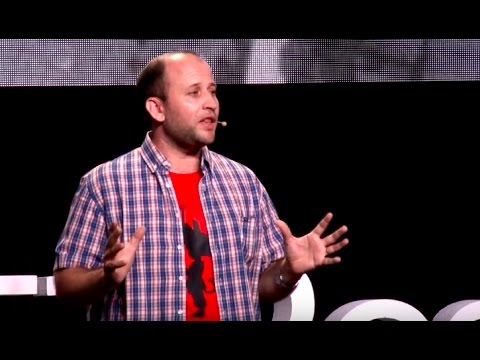
Goodnight. I’m going to start telling you something weird:
the title of my talk.
I warn you that you have an almost unpronounceable word:
“The invisibilization of science”.
The idea has been going around in my head for a long time.
If I wanted to be like someone cultured and elegant,
I could probably say that it has its genesis in some cute book.
I do not know, to quote an Argentine author, “El Aleph” by Borges.
But, being honest with me,
and with the way I’m dressed,
they will realize that the origin is, in fact,
in an inexhaustible source of popular knowledge,
much more banal may some think,
They are The Simpsons.
Actually, I’m still a child.
“Children, come down for your graduation photo.
Smile
Cute!
Now that scientists invented magic
We can do anything.
I feel proud”.
As you can understand,
The questions that arose were:
How quickly do we appropriate scientific advances?
And how much do we know about how much work is behind each one?
To tell you an anecdote, and start more relaxed,
I’m going to introduce you some friends.
The Nobel Prize for Physics of 2014
It was given to three people:
Akasaki, Amano and Nakamura.
Two are Japanese and one is American.
And the Nobel was given by the creation of the LEDs,
of the efficient blue light-emitting diodes
that have allowed more efficient sources of white light.
Translated into Spanish,
It is something that almost everyone knows.
These guys invented the LED of the color that was missing
to get all the colors of the rainbow.
For those who do not know,
All colors can be assembled simply
with a combination of red, green and blue.
The red LED and the green LED existed a long time ago
and the blue LED we owe to these guys.
How does this influence our daily life?
Do you remember big televisions, of these dimensions,
heavy, of cathode ray tubes?
They do not exist anymore. The LEDs ate them.
Do you remember high definition?
Many times they are LED.
To put it in perspective,
LED technology
he ate that of the cathode ray tubes
in a very short time
Since the mid 90’s, to the present.
And the history of the cathode rays had been functioning for more than 60 years.
However, a question arises.
Imagine that I’m going to take 115 in the morning,
the collective that brings me to work every day.
And as soon as the bondi starts, Nakamura goes up.
Nakamura is this American boy on the left.
I greet him, I look at him, and I’ll be left thinking:
“Is not that the Chinese who turns off the milk cooler?
every night?”
It’s possible.
However, imagine the same situation,
They take the 115 and Lionel Messi goes up.
What do we do? The bondi explodes.
Go crazy, people would ask for twine, photos, autographs.
Anything. And yet,
Lionel Messi comes out in HD,
thanks to these guys.
Then, as you will see, we appropriate the scientific contents
very quickly and sometimes we do not ask ourselves too much.
Then, the next two questions arise
that guide the rest of the talk.
They are partially oriented to scientists.
And then, to the rest of the community.
The question is do we want scientists
really be exposed in front of society?
And the second one is how do we do
so that the work we do in the laboratories
be more visible?
When I talk about being exposed,
does not mean, that to me
Mirta Legrand takes me to lunch instead of Pampita.
My old lady is watching me online and I would go crazy.
And I have already thought about the entry:
“Lunch today, with Mrs. Mirta Legrand
Dr. César Sobrero,
that managed to maximize the pseudo-elastic deformation
in copper beryllium aluminum “.
The program would explode.
The rating would sink.
And probably the producer of the program
It would hit me with all the reason in the world.
When I talk about being exposed,
It is that you question us.
That society looks at us
and ask us what we are doing.
And how can we, with our work,
influence the future of people.
I think it’s one of the most important points
And it is something that we have to do.
It has to be in day to day.
And they are part, those of us
in the scientific community and those that do not.
Because, if we must solve people’s problems,
but they are not raised by the community,
we run the risk of not knowing what is to be done.
The second question, how do we do
so that our work is a little more visible?
is, perhaps, the most important to analyze.
What we can do
so that this really looks?
I believe that scientific dissemination should be standardized.
It must be part of the day to day.
As a personal experience,
having gone to primary and secondary schools,
Having gone to places open to the general public
It has always enriched me and it has been very useful for me.
Tell children, students
– which are really future scientists –
that we need them,
we are waiting for you,
and that there are a lot of things to do,
it enriches us
And the round trip will improve
our vision of reality.
And it will allow us to expose ourselves
but that we always improve.
If we do not do this,
we run great risks.
I’m going to homework more by turning around.
Sometimes, only sometimes,
the media behave
as the uncontrolled WhatsApp group
from the parents of the garden
or those of the asado: “And you bought the barbecue?”
“Not yet not.” And we ran.
And they say almost incredible news.
As for example, “scientists find a cure for baldness.”
I read this, and I took out the comb again
I had saved, with all the excitement of the world.
As you will see, it is still not true.
And I’m still combing very little.
Or sometimes, data like
“A glass of red wine helps improve the heart.”
After two days, it is not convenient to take anything.
And after a year, it turns out that it was good to have a liter of white wine per day.
So, it’s everyone’s job
also analyze what the media say
and separate what information is true
and what information do we really want to sell?
a little bit of cheap wine
It is important.
It’s a lot of homework, but you have to do it.
Because if we do not succeed,
we run the risk of repeating a story,
or parts of a story,
that I will tell you next.
The story because it is important.
And because it was almost foundational
in Argentine science.
In the late ’40s,
more or less in 48,
an almost unknown Austrian physicist,
called Ronald Richter, proposes the then president, Juan Domingo Perón,
the possibility of performing controlled thermonuclear reactions.
It was incredible. The bomb had exploded recently,
and very few countries were in a position to do so.
USA UU I was starting.
And some countries in Europe.
Perón, without knowing too much,
decides to finance the project.
Richter, a little bit persecuted by ideas of espionage,
makes everything invisible, and hides it.
In fact, there were two possible locations for the project.
One was a desert and depopulated area
in the north of Argentina;
and the other was a beautiful island in one of the lakes
of the south of the country.
Thank God, and for the physicists of the future,
they choose the island Huemul, which is in the Nahuel Huapi lake
in front of San Carlos de Bariloche.
Richter begins with the project.
Immediately puts everything under a halo of protection.
It does not show what it is doing and shows very little of the results.
As time progresses,
the results become increasingly necessary.
And, like a Hollywood diva,
Richter decides, at a certain moment,
communicate your success to the government
and the government makes it public.
“On February 16, 1951 at the Pilot Plant
of Atomic Energy on Huemul Island, San Carlos de Bariloche,
thermonuclear reactions were carried out under conditions
of control in technical scale “.
This was the announcement.
And for the Argentine media of the year 50,
it was almost equivalent to the separation
between Angelina Jolie and Brad Pitt.
They exploded.
But in reality, referring to, for The Simpsons fans,
It was a fight between Krabappel and Professor Skinner.
What has happened?
Richter, from the night the morning,
He made his work visible.
He put himself in the center of the storm
without wanting to be too there.
At that time, with everything visible,
it is decided to form a supervisory commission
I had five people.
Among which, were the heroes of history.
In the middle, having a bottle of champagne,
There is the engineer Mario Báncora.
For those who do not know, or who do not know,
in Rosario, on the Siberian campus,
There is a nuclear reactor that bears his name.
The most peticito, perhaps the best known, is Dr. José Balseiro.
They began to analyze the results and promptly
they proved that Richter,
the disheveled and smiling on the left of the screen,
I was wrong.
With these data, the Huemul project was canceled.
The story for Argentina was not so sad.
The Huemul project was the genesis
of the National Atomic Energy Commission.
And Dr. Balseiro was the director
of the Institute of Physics that a posteriori would take his name.
What is the important fact to emphasize?
The scientists are wrong.
All the time.
But if we do not expose our results,
and we do not show them to society,
we run the risk of thinking
that we are infallible and untouchable within our laboratories,
as it once happened to Ronald Richter.
What do we have to look at?
We have to look forward
and think that going back and forth with people,
that communicating our results, allows us to improve.
It allows society to influence us
and that we generate something in it.
It’s important for everyone, that at the end of the day,
do not pass what Marge Simpson had said at the beginning of the story,
that we do not end up thinking
that all the things that happen are magic.
We need to be a well-informed society.
A well connected society.
In such a way that between all,
This is a task for the entire community,
We can choose and take the future we want and deserve.
Thank you very much.
(Applause)
”
Be First to Comment