
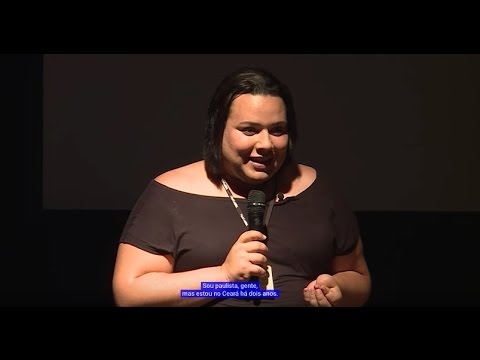
Good afternoon guys. My name is Helena, as he introduced.
I’m transvestite, I’m transfeminist.
and when they invited me to speak in [TEDx],
I was asked to speak of protagonism,
protagonism as the concept
which has been widely discussed in social movements,
especially in the identity minority movement:
the feminist movement, the LGBT movement.
Good,
when I began to think of this notion of protagonism as an activist,
was from the moment that I occupied some spaces
in which I had some visibility,
and I realized that the relationship of people with the struggles that I represented,
while a transvestite, while a militant LGBT,
while a transfeminist, had changed,
and they had not changed to a relationship of equity,
because I believe that the relationships that we should build
through social struggles are relations of equity.
No type of movement that is incapable of mobilizing,
to build horizontality
and to build relationships that allow subjects to grow collectively
is positive.
Then, in November of last year,
I wrote the cover story of Galileo magazine,
which was: “Everything you know about gender is wrong.”
That was not the title I gave. That’s what they got to stay media.
(Laughs)
Horrible inclusive, see, people? But it was not my title!
(Laughs)
But the text was mine.
And it was widely publicized,
came to the schools …
At some point,
I had received a message from a young man telling me thus:
“Helena, there’s a trans woman in my job.
She suffered transphobia and I did nothing. “
I said, “Wow, why?”
And he said: “Because I was afraid to steal the protagonism of the trans struggle.
I thought it was her responsibility. I was afraid to steal this place. “
I said, “Devil, is this what’s being produced in activism?”
I’m from São Paulo, people, but I’ve been in Ceará for two years.
So, “devil is it” is an expression that I loved
because it fits in many places.
(Laughs)
You know?
I also think that it should spread throughout Brazil.
(Laughs)
Huh? Because we get to the place: “Devil is that?”
So, it is an excellent thing.
So I started to realize
that when people interacted with activists
who had had great visibility,
this relationship started from fear:
the fear of making mistakes, the fear of acting, the fear of speaking,
the fear of putting a word in the wrong place
and be accused of being transphobic, etc.
I said, “There’s a problem there.
It’s not the kind of fight I’m trying to build. “
So, I started to think, “What does stealing play mean?
What is protagonism?
On the face, the concept bothered me; not the concept, the word.
The word bothered me because I remembered, I do not know, the course of the Sebrae,
of “entrepreneurial protagonism,” these things, you know?
I said, “This business vocabulary does not serve social struggles.”
For me, it’s a catching process.
When a social struggle begins to represent itself, to narrate itself,
from terms derived, for example, from the business world,
is a type of capture.
I said, “That was my first problem.”
Guys, I’m out of breath, right?
It’s because I smoke.
(Laughs)
It’s because I smoke.
I smoke a lot!
(Laughs)
So I’m breathless.
But although the word “protagonism” refers to the business world,
I still could not see a problem necessarily,
because they said: “But if you criticize the protagonism,
You’re saying that you want other guys
speak for historically marginalized subjects.
You’re wanting a man to go talk about trans women,
you are nullifying the idea of representativeness. “
And I said, “No, protagonism is not representativeness.
Protagonism is a painful process of building a new dichotomy,
a potentially dangerous dichotomy. “
What dichotomy is this?
When I think of protagonism, I think protagonist,
and then, I transform that which is not me into an antagonist.
The concept of protagonism
within a violent dichotomous structure, is not it?
And he is radically opposed
what we can think of as deconstruction,
like the concept of the philosophy of Jacques Derrida.
The Jacques Derrida …
Oh my God, I’m so breathless!
(Laughs)
Jacques Derrida, when he proposes the idea of deconstruction,
he does this in a book called “Scripture and Difference,”
or in “Gramatology”, I’m not sure.
But deconstructing is not necessarily destroying.
I do not need to transform the other who does not recognize me,
or the other who is different from me, into an enemy.
I do not need to destroy it.
I need to work on the prism of deconstruction,
which is necessarily a displacement.
To deconstruct oneself is to move
of what Derrida will call “violent truths”
to open up to other possibilities of truth.
So if I think of social struggles from an idea of protagonism,
taken as it has been used,
I am bringing to these struggles a dangerous dichotomy.
Then I can be questioned, as I am often:
“So you think guys should not be central to their fights?”
It is obvious that they should.
To be central in the struggle is to be the subject of struggle,
is the ability to become aware of your struggle
and to become aware of the construction of networks from the struggle itself.
“Being a protagonist” should be replaced by “being subject”:
“Who’s the guy in that fight?”
First, because “subject” refers to authenticity.
In what sense?
“Subject” refers to authenticity when one thinks
which subject is perhaps the one who performs the action.
Subject is one who acts upon the world, [from] a point of view.
Protagonist is one who plays a role in this world,
builds metanarratives of self
as a political strategy that is flawed.
It is failure because it is not true,
is flawed because it is sectarian, it is flawed because it is excluding.
Concepts that I have criticized,
as protagonism,
as even the concept of “place of speech” …
Have you heard of this?
It’s the idea that I can only talk about the situation of trans women
as long as I’m trans,
that is, all the knowledge to speak of something
would necessarily emerge from an experience, which is not a lie.
The experience can be a criterion of knowledge of the real.
However, it is not an absolute criterion, is it?
I can not reject, in building knowledge about a reality,
no kind of mechanism of knowledge.
I can not reject, for example, academic knowledge in my activist doing.
Because?
“Ah, but academic knowledge is exclusionary, it is white, it is cultural.”
He is, but with academic knowledge,
we have to conduct a process of anthropophagy.
We need to take this knowledge that excludes us
and, instead of denying it, take it upon itself, chew and build it again.
We can not deny it.
It is not possible to build any kind of struggle by denying the other,
turning the other into an enemy.
Much has been said about fascism recently, has not it?
It’s a term that we hear all the time. I do not know what “fascist”, “fascist” …
I was thinking those times about what that meant.
There, last week or late,
I made the opening of a national pre-meeting of philosophy students,
speaking precisely about fascism.
The point is, being fascist is easy, is not it?
Why is being fascist easy?
Because I can…
For example,
when I think there is, I do not know, a social chaos in the country,
instead of thinking this from the point of view of structures,
the relations between the subjects, the macro-politics,
I materialize an enemy,
I materialize someone who will receive guilt.
So I say, “It’s the gays’ fault!”
Then I materialize that other into an enemy and I can kill him.
And fascism is not exclusive to the right.
Fascism is a collective method that “facilitates” life,
perversely worsens life.
So when, for example, I,
in my struggle as a transsexual woman, as a transvestite,
I say that the other, who is man, who is a genus,
is the problem,
I’m materializing this problem, I’m forgetting that it’s product
of gender relations and of a gendered idea that captures all,
men, women, and any subject that is going to be marked by gender.
So when I materialize an enemy
instead of thinking about the relations that produce this enemy, I am fascist.
Fascist is anyone who acts by the annihilation of the other
and when I transform that other into an antagonist to me, I want to annihilate,
because the result of every scenic product that has a protagonist
is the annihilation of the antagonist.
Who watches a soap opera, a play or a movie
and does not expect the “villain” to die, who is the antagonist?
It is not?
Then you can say, “Oh, Helena, you’re freaking out.”
You can. People say. Sometimes I really am.
(Laughs)
It’s part.
I can not propose that that violent truth should be criticized
from a violent truth, is not it?
I have to be aware that maybe what I’m criticizing
and the criticisms I make come from an erratic point.
I can assume that.
Then, when one thinks of protagonist and antagonist, he says: “And the coadjuvantes?”
Because it has a third element in this relationship that is not so dichotomous.
However, who is the supporting actor in the play
but that which is always subject to the action of the protagonist and the antagonist?
The supporting actor is one who does not change the plot.
So this means I’m building a fight
in which only one person, in which only one subject is capable of bringing about change.
This is desperate, even for me!
When someone says to me, “Look, you’re a transvestite.
It is her responsibility as the protagonist of the struggle of the transvestites to fight. “
I do not want this whole weight for my fight.
I do not want to turn any fight into a property of any guy
because the emancipation or the acts of freedom are collective
and are built collectively.
I can not deny that other guys who do not share the same pains that I
can practice empathy and can fight.
So, when you call me to talk about protagonism,
I just come to say that I think protagonism is a horrible idea,
what a protagonist is a horrible idea
and that we do not have to play a leading role
as a fight marker, for no fight.
“Ah, but let’s talk about youthful protagonism.”
No! Do not.
Let’s talk about how these young people can build,
can be subjects of their struggles,
and how we can give support.
One should not speak of protagonism, I believe.
This creates a very dangerous kind of immobilism.
When we think about recent setbacks
that the struggles of women, that the feminist struggles,
that LGBT identity movements have had,
we think, “How did we allow it?
When did we lose the ability to mobilize? “
Sometimes they say, “Oh, the revolution is going to be a transvestite.”
I say, “Yes, I would love the revolution to be a transvestite.
I was super into jumping, fighting and such … “
(Laughs)
However, the revolution, as it walks, will not be transvestite,
it’s not going to be gay, it’s not going to be any of that, why?
Because revolution is the one who mobilizes.
You know, any sectarian speech can not mobilize.
The fight does not have to be to deal only with my pains.
I can not turn a political struggle with an excess of subjectivity
to ease my pain.
It has to be strategic, you have to think about results
and mobilization.
So when they ask me, for example:
“What UFRJ do we want for our children?” …
I thought about it.
Of course the first thing I thought about is that I probably will not have a child.
It is not?
So, I think about what university we want for the future,
to the people who will come:
a university that allows,
first, that knowledge embraces reality,
that is, that knowledge responds to the demand of the real,
as the actions of the subjects respond to the demand of the real
and not to the demand of excessively abstract models,
which are disconnected at all and that close at all to the access from the outside.
“Are you saying we have to give up abstract knowledge?”
No, I’m saying that we need to find strategies
so that what is conceptual in excess, abstract,
can be democratized.
That’s what I’m saying.
And more: that the political and social struggles that leave the university
dialogue as a political investment.
In opposition to extremely rigid concepts of struggle,
I believe that dialogue is the possibility of overcoming,
dialogue as a political investment, dialogue while political, is not it?
Because it is not easy to talk.
It is not easy to talk when you carry a baggage of oppression, etc.,
because people are sometimes very reactive.
We are reactive to what we suffer.
However, to dialogue is to invest politically in relation to the other
and in collective relations.
The death of dialogue is necessarily the death of politics,
as Arendt had already said.
That’s it, people.
(Applause) (Live)
”
Be First to Comment